
Is your personal data a digital legacy, or is it just industrial-grade fertilizer for the next generation of predictive algorithms? While the tech industry fixates on the processing power of the latest large language models, the real story here isn't the raw speed of the silicon—it's the commodification of the human experience that powers it.
The Rat Trap of Modern Data Harvesting
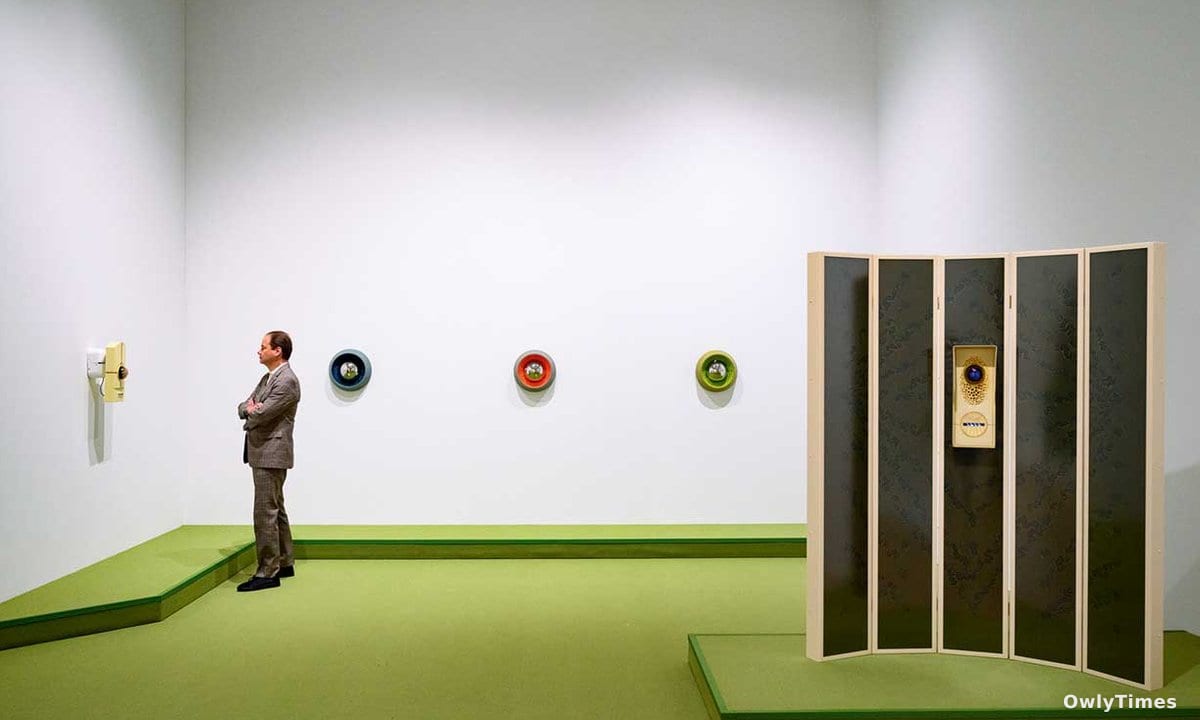
New York’s contemporary art scene has been saturated with high-profile events over the past two months, including the Greater New York quinquennial and the Whitney Biennial. Among the noise, the work of Cooper Jacoby stands out as a necessary, if unsettling, mirror to our current AI-obsessed moment. Jacoby’s installation at the Whitney is intentionally designed as a "rat trap," pulling visitors into a green-carpeted environment where the walls don’t just have ears—they have voices, cameras, and an insatiable appetite for data.
When Your Digital Ghost Becomes an Asset
The centerpiece of this installation is the 2026 work Estate (July 10, 2022). It is a folding screen outfitted with an intercom that speaks to passersby using the voice of the artist's own family members. The vocal output is derived from an AI model trained on the social media archives of an anonymous creative who passed away on that specific date.
This is more than a morbid curiosity; it is a direct critique of how corporations treat our digital footprints. Jacoby notes that he selects his subjects based solely on the volume of their data—the size of their corpus. This mimics the exact strategy used by OpenAI and its competitors, who view the sum total of human online expression as nothing more than raw material to be harvested. By turning the deceased’s digital life into a reactive, vocal machine, Jacoby makes the invisible process of data extraction painfully audible.
Quantifying the Human Condition
Jacoby’s critique extends beyond the training of AI models to the predatory nature of the insurance industry. His series Mutual Life features sculptures of massive, clock-like eyes that track time based on a subject’s "biological age." This metric, which measures cellular deterioration against demographic averages, is currently used by health insurers to estimate risk and adjust premiums.
Jacoby’s realization of this reality—prompted by an offer from his own insurer to lower his payments in exchange for taking a biological age test—highlights the encroaching surveillance of our biological selves. When algorithms can predict our lifespan as accurately as they can predict our shopping habits, the distinction between a person and a data point begins to vanish. We are all living in a laboratory where every scrap of health and social data is being refined into a financial asset for corporate balance sheets.
The Unregulated Frontier of Digital Death
The core of Jacoby’s work points to a significant societal gap: we have almost no established norms for what happens to our digital selves after we die. As he points out, the rituals and rights governing our online existence remain dangerously underdeveloped. The discomfort of hearing his own mother’s voice vocalizing the posts of a deceased stranger is a Freudian, visceral reminder of the lack of consent in our hyper-connected reality.
Whether these systems are being used to train the next generation of chatbots or to calculate the risk profile of a life, the result is the same: the privatization of human experience. The next reading of the data collection metrics from major AI developers will indicate whether this trend toward complete digital transparency continues to accelerate, or if the public pushback against "data mining" finally forces a change in how these firms handle our digital remains. The Whitney Biennial remains open at the Whitney Museum of American Art in New York until August 23.