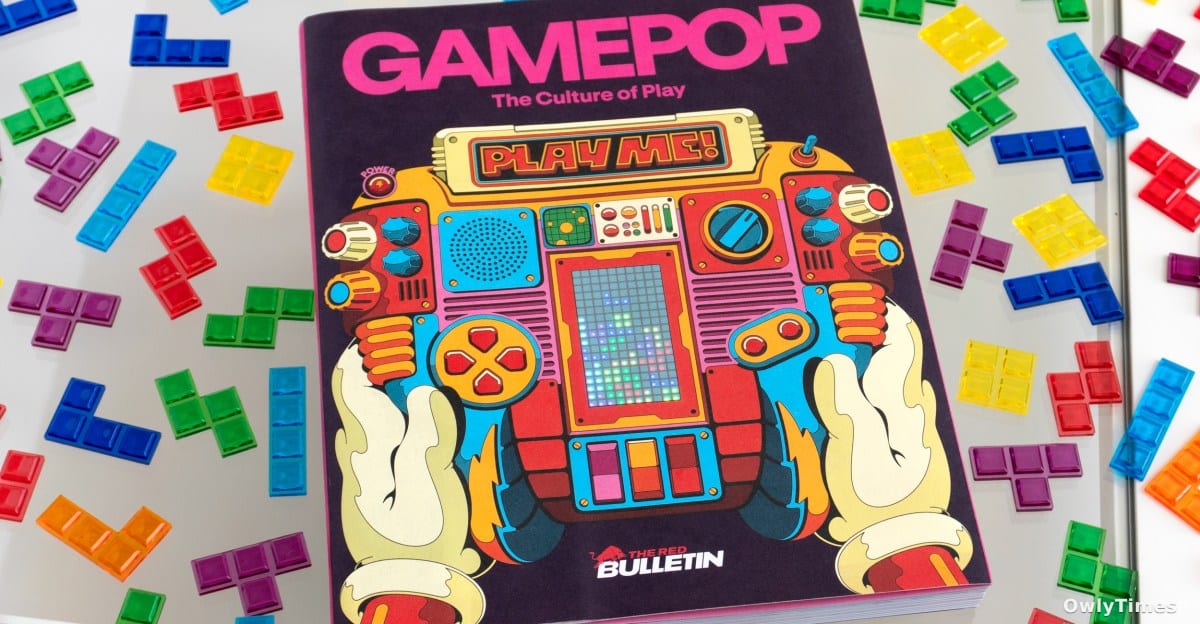

The chipped plastic of a McDonald’s Happy Meal toy, a fleeting promotional gimmick – that’s often how we remember Tetris’s forays beyond the screen. But hold that image, because Kevin Bates and Red Bull just redefined the game’s physical form, embedding a fully playable version of Alexey Pajitnov’s iconic puzzle directly into the cover of The Red Bulletin magazine. It’s not a nostalgic nod, or a tech demo; it’s a statement about where gaming, and even media itself, is heading – a place where the line between consumption and interaction is dissolving into something surprisingly tactile.
This isn’t the first time Bates has bent the rules of what a game console is. He first gained notoriety in 2014 with a Tetris-playing business card, a feat of miniaturization that hinted at a larger obsession. That obsession blossomed into the $39 Arduboy, a credit card-sized handheld that fostered a dedicated developer community, and a series of increasingly compact Tetris devices. But the Red Bull collaboration, culminating in a playable magazine cover, represents a leap beyond personal projects. It’s a deliberate flexing of accessible technology, a challenge to the assumption that compelling gaming experiences require expensive, cutting-edge hardware. Last year’s spectacle of turning the Dubai Frame into a giant playable Tetris installation using 2,000 drones – a stunt that garnered global attention – feels less like a standalone event and more like a prelude to this quieter, more intimate revolution.
Drawn from The Verge.
The technical hurdles were significant. Forget foldable OLED screens; those are still too fragile and costly for this application. Bates instead engineered a custom matrix of 180 tiny 2mm RGB LEDs, mounted on a flexible circuit board a mere 0.1mm thick. The result isn’t high-resolution, but it is remarkably durable. He reportedly “hit it with a hammer a few times” during testing, a testament to its resilience that no folding phone manufacturer would dare attempt. The game utilizes capacitive touch sensors “printed in the copper layer of the board,” eliminating the need for physical buttons and further streamlining the design. While the magazine’s cover isn’t going to rival the visual fidelity of a modern smartphone, it delivers a surprisingly satisfying and responsive gaming experience. The fact that it feels like playing a handheld made of paper is the point.
But beyond the engineering marvel, the Red Bull project speaks to a broader cultural shift. We’re saturated with screens, bombarded with digital content. The impulse to find new ways to engage, to feel the experience, is growing. The limited run of 1,000 magazines, with only 150 featuring the playable cover, underscores this exclusivity. These weren’t mass-marketed toys; they were distributed to Tetris competitors, those featured in the magazine, influencers, and select media – a carefully curated experience designed to generate buzz and demonstrate the possibilities. The fact that Red Bull paired this with a 180-page gaming edition of The Red Bulletin isn’t accidental. It’s a signal that the energy drink giant sees gaming not just as an esport, but as a lifestyle, a cultural force ripe for innovative integration.
The cost of manufacturing remains undisclosed, but Bates’s focus on accessible technology suggests a deliberate effort to keep the project grounded in reality. The game utilizes a rechargeable LIR2016 3V coin cell battery and a deconstructed USB-C charging port – a clever solution that avoids the fragility of a traditional connector. While some modern Tetris features, like piece previews and holds, were sacrificed to conserve battery life, the core gameplay remains intact. This isn’t about replicating a full-fledged gaming experience; it’s about proving that compelling interaction can be embedded into unexpected places.
The GamePop GP-1 isn’t going to revolutionize the print industry, and it won’t lead to rollable smartphones anytime soon. But it does force us to reconsider the potential of physical media in a digital age. What other experiences could be woven into the fabric of everyday objects? What happens when the packaging is the product? As Bates continues to push the boundaries of flexible electronics, the question isn’t whether we’ll see more playable magazines, but what other forms this technology will take – and how it will reshape our relationship with the objects around us. Will we soon be interacting with our environment in ways we haven’t even imagined, turning the mundane into the magical with a touch, a bend, and a flash of LEDs?