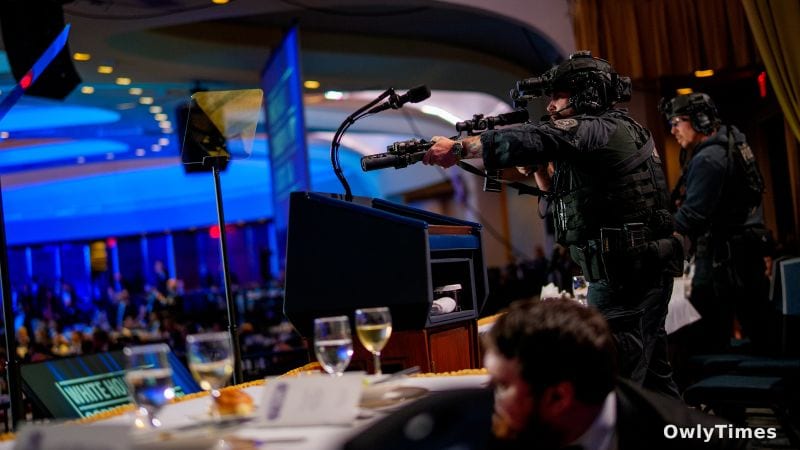

The strategic calculus behind President Donald Trump’s recent pivot is clear: by framing political violence as an exclusively Democratic ailment, he seeks to neutralize his own legacy of rhetoric while delegitimizing his political opposition. This narrative shift, deployed following the assassination of Charlie Kirk in September and reiterated after the arrest of a gunman outside the White House Correspondents’ Dinner, is an attempt to rewrite the historical record of his first term. Five years ago, Trump directed supporters to march to the Capitol and his lawyer, Rudy Giuliani, urged a “trial by combat,” leading to a violent storming of the US Capitol. Upon returning to office, Trump pardoned virtually all participants, including more than 200 individuals who assaulted police. By pointing the finger at the left today, he aims to insulate himself from the political fallout of that history.
Who benefits and who loses in this rhetorical tug-of-war? Trump benefits if he can successfully rebrand the climate of instability as a partisan failure of his opponents, distracting from his own record of normalizing inflammatory language. The public, however, appears caught in a cycle of diminishing returns. According to the Pew Research Center, fully 85% of Americans stated after the Kirk assassination that politically motivated violence was on the rise. While Trump attempts to cast this as a one-sided issue, the broader electorate views it through a more cynical, symmetrical lens.
The data reveals a stark historical evolution in how the public perceives the drivers of violence. Since 2011, NBC News polling has tracked whether major acts of violence are viewed as the work of a “disturbed person” or the result of “extreme political rhetoric.” The percentage blaming rhetoric has climbed from 24% following the 2011 shooting of then-Rep. Gabrielle Giffords to 61% last year following the Kirk assassination. This shift marks a significant milestone: for the first time, majorities in both parties agree that rhetoric, not just individual mental health, is the primary accelerant.
Despite this consensus, contradictions remain in how different demographics assign blame. An October Gallup poll found 69% of Americans believe Republicans have “gone too far” in their inflammatory criticism of opponents, compared to 60% who feel the same about Democrats. This aligns with earlier trends, such as a 2019 Quinnipiac University poll where 45% of voters blamed Trump personally for the decline in political civility, far outpacing the 34% who blamed Democrats. Even in a polarized environment, the public has not fully embraced the idea that violence is solely a Democratic creation, even as the political center of gravity regarding “justified violence” begins to drift.
The most profound shift is the erosion of the partisan gap regarding the legitimacy of political force. Historically, polling showed Republicans were significantly more likely to entertain the concept of justified violence. However, recent data from PRRI and Marquette Law School suggests a convergence. Only 17% of Democrats and 19% of Republicans now agree that “true American patriots may have to resort to violence in order to save our country.” This represents a dramatic decline for the Republican side, where such sentiments were previously three times higher during the Biden administration.
This narrowing of partisan attitudes suggests that while the intensity of the rhetoric has not subsided, its distribution has become more balanced across the aisle. As the political landscape absorbs the fallout from the Kirk assassination and subsequent security threats, the next reading of the Reuters-Ipsos poll on political approaches to extremism will show whether this “both sides” perception holds or if one party manages to successfully pin the narrative of instability on the other.





