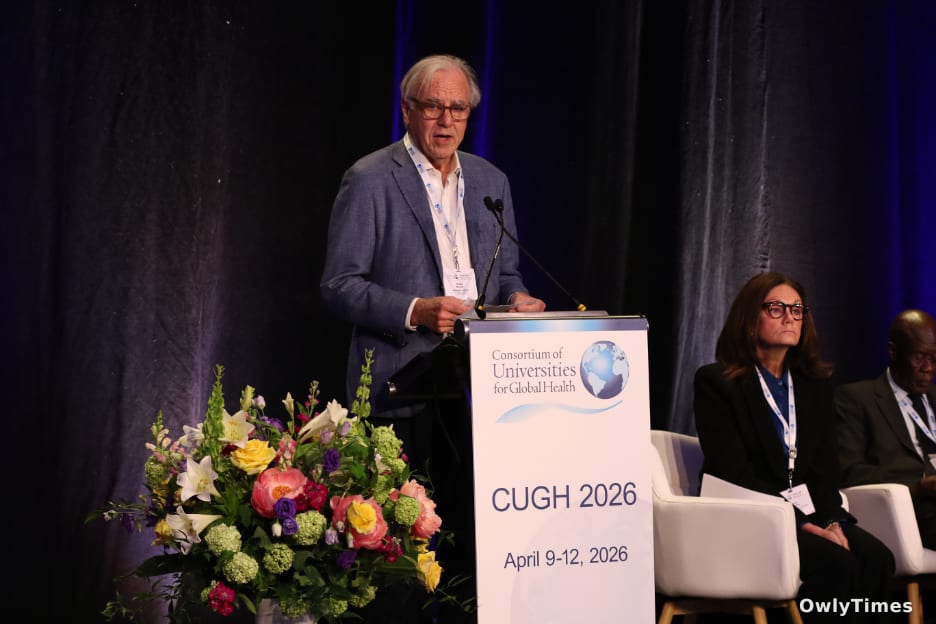

What does it take to move the needle in global health from a mere academic pursuit to a tangible, life-saving infrastructure? For Robert Murphy, MD, executive director of the Robert J. Havey, MD Institute for Global Health, the answer lies in the intersection of rigorous clinical research and the relentless scale-up of accessible diagnostics. On April 11 in Washington, D.C., the Consortium of Universities for Global Health (CUGH) honored this philosophy by presenting Murphy with the 2026 CUGH Distinguished Leadership in Global Health Award.
While headlines often frame such honors as a celebration of an individual’s career, the reality of this award reflects a specific shift in how we approach infectious disease: the move from lab-based discovery to point-of-care implementation. Murphy’s career, which began in 1993 with the U.S. Peace Corps researching HIV among returning volunteers, highlights a transition from observational study to active systemic intervention. His work, particularly in sub-Saharan Africa, demonstrates that the true measure of a research program is not just the drugs developed, but the reach of the clinics that deliver them.
Scaling Infrastructure Beyond the Lab
The metrics of Murphy’s impact are grounded in his time as the Nigeria country director for the President’s Emergency Plan for AIDS Relief (PEPFAR). During that tenure, he was instrumental in establishing 55 clinical sites, a network that now provides care for more than 150,000 people living with HIV. This is not merely a logistical achievement; it serves as a blueprint for how medical research institutions, such as the Feinberg School of Medicine where Murphy serves as a professor, can transition from theoretical research to the front lines of global infectious disease response.
Under his leadership, the Havey Institute has evolved from a singular research program into an organization housing 10 specialized centers. This growth emphasizes a shift in the field: researchers are increasingly expected to act as architects of health systems rather than isolated scientists. By partnering with the Point-of-Care Technology Research Network (POCTRN), Murphy has focused on the practical necessity of diagnostics, a critical bottleneck in treating HIV, tuberculosis, and emerging threats like COVID-19.
Limitations to Consider in Global Health Strategy
Despite the successes highlighted during the CUGH annual conference, held April 9-12, the field faces significant hurdles that no single award or career can resolve. The tension between rapid diagnostic development and the uneven distribution of these technologies remains a persistent friction point in global health. While the work presented by Murphy’s team—including oral presentations on cervical cancer triage interventions in Mali and Nigeria—shows progress, the scalability of these models depends heavily on local workforce development.
The panel discussion featuring Ashti Doobay-Persaud, MD, on building Africa’s health workforce underscores this limitation. Innovations in health professions education are essential, yet they require sustained, multi-year funding and political stability that can fluctuate. The data presented by the team, including reviews on pediatric palliative care in Africa, suggests that while the research is robust, the implementation phase is subject to the complexities of local health unit functions and international partnership sustainability.
The Future of Collaborative Research
The next steps for this research trajectory will be found in the ongoing integration of technology and community-level care. As Murphy noted during his acceptance, the ability to communicate with the communities being served is as vital as the science itself. Whether this approach can effectively bridge the gap between high-level policy—such as the work discussed with Jarbas Barbosa, MD, MPH, PhD, of the Pan American Health Organization (PAHO)—and ground-level outcomes will be the primary metric for success in the coming years.
Observers looking to track the practical efficacy of these initiatives should watch the continued output of the Havey Institute’s 10 specialized centers. Their future progress, particularly in scaling point-of-care diagnostics and palliative care partnerships, will serve as the next indicator of whether current academic collaborations are successfully translating into long-term, self-sustaining health outcomes for the populations they aim to serve.





