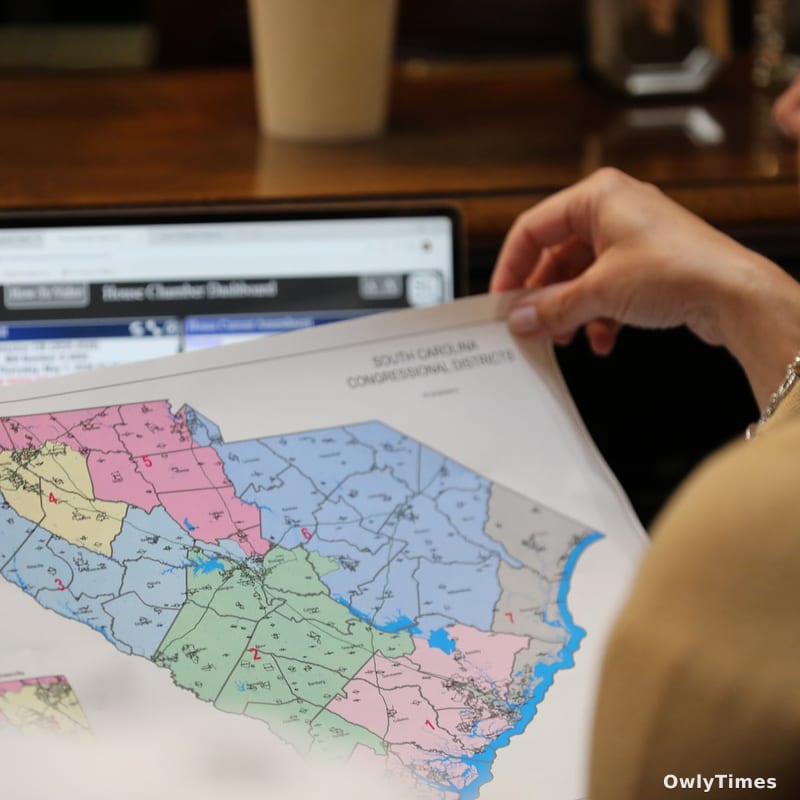

The South Carolina Senate’s recent vote to reject new congressional redistricting plans represents a calculated political maneuver, prioritizing perceived state interests and incumbent security over national party directives. While Donald Trump exerted considerable pressure for the redrawing of maps, the defiance by a bloc of Republicans, led by Majority Leader Shane Massey, reveals a strategic calculus rooted in local power dynamics and a cautious assessment of electoral risk. This decision diverges sharply from actions taken in states like Tennessee and Louisiana, where Republican-dominated legislatures have moved to eliminate Democratic-held districts or postpone primaries to facilitate redistricting following the US Supreme Court’s effective gutting of the Voting Rights Act.
Local Interests vs. National Mandate
The immediate strategic motivation behind the Senate’s rejection, which saw the proposal fail by a 29-17 vote—two votes short of the two-thirds needed—was to preserve the existing electoral advantage held by Republicans and avoid unforeseen complications. Currently, Republicans hold six of South Carolina’s seven US congressional districts. The proposed changes would have targeted the state’s sixth congressional district, held by long-serving Democratic Representative James Clyburn, moving some of its Democratic voters into adjoining districts held by Republicans Nancy Mace and Joe Wilson. Massey and other Republicans, including state senator Luke Rankin of Horry county, chair of the senate judiciary committee, argued that tinkering with an already favorable map could backfire. “The numbers are not reliable,” Massey stated, adding, “What I do know is that we are 6-1 today. If we start tinkering with this, my concern is that we could make this a whole lot worse.” This sentiment underscores a pragmatic fear that aggressive gerrymandering could inadvertently create more competitive districts or, critically, galvanize opposition turnout.
Who Benefits and Who Loses in the Status Quo
In this scenario, the immediate beneficiaries are the incumbent Republican representatives in South Carolina who avoid the uncertainty of new boundaries, and crucially, Representative Clyburn, who retains his district’s current configuration. State Senator Darrell Jackson, a Democrat from Richland county, highlighted Clyburn's unique role as a "rainmaker" for the state, directing federal funding for projects like highway construction and rural broadband, benefiting all South Carolinians. Massey himself acknowledged the importance of having a figure like Clyburn who can "make a phone call and somebody at the White House will answer." Losing such a figure, even if replaced by a Republican, could diminish South Carolina’s influence on a national stage. The losers are arguably the national Republican party and Trump himself, whose explicit call on Monday evening to “GET IT DONE!” was rebuffed. However, the move also protects state Republicans from potential "down ballot" repercussions, as Massey warned that aggressively redrawing maps could motivate Black turnout, leading to unintended consequences for local races.
Historical Echoes of Political Autonomy
The tension between national party pressure and state-level political autonomy is not new. Massey, in an extraordinary address from the well of the state’s senate chamber, evoked powerful historical parallels to underscore his point, likening redistricting to the incitements that led to the French Revolution and reminiscent of Russian premier Nikita Khrushchev slamming a boot down on a lectern. These comparisons, while dramatic, highlight the potential for heavy-handed power plays to backfire, creating unintended opposition and instability. Massey appealed to his Republican colleagues to take their cues from constituents rather than Washington leaders, arguing that South Carolina has always “punched above their weight” and that diminishing this influence would be a disservice. His defiance, even after a personal call from Trump over the weekend, suggests a belief that local political calculations, especially regarding the integrity and effectiveness of state representation, must supersede national party loyalty. The Guardian report highlighted Massey's personal risk, stating he was "comfortable" with the "likely consequences" for his position.
The Next Chess Move for South Carolina
The legislative clock is now the critical factor. South Carolina’s regular legislative term is nearing its end on May 14. Legislative rules require a two-thirds majority to add a redistricting vote to the session following adjournment sine die. The failure of Tuesday’s vote, which was two votes short of that threshold, means the window for redistricting this session is effectively closed unless extraordinary measures are taken. The immediate political chess move to watch will be how the national Republican party, and particularly Donald Trump, respond to this public defiance. While Massey claimed Trump told him he had to "do what you're comfortable with," the broader political implications of a state party bucking a clear presidential directive could set a precedent for other states grappling with similar redistricting pressures. The question now shifts from if South Carolina will redraw its maps to when and under what conditions it might revisit the issue, given the logistical hurdles and the potential for a renewed push from national figures in the next legislative cycle. Donald Trump's influence, while significant, clearly has its limits when confronted with entrenched state-level political calculations.





