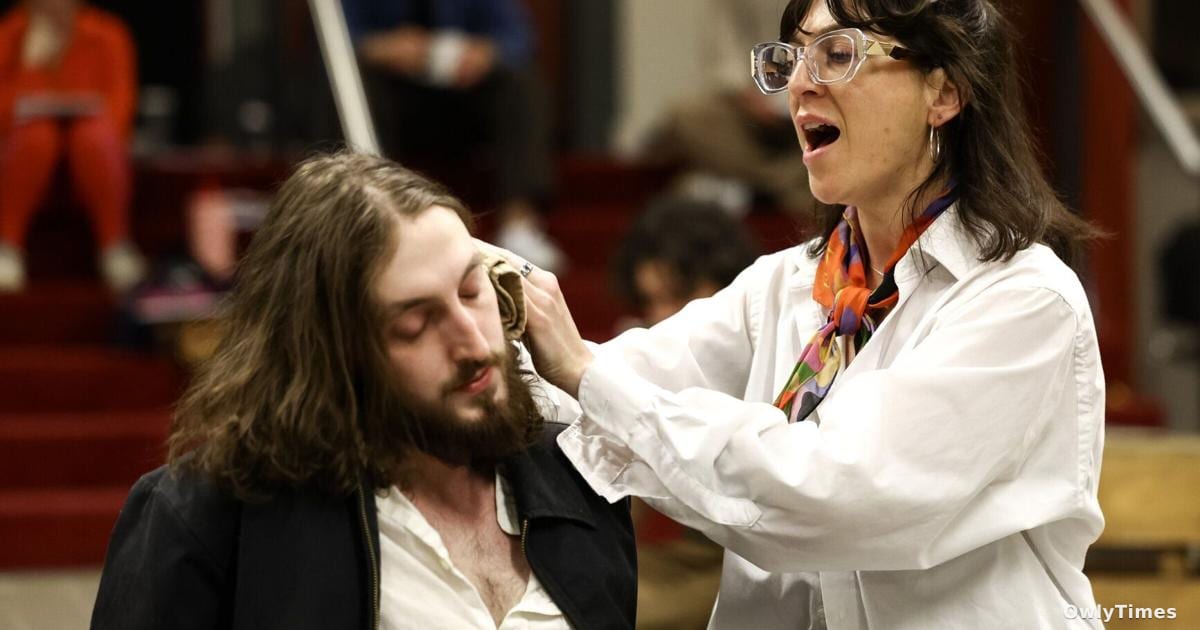

In a rehearsal room tucked beneath the stage of The 5th Avenue Theatre, the atmosphere is thick with a tension that feels more like a lived-in struggle than a theatrical exercise. Here, the fire in the eyes of Judas isn’t merely acting; it is desperation boiling toward a breaking point. Cameron Miles Lavi-Jones, a fixture of the local scene as the frontman for King Youngblood, observes his castmates with the intensity of someone navigating a genuine political fracture. Beside him, local actor Alexander Kilian—stepping into the role of Jesus of Nazareth—and Molly Sides, the powerhouse lead singer of the rock band Thunderpussy, are attempting to translate the high-stakes friction of a revolution into a language that feels urgent and unpolished.
Bridging the Seattle Divide
This collision of creative sensibilities is the centerpiece of The 5th’s upcoming production of “Jesus Christ Superstar,” running from May 2 through May 17. For Bill Berry, the theater’s Executive and Artistic Director, the casting choice was an intentional effort to pull the production out of the museum and into the present. By marrying the precision of traditional musical theater with the raw, jagged edge of Seattle’s rock-music bench, Berry is betting that the show’s inherent rock roots will resonate more deeply with a modern audience.
Beyond the choreography and the vocal coaching, there is a deliberate attempt to dismantle the silos that often separate Seattle’s independent music scene from its established theatrical institutions. For Lavi-Jones, the experience is about more than hitting notes; it is about serving as an ambassador between worlds that rarely intersect. The cast, which also features Mari Nelson, Mark Siano, and Cassi Q Kohl, is tasked with building a bridge in real-time, proving that the collaborative spirit of rock can survive the rigid structure of a Broadway-caliber stage.
The Weight of the Public Eye
The original 1970 concept album, which featured Deep Purple’s Ian Gillan as Jesus, Murray Head as Judas, and Yvonne Elliman as Mary Magdalene, was a daring departure from the musical theater norms of its time. While the record initially struggled in the U.K., it eventually surged to No. 1 on the U.S. Billboard top albums chart in 1971, cementing its status as a cultural phenomenon that would later be defined by the 1973 film directed by Norman Jewison. Yet, the performers in this current iteration argue that the story’s longevity stems from its fundamental humanity rather than its rock pedigree.
Kilian, who previously captivated local audiences as Moritz in “Spring Awakening,” notes that the challenge lies in the vulnerability of the central figures. The production strips away the mythic distance of the characters to focus on the fear, anxiety, and profound imposter syndrome that accompanies anyone forced into the public eye. When the performers lean into these relatable pressures, the sound becomes less like a curated production and more like a raw, 1970s-style rock experience.
Finding Revolution in the Mundane
For Sides, who has been commanding stages since forming her band in 2014, the transition to musical theater has been a humbling lesson in the scale of collaboration. Coming from a world of DIY production, she finds the sheer number of people working behind the curtain to be a revelation. This production aims to treat the "Superstar" narrative not as a fixed historical record, but as the chaotic, messy, and interpersonal "soap opera behind the scenes of a revolution."
The goal for this ensemble is to remind the audience that these characters, much like the people watching them, are navigating an uncertain future without a script. As the production approaches its opening date, the success of this experiment will be measured by whether the audience views these iconic figures as distant icons or as neighbors navigating the same complex, modern world. The next reading of the production’s reception—and its ability to pull in both theater loyalists and the local rock-music demographic—will indicate whether this fusion of scenes is a sustainable model for the future of the regional stage.