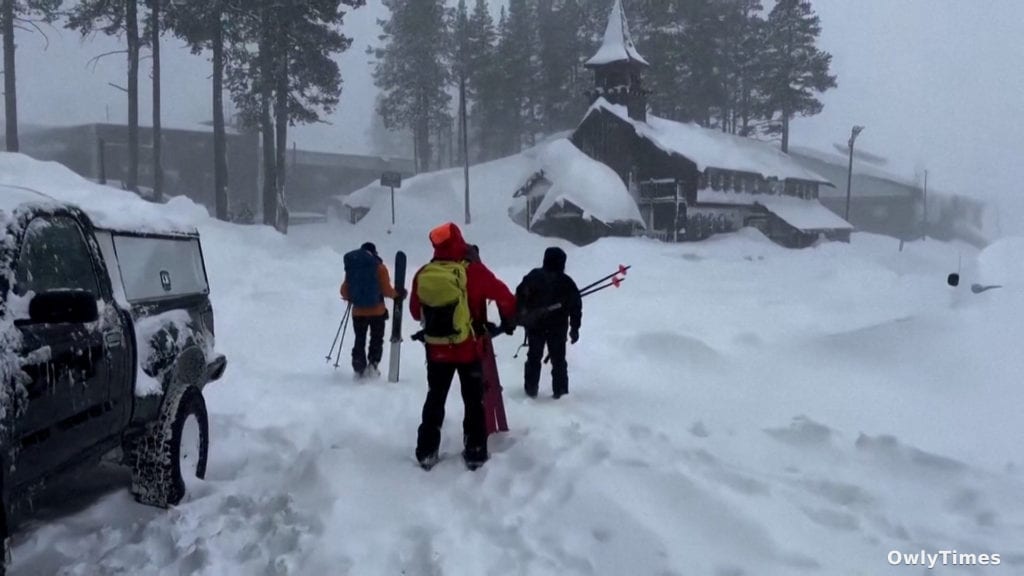

The immediate aftermath of the February 19th avalanche near Truckee, California, focused on the tragic loss of life and the heroic rescue efforts. But beneath the surface of this disaster lies a chillingly predictable confluence of climate-altered weather patterns and the complex physics of snowpack stability. It’s not simply that more snow fell, but how it fell – a sequence dictated by a “snow drought” preceding a rapid, heavy snowfall – that created the conditions for catastrophe, and this pattern demands a re-evaluation of avalanche forecasting and mitigation strategies across the Western United States. While initial reports understandably emphasized the immediate triggers, the underlying story is one of increasing risk in a warming climate, where seemingly contradictory weather events – drought followed by deluge – are becoming more common.
The Paradox of a “Snow Drought”
The term “snow drought” might seem counterintuitive in a region known for its winter snowfall, but it accurately describes the conditions that prevailed in the Sierra Nevada for several weeks leading up to the avalanche. According to avalanche specialists, this period wasn’t characterized by a complete absence of snow, but by unusually warm temperatures that led to a rain-snow cycle. This cycle resulted in the formation of a dense, icy layer at the base of the snowpack. Dr. Bethany Hayes, a snow hydrologist at the University of California, Berkeley, explained that this layer, formed by melt-freeze events, acts like a slick surface. “Imagine trying to build a stack of blankets on a glass table,” she said. “Everything above it is inherently less stable.” This base layer, hardened by the repeated freeze-thaw cycles, became the critical weakness when a significant amount of new, lighter snow accumulated on top of it.
This article draws on reporting from PBS.
How Layering Creates Instability
The subsequent storm, dropping several feet of snow in a short period, didn’t simply add weight to the existing snowpack; it created a dangerous disparity in stress. The new snow, lacking the density and cohesion of the older layer, sat precariously on top. Mark Olsen, a lead forecaster with the Sierra Avalanche Center, emphasized the physics at play. “The weight of the new snow imposed a shear stress on the weak layer below,” he stated. “Essentially, it was a breaking point. The interface between the layers couldn’t handle the load.” This isn’t a novel phenomenon – avalanche professionals have long understood the dangers of weak layers within the snowpack. However, the increasing frequency of snow droughts, driven by climate change, is amplifying the risk by creating these problematic base layers more often and over wider areas. The avalanche on February 19th wasn’t a statistical outlier; it was a demonstration of a growing trend.
Beyond Forecasting: The Limits of Current Models
The tragedy raises critical questions about the effectiveness of current avalanche forecasting methods. While the Sierra Avalanche Center had issued an avalanche warning for the area, predicting the precise location and timing of avalanches remains an immense challenge. Current models rely heavily on snowpack observations, weather data, and terrain analysis. However, these models often struggle to accurately capture the complex interactions between different snow layers, particularly those formed under the unusual conditions of a snow drought. The models are, in essence, built on historical data, and the historical baseline is rapidly shifting. Dr. Hayes noted that “we’re seeing conditions that are outside the range of what our models were designed to predict.” This isn’t a failure of the forecasters, but a signal that the tools themselves need to evolve.
Limitations to Consider
It’s crucial to avoid framing this event as simply a failure of prediction. Avalanche forecasting is inherently probabilistic, not deterministic. Even under ideal conditions, pinpointing exactly where and when an avalanche will occur is impossible. Furthermore, human factors – the decisions made by backcountry users – play a significant role in avalanche incidents. The warning issued by the Sierra Avalanche Center was a call for increased caution, not a guarantee of safety. However, the increasing frequency of these complex snowpack scenarios underscores the need for more sophisticated modeling techniques and a greater emphasis on public education regarding the evolving risks.
The Future of Avalanche Risk Assessment
The next critical research steps involve refining snowpack models to better account for the effects of snow droughts and rain-on-snow events. This will require integrating more detailed data on snow microstructure, layering, and bonding strength. Furthermore, investment in automated snow monitoring systems – sensors that can continuously measure snowpack properties in real-time – is essential. But perhaps the most important question moving forward is this: as climate change continues to disrupt traditional weather patterns, how do we adapt our infrastructure and recreational practices to coexist with a landscape that is becoming increasingly unstable? Will we see a shift towards more restricted access to backcountry areas during periods of heightened avalanche risk, or will we prioritize the development of technologies that can provide more precise and reliable warnings? The answer to that question will determine not only the safety of backcountry enthusiasts, but also the future of winter recreation in the Western United States.