
The Sun’s Subtle Push: Investigating a Potential Link Between Solar Flares and Earthquakes
For decades, the question of whether events beyond our planet can influence seismic activity on Earth has lingered at the edge of geophysics. While the idea of predicting earthquakes remains a holy grail – and a deeply complex challenge – a new study proposes a surprisingly direct mechanism: could solar flares, those dramatic bursts of energy from the sun, subtly nudge faults towards rupture? The research, published in the International Journal of Plasma Environmental Science and Technology by Atsushi Mizuno, Masaki Kao, and Kenji Umeno, doesn’t claim the sun causes earthquakes, but rather suggests a pathway through which solar activity might alter the delicate balance of stress within the Earth’s crust. This isn’t a claim of astrological influence, but a proposition rooted in the physics of electrical forces and the surprisingly conductive nature of stressed rock.
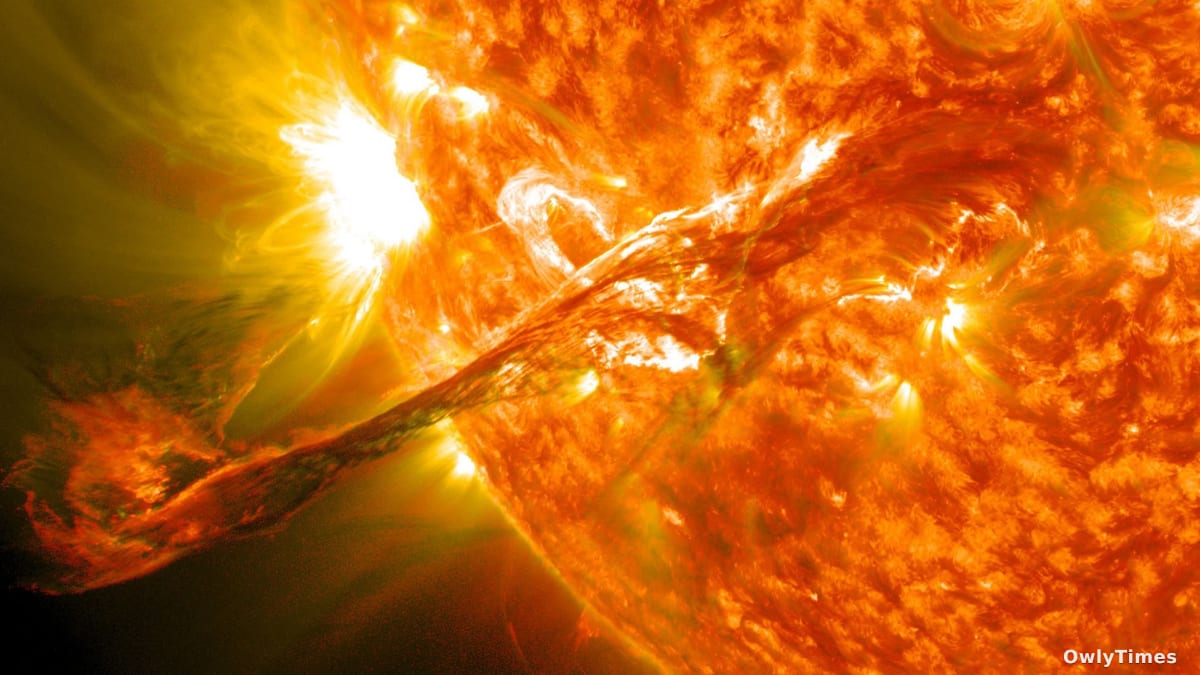
The core of the study lies in a novel modeling approach. The researchers conceptualized Earth as a vast, naturally occurring electrical circuit. The Earth’s crust, particularly areas riddled with cracks and fissures, acts as a capacitor – a device that stores electrical energy. Within these cracks exists supercritical fluid, water under immense pressure and temperature, teeming with electrically charged ions. This creates a reservoir of potential energy. Above us, the ionosphere, a layer of charged particles extending roughly 250 miles above the surface, functions as the other end of this circuit. The team’s model connected these two components with an electrical field, essentially treating the planet as a “leaky battery.” When a solar flare erupts, it doesn’t simply bathe Earth in radiation; it rearranges the charged particles in the ionosphere, shifting electrons downward and creating a concentrated layer of negative charge.
This shift, according to the model, increases the electrostatic force acting on the charges within the Earth’s crust. Imagine squeezing a stressed rock – a small additional pressure can be the tipping point. The researchers calculate that this increase in electrostatic force is comparable to other known influences on fault stability, such as gravitational forces or even tidal stresses. This isn’t about overwhelming existing forces, but about adding a subtle, potentially destabilizing influence. The model predicts that this increased pressure could nudge a fault already primed for movement into an earthquake. It’s a compelling idea, but one that immediately raises the question of how such a subtle effect could be reliably detected amidst the cacophony of geological forces at play.
This article draws on reporting from Live Science.
The researchers point to the 2024 Noto Peninsula earthquake in Japan as a potential supporting case. This significant quake occurred during a period of heightened solar flare activity, seemingly aligning with the model’s predictions. However, it’s crucial to understand that correlation does not equal causation. The U.S. Geological Survey has consistently maintained that there’s no clear, repeating relationship between the sun’s 11-year solar cycle and earthquake frequency. This is a critical point: coincidences happen. Solar flares are relatively common, as are earthquakes, so some overlap is statistically inevitable even if there’s no causal link. The challenge lies in demonstrating that the observed overlap is more than just random chance.
Furthermore, the model itself has limitations to consider. Victor Novikov, a geophysicist at the Russian Academy of Sciences who was not involved in the study, highlights the simplification inherent in the approach. He notes that the model doesn’t fully account for the varying electrical resistance of different rock layers within the Earth’s crust. This resistance could effectively dampen the electric field before it has a significant impact on fault stability. “Observational results do not support the proposed idea,” Novikov stated in an email to Live Science. This critique underscores the need for more sophisticated models that incorporate the complex geological realities of our planet. The Earth’s interior isn’t a uniform conductor; it’s a patchwork of materials with vastly different electrical properties.
Despite these challenges, the study represents a valuable contribution to the ongoing search for earthquake precursors. The next steps involve refining the model to incorporate more realistic geological parameters and, crucially, seeking observational evidence to support the proposed mechanism. This could involve deploying a network of sensitive sensors to monitor both ionospheric changes during solar flares and subtle electrical fluctuations within the Earth’s crust near known fault lines. Specifically, researchers should focus on identifying instances where a significant solar flare is immediately followed by a measurable change in stress along a known fault, and then, critically, an earthquake. If such a pattern emerges, it would provide compelling evidence for the sun’s subtle, yet potentially significant, influence on our planet’s seismic activity. The question now isn’t simply can the sun influence earthquakes, but under what specific conditions might it do so, and could that knowledge ever be used to improve earthquake early warning systems?