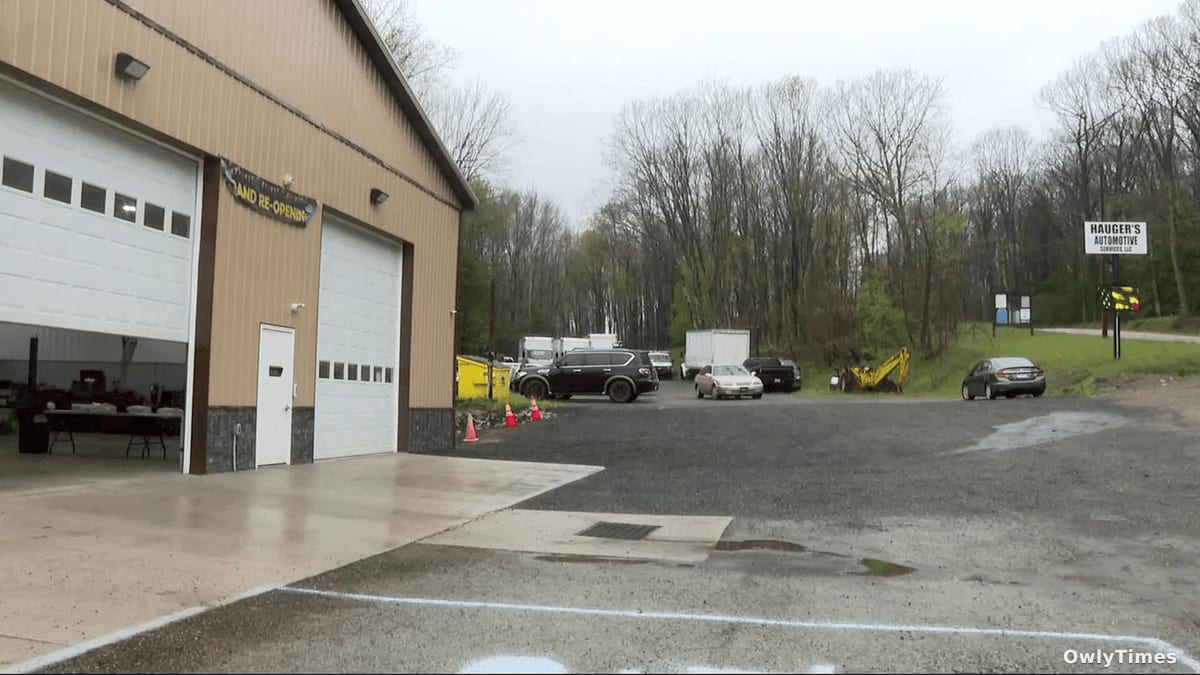

Two years after a total loss event rendered their operations non-existent, Hauger’s Automotive Services in Stoystown has officially transitioned from a makeshift carport recovery operation back to a fully equipped commercial facility. The restoration of this Somerset County business serves as a localized case study in capital recovery, where the intersection of community goodwill and physical asset replacement dictates the survival of small-scale enterprises.
The Cost of Total Loss and Capital Recovery
When the original shop succumbed to fire, the destruction was absolute. Owner Robert Hauger noted the severity of the incident, describing how the intense heat melted the aluminum bed of a rollback truck, with the molten metal running beyond the building’s perimeter. This level of physical devastation typically forces permanent closure for family-run entities lacking the liquid capital to replace specialized machinery.
Following the fire, the business pivoted to a survival model, operating out of a cold, enclosed carport utilizing propane heaters to maintain basic functionality. The reliance on this temporary infrastructure highlights the narrow margins inherent in independent automotive repair, where the loss of a physical workshop creates an immediate, total cessation of revenue-generating capacity.
Community Equity as an Economic Safety Net
The path to rebuilding was not funded by traditional institutional lending alone, but through a significant influx of community-sourced capital. Dustin Hauger reported that residents and strangers contributed physical assets, specifically donating essential tools and equipment necessary to restart operations. Beyond equipment, the community provided direct liquidity, covering food tabs at Snyder’s and providing cash infusions that allowed the owners to maintain their personal subsistence while prioritizing business expenditures.
Follow the money in this context reveals that the community functioned as an informal insurance syndicate. By absorbing the immediate costs of food and tools, these donors allowed the Hauger family to focus their limited resources on structural reconstruction rather than operational survival. This grassroots investment proved as critical to the business’s solvency as any formal reconstruction plan.
Operational Upgrades and Future Throughput
The new facility represents a significant capital upgrade over the pre-fire structure. By incorporating bigger bays and additional lifts, the shop has increased its potential volume of throughput. The inclusion of new tools further reduces the time-per-repair cycle, a key metric for profitability in the automotive services sector.
On Saturday, the business hosted an event to demonstrate these new capabilities, inviting customers to view the mechanics of an alignment rack in real-time. This focus on transparency and customer education acts as a marketing strategy to reclaim the client base that was forced to seek services elsewhere during the two-year reconstruction period.
The Metrics of Rebound
The financial viability of the new shop will be determined by its ability to convert these expanded physical assets into consistent billable hours. While the community support provided the bridge to reopen, the long-term success of the business now depends on the efficiency of the new bays and the retention of the customer base. The upcoming quarterly volume of vehicles serviced will be the primary indicator of whether the transition from the carport model to the current, fully equipped facility has effectively restored the shop’s pre-fire market position.





