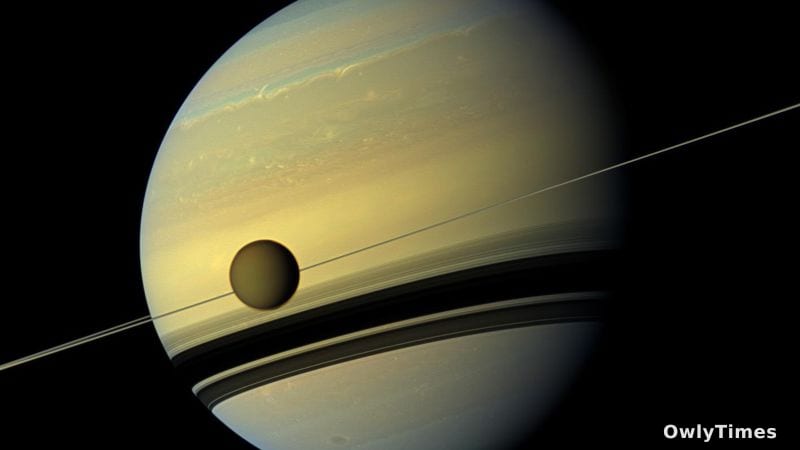

The story of Saturn’s rings isn’t just about beautiful ice particles; it’s a detective story unfolding across billions of years, and the latest chapter points to a dramatic collision that reshaped the Saturnian system. For decades, astronomers puzzled over Saturn’s unusual 26.7-degree axial tilt – a wobble seemingly out of sync with the gravitational influence of its planetary neighbor, Neptune. Now, a new study by Matija Ćuk of the SETI Institute proposes that this tilt, along with the surprisingly rapid outward drift of Saturn’s largest moon, Titan, can be explained by a cataclysmic event: a collision between Titan and a now-lost moon roughly half a billion years ago. This isn’t simply revising a timeline; it’s a fundamental shift in how we understand the formation of both Titan and the iconic rings.
The prevailing theory before NASA’s Cassini mission, which explored the Saturnian system from 2004 to 2017, attributed Saturn’s tilt to Neptune’s gravitational pull. The idea was that subtle wobbles in Neptune’s orbit could, over immense timescales, nudge Saturn off its axis. However, Cassini’s precise measurements revealed a mismatch – Neptune’s influence wasn’t quite enough to account for the observed tilt. In 2022, the hypothesis of a lost moon named Chrysalis emerged, suggesting it was pulled apart by Saturn, forming the rings and contributing to the axial tilt. Ćuk’s research builds on this, proposing a more violent scenario: not a gentle disintegration, but a full-blown collision.
Source material: CNN.
What sets this new work apart is its attempt to reconcile multiple anomalies within the Saturnian system. Ćuk and his team combined data from Cassini, existing theories about Titan’s formation, and sophisticated computer simulations. They posit that the colliding body, dubbed “proto-Hyperion” – a moon approximately one-thousandth the mass of Titan – didn’t simply shatter. Instead, it largely merged with Titan, dramatically increasing its mass and altering its orbit. This increased mass is key to explaining why Titan is currently receding from Saturn at a rate of 11 centimeters (4.3 inches) per year – a rate significantly faster than previously estimated, and fast enough that it could eventually be ejected from Saturn’s orbit altogether. The collision also, crucially, accounts for Saturn’s current axial tilt, bringing the system back into gravitational resonance with Neptune.
The implications extend beyond Titan’s origin. The researchers suggest the collision also birthed Hyperion, Saturn’s largest non-spherical moon, either as a direct fragment of the impact or from debris accumulating around Titan’s orbit. Furthermore, the disruption caused by the collision could have destabilized other inner moons, leading to further collisions and ultimately forming Saturn’s rings around 100 million years ago. This timeline aligns with recent findings suggesting the rings themselves are relatively young – perhaps only a few hundred million years old – a conclusion supported by a February study indicating Titan’s surface is similarly youthful, lacking the extensive impact craters expected on an ancient landscape.
However, it’s crucial to acknowledge the limitations of this model. While the simulations provide a compelling narrative, they rely on assumptions about the composition and initial conditions of the lost moon. The exact fate of proto-Hyperion – whether it became part of Titan or formed Hyperion directly – remains uncertain. The study, currently published on the open-access repository ArXiv and accepted for publication in The Planetary Science Journal, is based on modeling and interpretation of existing data; direct evidence of the collision is, understandably, absent. As Linda Spilker of NASA’s Jet Propulsion Laboratory, who was not involved in the study, notes, determining the age of the rings – whether they formed alongside Saturn or are a much more recent phenomenon – remains a key question.
The next crucial step in unraveling this cosmic mystery lies with NASA’s Dragonfly mission, scheduled to launch in 2028. This innovative rotorcraft will explore Titan’s surface, collecting and analyzing samples to determine its composition and geological history. The data returned by Dragonfly will provide critical constraints on the collision hypothesis, potentially confirming the presence of materials originating from the lost moon. More specifically, scientists will be looking for isotopic anomalies – unusual ratios of elements that could indicate a mixing of materials from two distinct bodies. The Saturnian system, as William B. Hubbard of the University of Arizona aptly describes, is a “dynamicist’s paradise.” The question now isn’t if something dramatic happened in Saturn’s past, but precisely what that event was, and how it sculpted the breathtaking spectacle we observe today. Will Dragonfly uncover the “forensic evidence” needed to definitively close the case?