
A Collective Breath: Witnessing the Unexpected Social Life of Sperm Whales
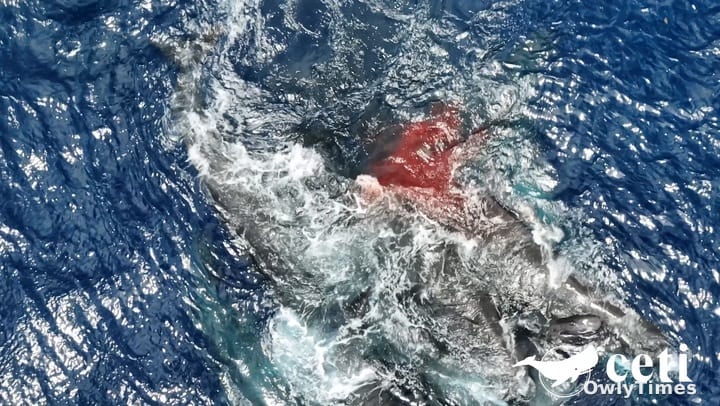
The water turned crimson, a sudden, shocking bloom against the turquoise of the Caribbean Sea. Shane Gero, a marine biologist with Project CETI, braced for the worst. Years spent tracking sperm whales had prepared him for the brutal realities of the ocean – predator attacks, territorial disputes, the constant struggle for survival. But what unfolded that July day in 2023 wasn’t a tragedy, but a revelation. It was a birth, meticulously documented by drones and underwater microphones, and it revealed a level of cooperative behavior in sperm whales that challenges our understanding of these ocean giants – and, perhaps, of ourselves. This wasn’t just about observing a new life entering the world; it was about witnessing a community actively choosing to nurture it.
This piece references the NPR report.
The initial observation – eleven whales clustered calmly near the surface – was already unusual. Gero noted their lack of typical activity, a stillness that initially triggered alarm. “To be honest, I thought that predators had attacked,” he recounts. What followed, captured in stunning detail and now published in Science and Scientific Reports, was the birth of a sperm whale calf, and a subsequent, hours-long effort by the entire group to keep the newborn afloat. This isn’t a simple story of maternal instinct; roughly half of the assisting whales weren’t even related to the mother, a whale the researchers have named Rounder. The implications are profound, suggesting a complex social structure built on reciprocal altruism, a system where helping others increases one’s own chances of survival, even without direct kinship.
Sperm whale society is traditionally understood through the lens of matrilineal lines – grandmothers, mothers, and daughters forming tight-knit pods. Males venture out on their own in adolescence. Rounder’s group, Unit A, contained two such matrilineal lines that rarely interact. Yet, during and after the birth, whales from both lines, and even those outside of Unit A altogether, took turns physically supporting the calf, preventing it from sinking. Newborn sperm whales lack the fully developed oil-filled organ that allows adults to control their buoyancy, making them vulnerable to drowning. For three crucial hours, the group functioned as a collective life raft, a rotating support system ensuring the calf could reach the surface to breathe. This isn’t merely instinctive behavior; it’s coordinated, deliberate, and demonstrably extends beyond familial obligation.
The data collected by Project CETI, a non-profit dedicated to decoding whale communication, goes beyond visual observation. Underwater microphones captured the whales’ intricate clicking patterns, a language scientists are only beginning to understand. While the specific meaning of these clicks during the birth remains unclear, the very act of vocalizing suggests a level of communication and coordination that underscores the cooperative effort. This research builds on a growing body of evidence demonstrating the intelligence and social complexity of cetaceans. In 2022, for example, researchers documented humpback whales intervening in orca hunts, risking their own safety to protect other species – a behavior previously considered unique to humans. The sperm whale birth, however, offers a rare, intimate glimpse into the internal workings of a highly structured, non-human society.
Philippa Brakes, a behavioral ecologist at the University of Exeter, frames the discovery with a compelling human analogy. “An analogy for humans might be that some of us like sushi, others like fries — but when it comes to helping people in extremis, most of us would respond to someone who was giving birth in the street,” she explains. This highlights the distinction between individual preferences and fundamental social obligations. The whales aren’t helping because they want to, but because there’s an understood expectation of reciprocal support within their community. This challenges the often-individualistic narratives that dominate our understanding of animal behavior, and forces us to consider the evolutionary advantages of widespread cooperation.
Beyond the headlines of a remarkable birth, this discovery arrives at a critical moment. As human activity increasingly encroaches on marine ecosystems – through noise pollution, shipping traffic, and climate change – understanding the intricate social structures of these animals is paramount. Disrupting their communication, fragmenting their habitats, or depleting their food sources doesn’t just impact individual whales; it threatens the very fabric of their societies. The question now isn’t simply can sperm whales survive, but how will their complex social systems adapt to a rapidly changing world, and what responsibility do we have to ensure they have the space and resources to do so? The birth of a single calf in the Caribbean Sea has offered a glimpse into a world of unexpected cooperation – a world we ignore at our peril.





