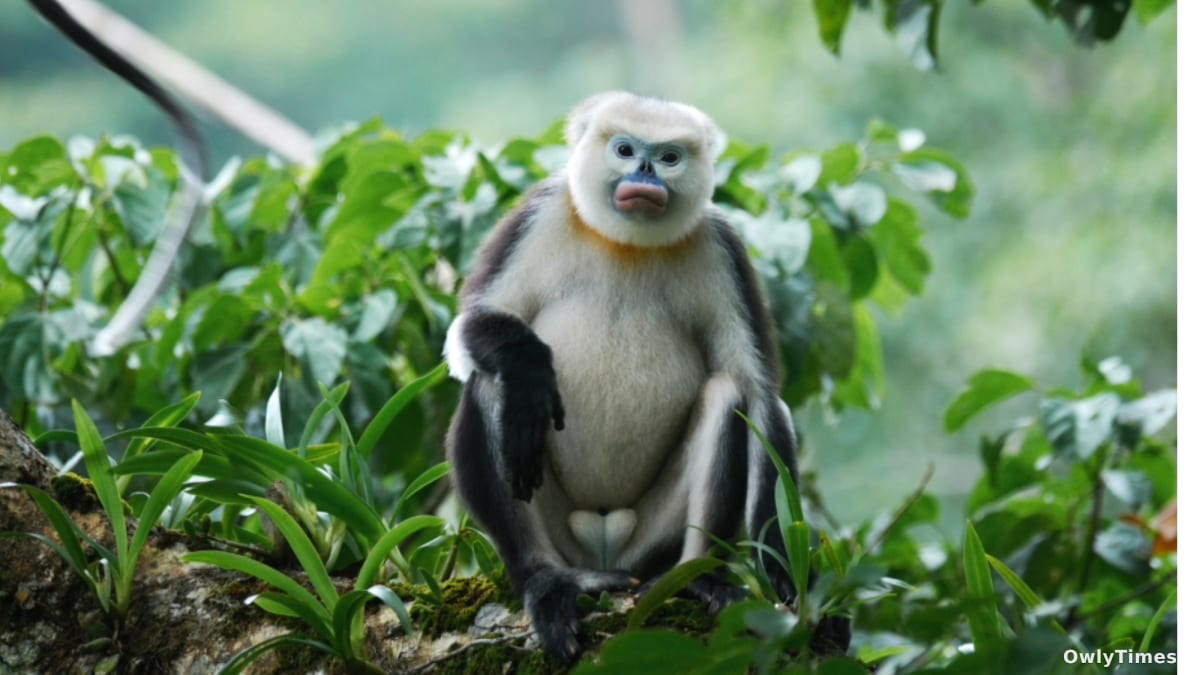

The mist hangs thick in the forests of northern Vietnam, clinging to the jagged limestone peaks like a secret. It’s a landscape that feels ancient, untouched – and yet, increasingly fragile. For the Tonkin snub-nosed monkey, a primate so rare it barely registers in the global consciousness, that mist is both a refuge and a reminder of how close it is to vanishing. Recent news offers a sliver of hope: a population census conducted by Fauna & Flora confirms the roughly 160 individuals within the Khau Ca Species and Habitat Conservation Area are, for now, stable. But beyond the headlines of a “stable” population lies a story of relentless pressure, community-led conservation, and a species walking a tightrope between survival and extinction.
A Face Only Vietnam Knows
The Tonkin snub-nosed monkey isn’t winning any beauty contests by conventional standards. With its strikingly red nose, thick lips, and perpetually mournful expression, it’s a face uniquely adapted to its harsh environment. But its unusual appearance is also a marker of its extreme vulnerability. Limited to just two primary areas – Quan Ba Forest and Khau Ca – in northern Vietnam, the species numbered around 250 individuals in the most recent estimate. That’s fewer than the population of some small towns, and a stark reminder of how close we are to losing an entire species. The fact that the Khau Ca population remains steady, even with a total species estimate still hovering around that precarious 250 mark, is a victory, but a qualified one. It’s a pause in the decline, not a reversal.
See the original popsci.com story for the full account.
The Power of the Grid and Local Eyes
What makes this census different isn’t just the positive result, but how Fauna & Flora achieved it. The 19-day survey wasn’t a haphazard trek through the forest. Instead, the team, working alongside local community groups, implemented a grid system, assigning each group to a specific cell within the survey area. This seemingly simple tactic eliminated overlap and dramatically increased efficiency. Coupled with traditional methods like binoculars and, crucially, the integration of technology – thermal imaging drones and camera traps – the census represents a new approach to monitoring critically endangered species. But the real innovation wasn’t the tech, it was the partnership. Canh Xuan Chu, Tonkin snub-nosed monkey project manager at Fauna & Flora, emphasized the absence of poaching in the area, a direct result of increased community involvement. “These numbers still aren’t big,” he stated, “But it is reassuring that we have been able to identify various family groups in Khau Ca and that there is no evidence of trapping or hunting.”
From Poaching to Palm Oil: Shifting Threats
For years, poaching was the primary driver of the Tonkin snub-nosed monkey’s decline. The demand for traditional medicine and the bushmeat trade decimated populations. While that threat has lessened thanks to concerted conservation efforts and community engagement, a new, more insidious challenge has emerged: habitat loss. As Tran Van On, a Community Conservation Team member, explained, agricultural expansion, particularly the growth of palm oil plantations, is rapidly eroding the monkeys’ forest home. This isn’t simply about trees being felled; it’s about fragmenting the landscape, isolating populations, and disrupting the delicate ecological balance the monkeys depend on. The shift from direct poaching to habitat destruction is a common pattern in conservation, and it’s often harder to combat. It requires tackling complex economic and political forces, not just law enforcement.
Beyond Stability: The Future of a Species
The “cautiously optimistic” tone surrounding the census is understandable. The stability of the Khau Ca population is a testament to the dedication of Fauna & Flora and the local communities. But it’s also a warning. Maintaining this stability requires sustained effort, increased government protection of conservation areas, and the restoration of wildlife corridors to connect fragmented habitats. The success in Khau Ca doesn’t guarantee the survival of the species as a whole. The population in Quan Ba Forest remains less well-understood, and the overall genetic diversity of the Tonkin snub-nosed monkey is alarmingly low, making it vulnerable to disease and environmental changes. The question now isn’t just whether we can keep the numbers stable, but whether we can actively grow the population and secure a future for this unique primate. Will the momentum generated by this census translate into concrete policy changes and increased funding for conservation efforts? Or will the Tonkin snub-nosed monkey remain a poignant symbol of a biodiversity crisis unfolding in the mists of northern Vietnam?





