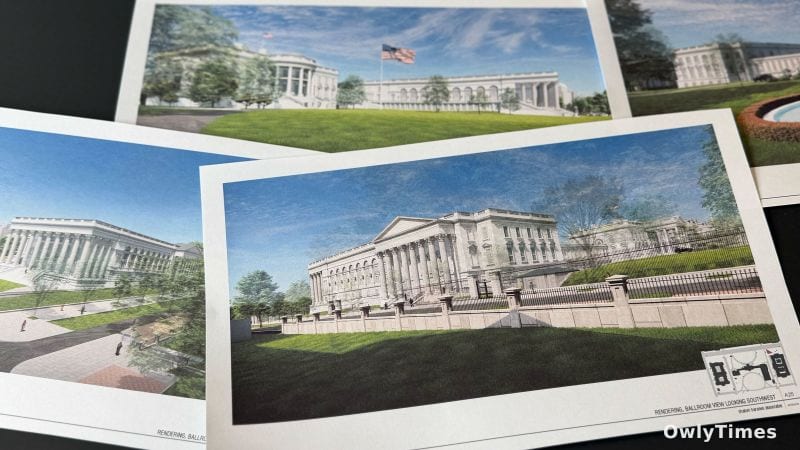

The strategic imperative behind President Trump’s push for a 1,000-person ballroom at the White House isn’t about hosting larger events; it’s about establishing a precedent – a demonstration of executive power to reshape national symbols with minimal constraint. Thursday’s approval by the National Capital Planning Commission (NCPC), despite over 32,000 public comments in opposition, wasn’t a surprise given the commission’s composition, but it was a calculated risk. The immediate victory is shadowed by a legal challenge from Judge Richard Leon, revealing a power struggle over the very definition of presidential stewardship versus ownership of national landmarks. This isn’t simply a building project; it’s a test case for the limits of executive authority in the realm of national heritage.
The NCPC vote, secured by a board stacked with Trump loyalists like chairman Will Scharf, highlights a familiar pattern: leveraging institutional control to bypass traditional checks and balances. Scharf’s assertion that the ballroom “will be considered every bit as much of a national treasure” as existing White House components isn’t an aesthetic judgment, but a preemptive attempt to legitimize the project’s historical significance – to manufacture consensus where none organically exists. Who benefits and who loses is starkly defined: President Trump gains a lasting monument to his tenure, while the public, represented by the overwhelming opposition in the comment period, loses a degree of control over the symbolic heart of the nation. The $300-400 million price tag, privately funded as the administration claims, obscures the broader cost – the erosion of established processes for preserving national spaces.
Source material: CNN.
The legal challenge brought by Judge Leon, an appointee of George W. Bush, is crucial not for its likely outcome – the administration has already appealed – but for its articulation of the core principle at stake. Leon’s ruling, that congressional authorization is required, directly contradicts Trump’s claim of unfettered authority. This echoes historical precedents where presidents have attempted to expand executive power in the face of congressional resistance. Consider President Lincoln’s suspension of habeas corpus during the Civil War, or President Jackson’s defiance of the Supreme Court in the case of Worcester v. Georgia; these moments, like the current situation, involved a president asserting authority beyond established legal boundaries. The two-week delay imposed by Leon before fully implementing his ruling is a tactical maneuver, allowing the administration time to potentially accelerate construction and create a fait accompli before a higher court can weigh in.
The concerns raised by experts regarding the scale and design of the ballroom – the introduction of Corinthian columns, the asymmetric driveway – are less about architectural aesthetics and more about the project’s disregard for the White House’s established character. The demolition of the East Wing last October, a move that effectively pre-committed the administration to the project, demonstrates a willingness to bypass incremental planning and public input. This parallels the rapid, often controversial, redevelopment projects undertaken during Robert Moses’ tenure as New York City’s construction coordinator in the mid-20th century, where large-scale infrastructure projects were prioritized over community concerns and historical preservation. The speed and scale of Trump’s vision are not anomalies; they are deliberate choices designed to overwhelm opposition and solidify a legacy.
The broader context reveals a pattern of similar challenges to established norms. The proposed “Independence Arch,” a 250-foot structure near the Lincoln Memorial, and the attempts to temporarily shut down the Kennedy Center for renovations, are all facing legal hurdles. Judge Tanya Chutkan’s skepticism regarding the administration’s commitment to following due process, particularly in light of Trump’s public statements, underscores the judiciary’s growing scrutiny. Her concern that “ground [could] be broken while this case is pending” reflects a recognition that Trump’s rhetoric often precedes and drives action, regardless of legal constraints. Public Citizen’s allegations regarding the NCPC’s composition – that appointees lack the required experience – further expose the administration’s strategy of stacking institutions with loyalists to achieve desired outcomes.
The political chess move to watch next isn’t the outcome of the ballroom’s legal battles, but rather the administration’s response to potential setbacks. Will President Trump continue to push forward aggressively, risking further legal confrontations and public backlash? Or will he attempt to negotiate a compromise, potentially scaling back the project to appease critics? The answer will reveal whether this is a genuine attempt to enhance the White House or a calculated demonstration of power, and will set the stage for future battles over the control and interpretation of national symbols. Specifically, monitor whether the administration attempts any above-ground construction during the two-week delay granted by Judge Leon – a move that would signal a willingness to defy the courts and escalate the conflict.





