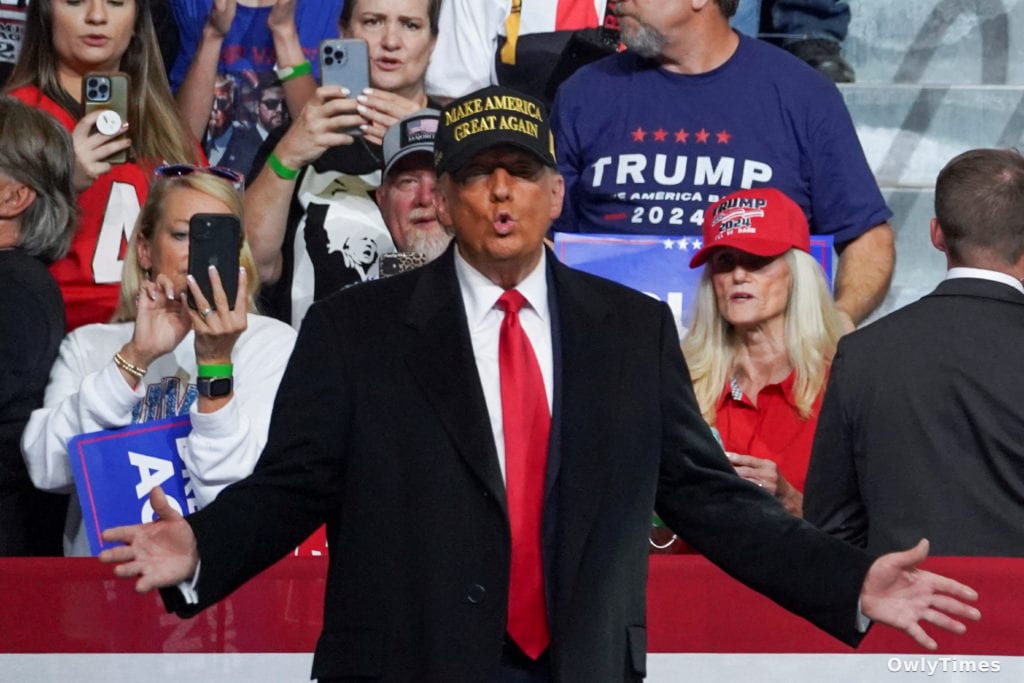

The calculated dissonance between President Trump’s actions and the stated purpose of his Georgia visit reveals a strategic pivot – or perhaps a deliberate misdirection – aimed at consolidating Republican support ahead of the midterms. The trip, ostensibly focused on the economy, arrives amidst a flurry of potentially destabilizing foreign and domestic policy maneuvers, suggesting the economic messaging is less about genuine policy emphasis and more about providing palatable cover for a broader, riskier political strategy. This isn’t simply a campaign stop; it’s a pressure test of the Republican base’s loyalty, gauging their willingness to follow a leader increasingly willing to defy conventional political norms.
The Iran Question and Domestic Distraction
The timing of the Georgia trip is particularly noteworthy given the escalating tensions with Iran. Reports of potential military action, while not new, have intensified in recent weeks, creating a volatile international environment. Simultaneously, the administration continues to pursue an aggressive immigration crackdown, and, crucially, has openly floated the possibility of federal intervention in state election administration – a move that directly challenges the principles of federalism and could be interpreted as an attempt to preemptively delegitimize potential election results. The insistence on focusing on the economy, therefore, reads as an attempt to compartmentalize these potentially divisive issues, presenting a veneer of normalcy while simultaneously pursuing a high-stakes, multi-pronged strategy. Who benefits and who loses here is stark: President Trump benefits from projecting strength on the world stage and rallying his base around a perceived defense of American interests, while Democrats – and potentially moderate Republicans – risk being painted as weak or unpatriotic if they criticize his actions. Iran, and potentially U.S. allies, clearly lose from increased instability.
Source material: PBS.
Georgia as a Bellwether: Beyond the Economic Narrative
Georgia, a state that narrowly flipped to President Biden in 2020, is a crucial battleground for the upcoming midterm elections. The focus on the economy isn’t accidental. While national inflation remains stubbornly high at 8.2% – significantly above the Federal Reserve’s 2% target – Georgia’s economic performance has been relatively strong, with unemployment rates falling to 3.1% in September, a historic low. This allows the Trump campaign to highlight localized successes, potentially mitigating concerns about the broader national economic picture. However, the economic message is likely aimed at a specific demographic: working-class voters in rural and suburban areas who were instrumental in President Trump’s 2016 victory and whose support is now wavering. The question is whether a focus on economic gains can outweigh concerns about the administration’s more controversial policies, particularly among suburban voters who may prioritize stability and adherence to democratic norms.
Historical Echoes: Nixon and the “Southern Strategy”
The strategy employed by President Trump bears a striking resemblance to the “Southern Strategy” utilized by Richard Nixon in the late 1960s and early 1970s. Like Trump, Nixon faced political headwinds and sought to consolidate support among white working-class voters in the South by appealing to cultural anxieties and emphasizing law and order. While the specific issues differ – civil rights in Nixon’s era versus immigration and cultural grievances today – the underlying dynamic is the same: a deliberate attempt to exploit social divisions to mobilize a specific voting bloc. However, the parallel isn’t perfect. Nixon operated within a more established political framework, whereas President Trump has consistently challenged and disrupted traditional norms, creating a more unpredictable and volatile political landscape. The risk for Trump is that this disruption could alienate moderate voters and ultimately backfire, as it arguably did in the 2020 election.
The Midterm Endgame: Election Integrity and the Base
The repeated questioning of election integrity, coupled with the suggestion of federal intervention in state elections, isn’t simply rhetoric; it’s a calculated attempt to lay the groundwork for contesting potential losses in the midterms. By pre-emptively raising doubts about the fairness of the election, President Trump is attempting to inoculate himself and his supporters against the possibility of defeat, and to maintain his grip on the Republican base even if the party underperforms. This tactic, while dangerous to democratic institutions, is a logical extension of his broader political strategy: to portray himself as a victim of a rigged system and to rally his supporters against perceived enemies. The 4 p.m. EST speech in Georgia will be closely scrutinized for any further signals regarding this strategy.
The political chess move to watch next isn’t what President Trump says about the economy in Georgia, but rather what actions he takes in the weeks leading up to the midterms regarding election oversight. Will he actively push for federal intervention in state elections, or will he dial back the rhetoric and focus solely on mobilizing his base? The answer to that question will reveal the true extent of his willingness to risk further destabilizing American democracy in pursuit of political gain.





