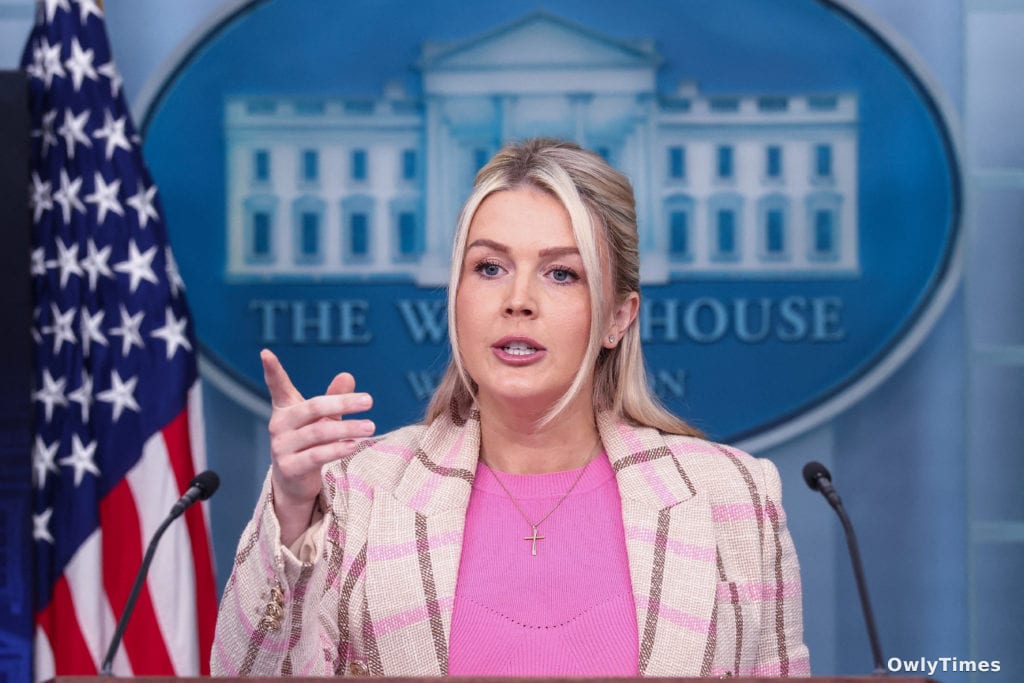

The White House’s deflection regarding President Trump’s claim of Iranian possession of U.S.-made Tomahawk cruise missiles isn’t a gaffe; it’s a calculated maneuver to maintain political flexibility in a rapidly escalating geopolitical situation. Press Secretary Karoline Leavitt’s response – invoking the President’s right to “share his opinions” while simultaneously deferring to a future investigation – reveals a strategy of ambiguity designed to avoid prematurely boxing in U.S. policy toward Iran. The immediate consequence is a further erosion of trust in official statements, but the larger aim is to preserve options for escalating or de-escalating tensions as circumstances dictate. This isn’t about correcting a factual error; it’s about controlling the narrative.
The Strategic Value of Uncertainty
The core of the strategy lies in the deliberate creation of uncertainty. Leavitt’s statement, delivered during a Tuesday press briefing, wasn’t an attempt to clarify the situation, but to delay clarification. By asserting the President’s right to opinion, the administration effectively decoupled the statement from the realm of verifiable fact. This is a tactic with historical precedent. During the lead-up to the Iraq War in 2003, the Bush administration similarly employed ambiguous language regarding weapons of mass destruction, allowing for a justification of military action even as intelligence remained inconclusive. The difference here is the speed – the Trump administration is operating in a media cycle demanding instant accountability, making the deflection all the more notable. The claim, made on Monday, was met with immediate scrutiny, yet the response prioritized protecting the President’s latitude over providing a factual accounting.
Who Benefits and Who Loses from the Ambiguity?
The primary beneficiary of this ambiguity is, predictably, the President himself. By claiming ignorance – “Because I just don’t know enough about it,” he stated when pressed – Trump shields himself from direct responsibility for a potentially damaging falsehood. This is crucial given the sensitivity of the claim: alleging Iranian possession of Tomahawks, a weapon manufactured by Raytheon and sold to U.S. allies, carries significant implications for regional security and U.S. foreign policy. Conversely, those who lose from this tactic are the American public, Congress, and U.S. allies who rely on accurate information for informed decision-making. The lack of a clear answer fuels speculation and distrust, potentially undermining diplomatic efforts and increasing the risk of miscalculation. Raytheon, while not directly implicated in the falsehood, also stands to lose if the claim further destabilizes the region and impacts arms sales. The company’s stock price saw a negligible dip following the initial claim, but sustained uncertainty could affect long-term investor confidence.
Drawn from PBS.
The Tomahawk Question and Regional Implications
The assertion that Iran possesses Tomahawk missiles is particularly fraught given the recent strike on a girls’ school in Iran, resulting in 165 deaths. President Trump’s claim directly links Iran to the use of a U.S.-made weapon in a civilian attack, a charge that, if substantiated, would dramatically escalate tensions. However, there is currently no evidence to support this claim. Raytheon confirms sales to allies, but explicitly denies any evidence of Tomahawks falling into Iranian hands. This discrepancy raises a critical question: what prompted the President’s assertion? Was it based on faulty intelligence, a deliberate attempt to create a pretext for military action, or simply a misstatement? The White House’s refusal to address this question directly suggests a reluctance to reveal the underlying rationale, further reinforcing the impression of a calculated strategy. The parallel to the Gulf of Tonkin incident in 1964, where questionable reports of attacks on U.S. Navy ships were used to justify escalating U.S. involvement in Vietnam, is unsettling.
The Next Chess Move: Congressional Oversight
The political chess move to watch next isn’t a statement from the White House, but a response from Congress. Several key members have already signaled their intent to investigate the President’s claim and demand a full accounting of the intelligence that informed it. Specifically, the House Armed Services Committee, led by Representative Adam Smith, is likely to subpoena relevant officials and documents. The committee’s ability to compel testimony and access classified information will be crucial in determining the veracity of the President’s assertion and the extent to which the administration deliberately misled the public. The outcome of this investigation will not only shape the debate over U.S. policy toward Iran, but also test the limits of congressional oversight in an era of executive privilege and political polarization. Will Congress successfully challenge the White House’s obfuscation, or will the administration successfully navigate the scrutiny and maintain its strategic ambiguity? The answer will reveal much about the balance of power in Washington and the future of U.S. foreign policy.





