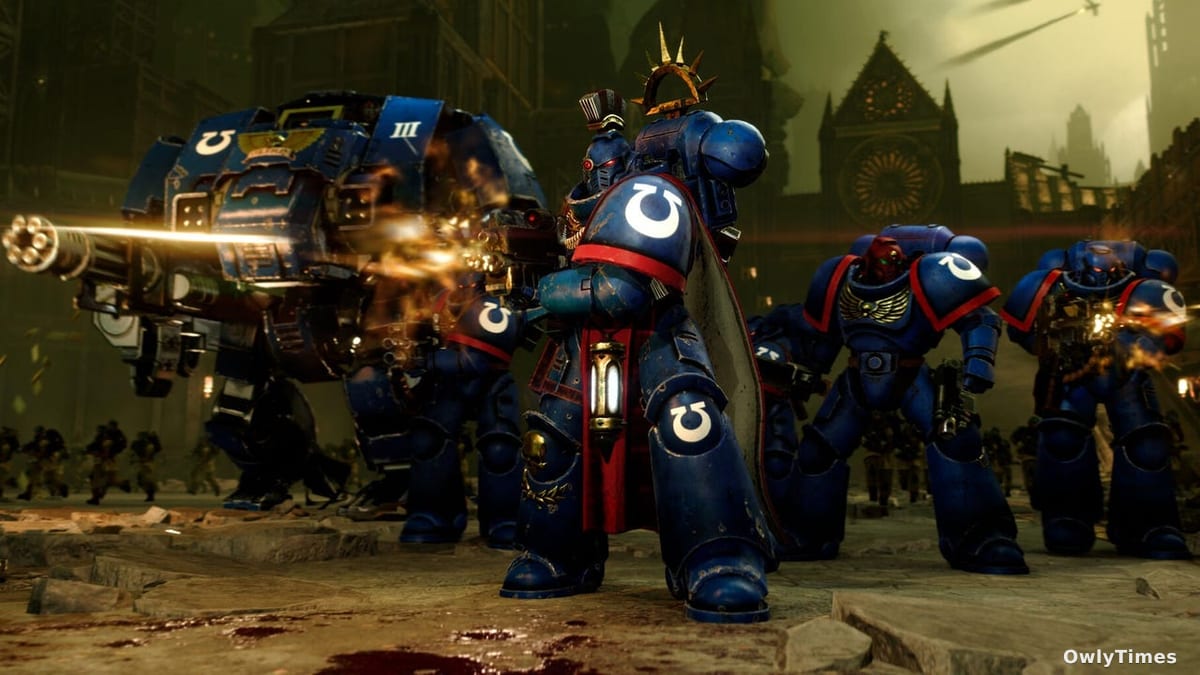

Is the future of strategy gaming defined by how much of the map we can leave standing, or how much we can turn into rubble? For decades, the genre has conditioned us to view terrain as a static puzzle—a series of static obstacles to be navigated or utilized. But as Creative Assembly peels back the curtain on its highly anticipated Total War: Warhammer 40,000, it is becoming clear that the real story here isn’t just the graphical fidelity of its hive worlds—it’s the shift toward total environmental agency.
Designing the Desolation of the Imperium
In a recent livestream, battle product owner David Petry and art director Kevin McDowell showcased the visual DNA of the game, focusing specifically on the "hive waste world." To understand the scale here, think of a hive planet as a vertical city-state that consumes everything in its path to fuel the Imperium’s war machine. These environments are not merely backdrops; they are manifestations of the game’s core tension between dense, choke-point-heavy urban warfare and the haunting emptiness of the surrounding wastes.
The team confirmed that planet variety will be governed by a system of biomes—arid, temperate, ice, and waste—layered with civilizational density markers. While McDowell noted that players shouldn't expect "dozens and dozens of planets" per system, the focus is clearly on quality over quantity. The goal is to provide a sense of place where the geography tells the story of the struggle, moving from the desolate outskirts where a few points of interest punctuate the horizon to the claustrophobic, high-density interiors of the hives themselves.
The Strategic Shift Toward Erasure
What makes this title fundamentally different from its predecessors is the role of destruction as a tactical layer. In most strategy titles, a forest or a building is a permanent feature of the battlefield. In Total War: Warhammer 40,000, these are temporary assets. Petry described the maps as "absolutely honking" in scale, noting that even within tight urban spaces, there is enough room to maneuver a sizable army.
If a building obscures your line of sight or provides cover for an enemy, you don't just work around it; you remove it. This introduces a "mental shift" for veteran players: the environment is no longer a constraint, but a resource to be sculpted. Whether through ground-based demolition or orbital bombardment, the ability to flatten the map transforms the battlefield into a dynamic, shifting canvas. It turns the player into an architect of their own terrain, allowing those who favor long-range line-of-sight units to literally carve out a tactical advantage.
Managing the Density of War
The tension between the game's massive scale and the intimate, destructive combat is the pivot point for this experience. We are seeing a move away from the rigid, pre-set maps of historical strategy toward a more reactive, brutalist approach. By allowing players to destroy structures to create space or collapse cover on unsuspecting units, the developers are moving the strategy focus from "where do I go" to "what do I destroy to get there."
The next reading of the development cycle will be the showcase scheduled for the end of June, which will indicate whether the game’s mechanics can successfully marry this high-level environmental destruction with the granular, unit-by-unit intensity that the Total War series is known for. Until then, the promise remains: in a universe defined by the Emperor’s war, the ground you stand on is only as permanent as your next artillery strike.