
The confirmation hearing of a Federal Reserve chairman nominee is ostensibly an interrogation of monetary theory, interest rate projections, and balance sheet mechanics. Yet, the exchange on Tuesday, April 21, 2026, between nominee Kevin Warsh and Senator Elizabeth Warren exposed the raw political calculus that increasingly governs the selection of the world's most powerful economic policymaker. By confronting Warsh with a direct question on whether Joe Biden won the 2020 presidential election, Warren was not seeking a civic lesson; she was executing a tactical maneuver designed to test the nominee's susceptibility to executive branch influence. Warsh’s calculated deflection—refusing to state plainly that Donald Trump lost—reveals a nominee walking a razor-thin tightrope, attempting to secure confirmation from a highly polarized Senate without triggering a veto-by-tweet from the president who nominated him.
The Litmus Test of Central Bank Independence
In this high-stakes rhetorical theater, understanding who benefits and who loses clarifies the underlying power dynamics. Warren, the ranking Democrat on the Senate Banking Committee, benefits by framing the nomination not around complex economic models, but around the fundamental preservation of democratic norms and institutional autonomy. By forcing Warsh into a corner, she highlights the potential vulnerability of a Fed chairman who appears hesitant to contradict Trump’s long-standing claims of voter fraud in the 2020 election.
Conversely, Warsh loses a degree of perceived non-partisan independence among institutionalists who view any hesitation to acknowledge the certified election results of January 6, 2021, as a capitulation to partisan pressure. Yet, Warsh simultaneously benefits by keeping his nomination alive. A direct contradiction of Trump's narrative would likely prove fatal to his prospects in a Republican-controlled confirmation process.
The exchange, first reported by The Hill, escalated quickly as Warren pressed for a factual commitment. "I’m asking, did Donald Trump lose in 2020?" she demanded, seeking to establish a baseline of objective reality. Warsh's response—"Keep politics out of monetary policy"—was a sophisticated attempt to weaponize the very doctrine of central bank independence to shield himself from a politically damaging answer. When Warren countered that she needed to "measure your independence and your courage," Warsh pivoted to the constitutional role of the legislature, noting that "this body certified that election many years ago." This verbal fencing matches the broader strategy of nominees who must navigate a political minefield where absolute candor is often a strategic liability.
Shifting the Blame to Monetary Policy
To completely disarm the line of questioning, Warsh executed a counter-offensive by linking the political controversy directly to the Fed's past economic record. "And I’m suggesting to you in 2020 the Fed made a huge inflation problem, and you certified the election," Warsh retorted.
This was a highly deliberate pivot. By pointing to the Fed's aggressive monetary expansion during the pandemic as the root cause of subsequent inflation, Warsh sought to redirect the committee's focus back to economic performance, where he could position himself as a reformer ready to correct institutional failures. It was a classic political maneuver: answering a question about personal political loyalty by attacking the policy record of the institution he aims to lead.
Historical Echoes of Executive Pressure
This struggle over the political neutrality of the Federal Reserve carries deep historical resonance. The modern expectation of Fed independence is often traced back to the historical precedent of the 1951 Treasury-Federal Reserve Accord, which formally separated monetary policy from the financing needs of the executive branch. However, the temptation for presidents to exert pressure has remained constant. In the early 1970s, President Richard Nixon famously pressured Fed Chairman Arthur Burns to maintain low interest rates to boost the economy ahead of the 1972 election—a move that contributed to the devastating stagflation of that decade. Warren’s aggressive questioning of Warsh is rooted in this exact historical anxiety: that a central bank chief who cannot or will not state uncomfortable political truths to the executive branch will eventually yield to political pressure on interest rates.
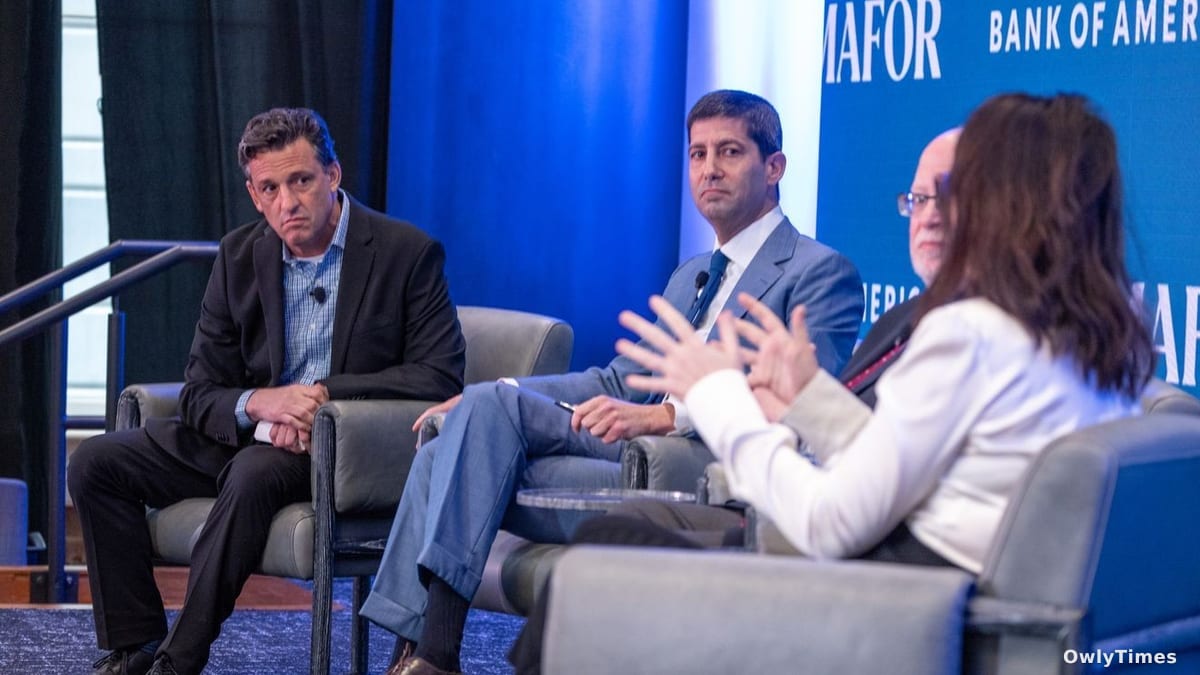
The political tightrope Warsh walked during the hearing stands in sharp contrast to the polite, academic debates of the economic establishment. Just two years prior, on April 18, 2024, at The Semafor 2024 World Economy Summit, Warsh was photographed in a relaxed discussion with author Jon Hilsenrath, Adam Posen, president of the Peterson Institute, and Karen Karniol-Tambour, Co-CIO of Bridgewater. In those elite circles, the norm of central bank independence is discussed as an absolute economic necessity. Yet, as reported by Natalia Mittelstadt of The National News Desk (TNND), the reality of the confirmation process forces nominees to abandon academic detachment in favor of survivalist political rhetoric.
The Confirmation Calculus Ahead
The immediate political chess move to watch next is the Senate Banking Committee's upcoming vote on whether to advance Warsh's nomination to the Senate floor. This vote will serve as a precise metric of whether Warsh's strategy of constructive ambiguity succeeded. If moderate senators accept his defense of keeping "politics out of monetary policy" as a valid shield, his nomination will likely clear the committee. However, if his refusal to directly answer the election question alienates crucial swing votes, the executive branch may find itself forced to recalibrate its strategy for the central bank leadership.





