
Is the future of driving less about building better cars and more about writing better software? That’s the question swirling around Wayve, the UK-based AI startup that just snagged a hefty $1.5 billion investment to expand its robotaxi ambitions. The real story here isn't just another funding round in the autonomous vehicle space – it’s a fundamental shift in how we’re approaching self-driving technology, and who stands to profit from it. While Tesla and Waymo are locked in a race to build complete, vertically integrated systems, Wayve is betting on becoming the operating system for autonomy, licensing its AI to anyone who makes a car.
This isn’t a small bet. The funding, valuing Wayve at $8.6 billion, comes from a who’s who of tech and automotive giants: Microsoft, Nvidia, Uber, Mercedes-Benz, Nissan, and Stellantis are all placing their chips on Wayve’s approach. The most immediate impact will be visible on London streets this year, where Wayve-powered robotaxis will launch on the Uber app, directly competing with Waymo’s long-awaited international debut. Alex Kendall, Wayve’s CEO, confidently declared to Business Insider, “This is our home turf,” referencing the eight years the company has spent training its AI on British roads. But “home turf” advantage only goes so far.
Original reporting: Business Insider.
What sets Wayve apart is its focus on software generalization. Unlike Waymo’s reliance on meticulously detailed, high-definition maps and a suite of expensive sensors, Wayve’s AI is designed to learn and adapt like a human driver. As Kendall explained, the goal is to create an AI that can quickly master new environments – switching sides of the road, navigating unfamiliar traffic laws – without needing to be explicitly programmed for each scenario. This “learn-as-you-go” approach, powered by machine learning, allows Wayve to sidestep the massive costs and logistical headaches of creating and maintaining hyper-specific maps. It also means their software can be integrated into a wider range of vehicles, regardless of sensor configuration. “Everyone wants autonomy, but not everyone wants to buy a Tesla,” Kendall pointed out, a pointed jab at Elon Musk’s walled-garden approach.
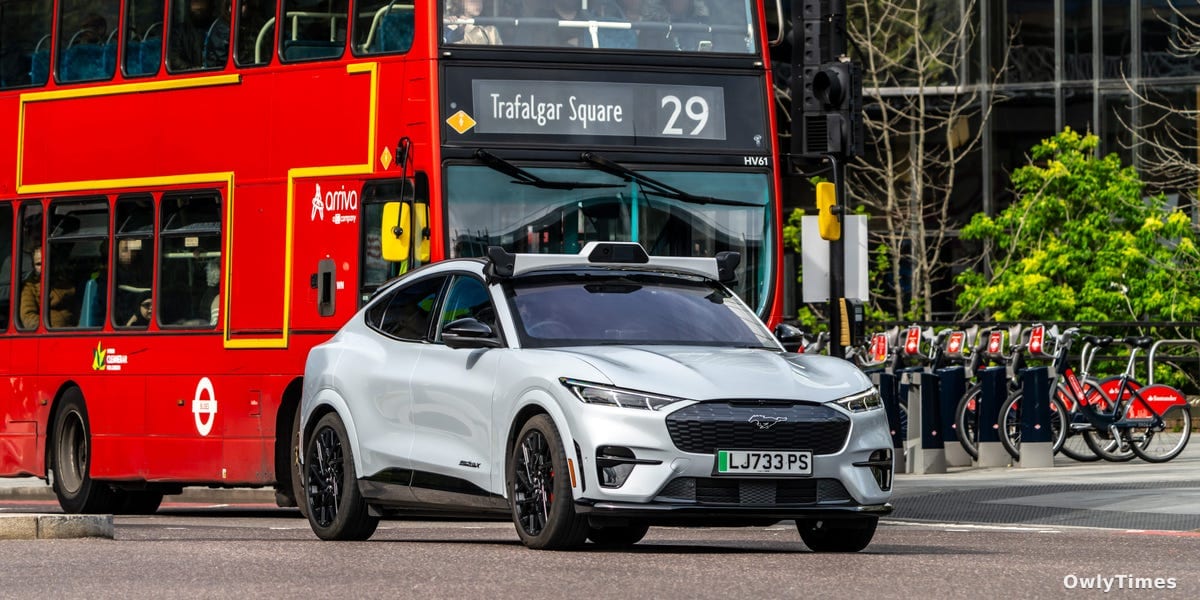
The implications for consumers are significant. If Wayve succeeds, we’re looking at a future where self-driving capabilities aren’t tied to a single brand or expensive vehicle. Imagine a world where your existing car, through a software update, gains advanced driver-assistance features, or even full autonomy. This is precisely the path Wayve is forging with its deal with Nissan, which will see its AI powering the Japanese automaker’s ProPilot driver assistance system starting in 2027. Over the past year, Wayve’s fleet of Ford Mach-Es, equipped with its AI driver, has logged miles in over 500 cities across Europe, North America, and Japan without city-specific training. That’s a level of adaptability that rivals simply haven’t demonstrated.
However, the road ahead isn’t without potholes. Waymo has a significant head start in terms of real-world testing and regulatory approvals. London is quickly becoming a crowded testing ground, with Baidu also partnering with Lyft to deploy robotaxis. And while Wayve’s software-centric approach is appealing, it still relies on the quality and reliability of the hardware it’s integrated with. A glitch in a car’s sensor suite could still compromise the AI’s performance. The $1.2 billion investment from giants like Microsoft and Nvidia suggests confidence in Wayve’s ability to overcome these challenges, but the proof will be in the pudding – or, more accurately, in the smooth, safe operation of its robotaxis on London’s notoriously complex streets.
Here’s what to watch for: by the end of 2026, we’ll see a clear divergence in the autonomous vehicle landscape. Will Wayve’s adaptable, software-first approach prove more scalable and cost-effective than the hardware-heavy strategies of its competitors? Specifically, keep an eye on the user experience within the Uber app in London. Are Wayve’s robotaxis demonstrably smoother, cheaper, and more readily deployable than Waymo’s? The answer to that question will determine whether the future of driving is built on silicon, or simply powered by it.