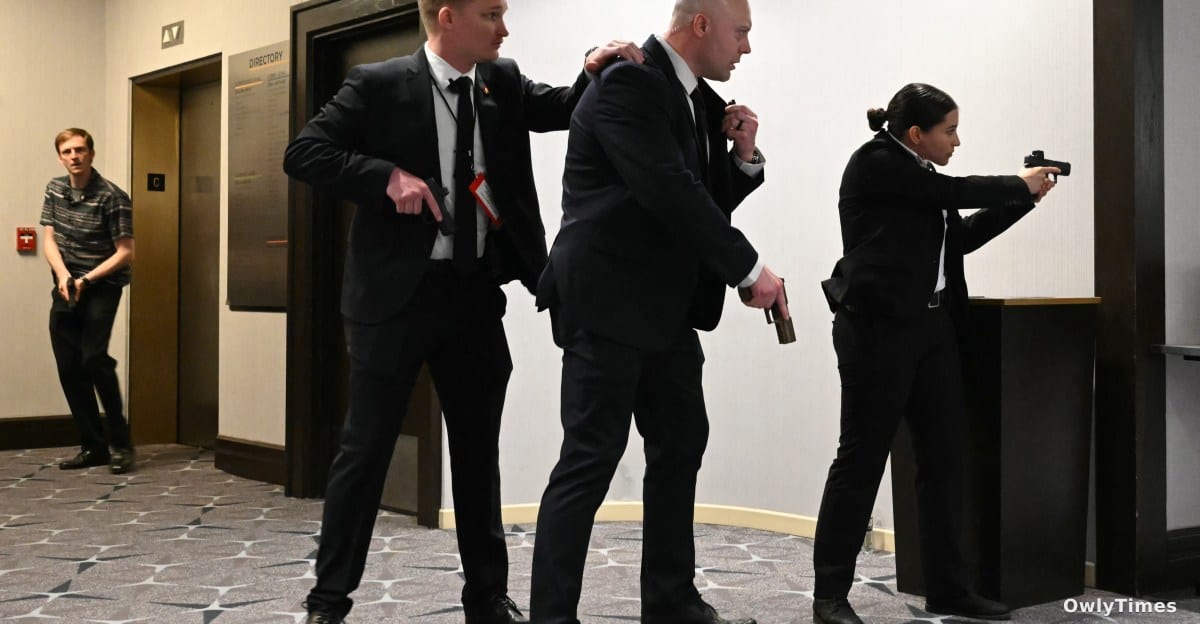

The strategic calculus behind the attempted attack at the Washington Hilton on Saturday night reveals a grim reality: for an increasingly polarized political class, physical security has become a constant, background hum rather than an extraordinary concern. By targeting a venue that carries the heavy historical weight of the 1981 assassination attempt on Ronald Reagan, the perpetrator sought to exploit the intersection of symbolic power and perceived vulnerability. When the security perimeter is breached, the political cost is not merely the potential loss of life, but the further erosion of the public square as a space for institutional engagement.
The "who benefits and who loses" framework in this instance is stark. President Donald Trump, who has survived two prior attempts on his life during the 2024 campaign, immediately leveraged the security failure to argue for his preferred architectural legacy: a new White House ballroom constructed atop the demolished East Wing. While the White House Correspondents’ Association (WHCA) functions as a private nonprofit responsible for its own security, the President is effectively using the breach to centralize control over executive-level event safety. The losers, conversely, are the institutions themselves—the press and the political establishment—who now face the prospect of their annual traditions becoming fortresses of armed checkpoints, further distancing them from the public they serve.
A Gathering Defined by Past Trauma
The guest list at Saturday’s event served as a haunting census of political violence in America. The presence of Erika Kirk, whose husband Charlie Kirk was killed at a campus event in Utah only months ago, alongside Robert F. Kennedy Jr., whose lineage is defined by the assassinations of the 1960s, underscored the normalization of danger. Republican Rep. Steve Scalise, himself a victim of a 2017 shooting at a Congressional baseball practice, was seen guiding Democratic Rep. Jared Moskowitz—a key figure in the House investigation into the January 6 attack—to safety. The proximity of CNN’s Wolf Blitzer, whose network was targeted by a serial bomber in 2018, to the gunman further highlights how the media and political elite are increasingly linked by shared experiences of targeted violence.
The Breach at the Perimeter
At approximately 8:30 pm ET, the security environment failed. Cole Tomas Allen, a 31-year-old teacher and engineer from Torrance, California, allegedly charged a checkpoint armed with a shotgun, a handgun, and knives. According to Acting Attorney General Todd Blanche, Allen had traveled across the country by train and secured a room at the hotel in advance. One Secret Service agent was struck by gunfire while protected by body armor; Trump later reported the agent is “doing great.” The fact that the suspect was taken alive offers a rare opportunity for federal investigators to parse the motives detailed in the manifesto Allen reportedly sent to family members, which explicitly cited concerns over the administration’s war in Iran and deportation policies.
Institutional Precedent and Future Security
The "Hinckley Hilton" nickname, derived from the 1981 attempt on Reagan, remains a staple of local Washington parlance. The recurrence of violence at this specific location serves as a reminder that the physical geography of power is rarely static. While Trump previously boycotted the dinner, his decision to attend as an honoree this year was met with political friction, as some Democrats avoided the event and others planned protests regarding media freedom. The tension between the press’s advocacy for transparency and the executive branch’s demand for hardened security is now entering a new, more volatile phase.
The next reading of the Secret Service’s operational posture will be determined by the briefing scheduled with Senators this week, where the focus will shift from the event’s cancellation to the systemic failures that allowed a suspect to identify weaknesses in hotel security. Allen is expected to appear in federal court on Monday, a proceeding that will likely trigger a broader legislative review of how private organizations hosting high-profile government figures manage their security protocols.





