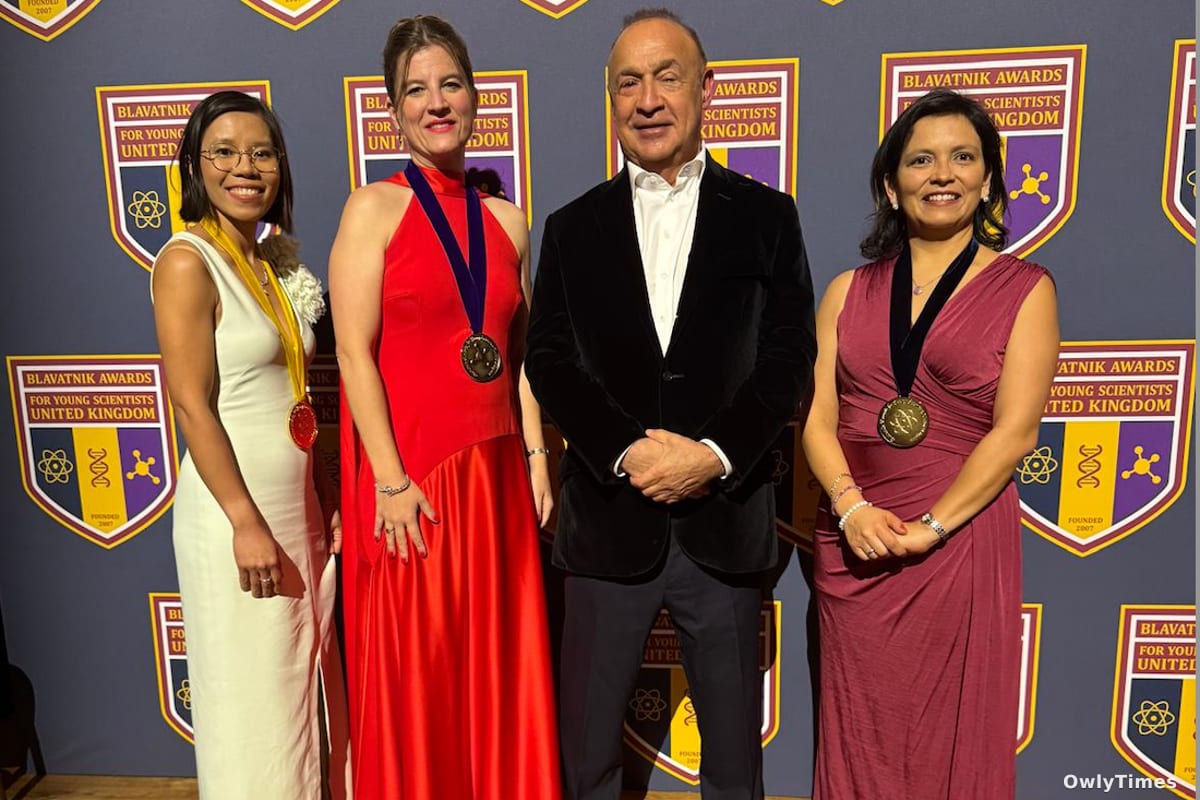

The narrative around scientific progress often focuses on incremental steps, but occasionally, a confluence of breakthroughs demands a reassessment of the landscape. This week’s announcement of the 2026 Blavatnik Awards for Young Scientists in the UK isn’t simply about recognizing three promising researchers; it’s a signal – not of future potential, but of current impact. While headlines rightly celebrate the £100,000 prizes awarded to Maxie Roessler, Thi Hoang Duong (Kelly) Nguyen, and Paola Pinilla, the true significance lies in the scope of their work and what it reveals about the evolving priorities within British science funding and the changing face of scientific leadership. It’s easy to frame this as a feel-good story about women in STEM, and it is that, but reducing it to a diversity narrative obscures the profound scientific advancements at its core.
The awards, now in their ninth year and totaling nearly £3.3 million in funding to 73 UK scientists since 2017, are designed to support “high-risk, high-reward” research. This year’s laureates exemplify that principle. Dr. Pinilla, of University College London, is tackling one of astrophysics’ most enduring mysteries: planet formation. Current models struggle to explain how planets coalesce from the swirling dust and gas surrounding young stars. Her research, combining telescope data with advanced modelling, identifies previously unrecognized “pressure points” within these protoplanetary disks, offering a crucial mechanism for planet emergence and, crucially, the delivery of water and other life-forming molecules. As Dr. Pinilla herself noted, her work represents a larger community effort, a common refrain among awardees highlighting the collaborative nature of modern science. It’s important to note that this isn’t about finding planets – exoplanet discovery is now routine – but about understanding the fundamental processes that make planetary systems, and potentially life, possible.
Meanwhile, Dr. Nguyen, at the MRC Laboratory of Molecular Biology, has achieved a breakthrough in understanding telomerase, the enzyme responsible for protecting chromosome ends during cell division. Often described as the “plastic tips” on shoelaces preventing fraying, telomerase’s function is critical to both aging and cancer. Dr. Nguyen’s team has created the first atomic-level model of this enzyme, providing unprecedented insight into its mechanics and opening avenues for targeted therapies. The significance here isn’t simply a deeper understanding of cellular aging, but the potential to manipulate telomerase activity to combat age-related diseases or disrupt cancer cell proliferation. Her casual description of science as a “hobby” belies the rigorous, years-long process of molecular modelling and experimentation that led to this discovery.
The work of Professor Roessler, from Imperial College London, completes this trio of impactful research. Her pioneering techniques allow scientists to observe the fleeting, reactive states of electrons during energy transfer within cells. This isn’t a visually dramatic field – we’re talking about observing phenomena on the attosecond timescale – but it’s foundational to understanding how cells generate energy and, consequently, how we might design more efficient catalysts and functional materials. Professor Roessler emphasized the broader impact of her work, noting that the tools she developed are now available to researchers globally, accelerating discovery across multiple disciplines. This speaks to a growing trend in scientific funding: supporting not just specific projects, but the development of enabling technologies that benefit the wider research community.
Original reporting: independent.co.uk.
It’s noteworthy that this is only the second time in the awards’ nine-year history that all three top prizes have been awarded to women. While celebratory, this fact also prompts a critical question: why isn’t this the norm? The selection process, based on peer review and assessment of impact, suggests that the talent has always been present, but systemic barriers may have historically limited opportunities for women in these fields. The £30,000 awards given to six additional finalists also demonstrate a commitment to broadening the base of support for promising early-career scientists. However, funding alone isn’t enough. Addressing issues of representation, mentorship, and implicit bias within scientific institutions remains crucial.
Limitations to consider include the relatively small sample size of awardees – three individuals cannot represent the entirety of British scientific innovation. Furthermore, the awards focus on early-career researchers, meaning the long-term impact of their work remains to be seen. While the potential is clearly present, translating these breakthroughs into tangible benefits will require continued funding, collaboration, and a supportive research environment. The Blavatnik Family Foundation’s broader philanthropic contributions, exceeding $1.3 billion over the past decade, demonstrate a long-term commitment to scientific advancement, but sustained public and private investment is essential.
Looking ahead, the next critical step will be to track the trajectory of these three researchers and their teams. Will the unrestricted funding allow them to pursue truly novel lines of inquiry? Will their work attract further investment and inspire the next generation of scientists? More importantly, will the increased visibility of their achievements – and the celebration of an all-women cohort – contribute to a more equitable and inclusive scientific landscape? The scientific community, and the public, should be watching closely to see how these laureates leverage their awards, not just to advance their own research, but to shape the future of science in Britain and beyond.





