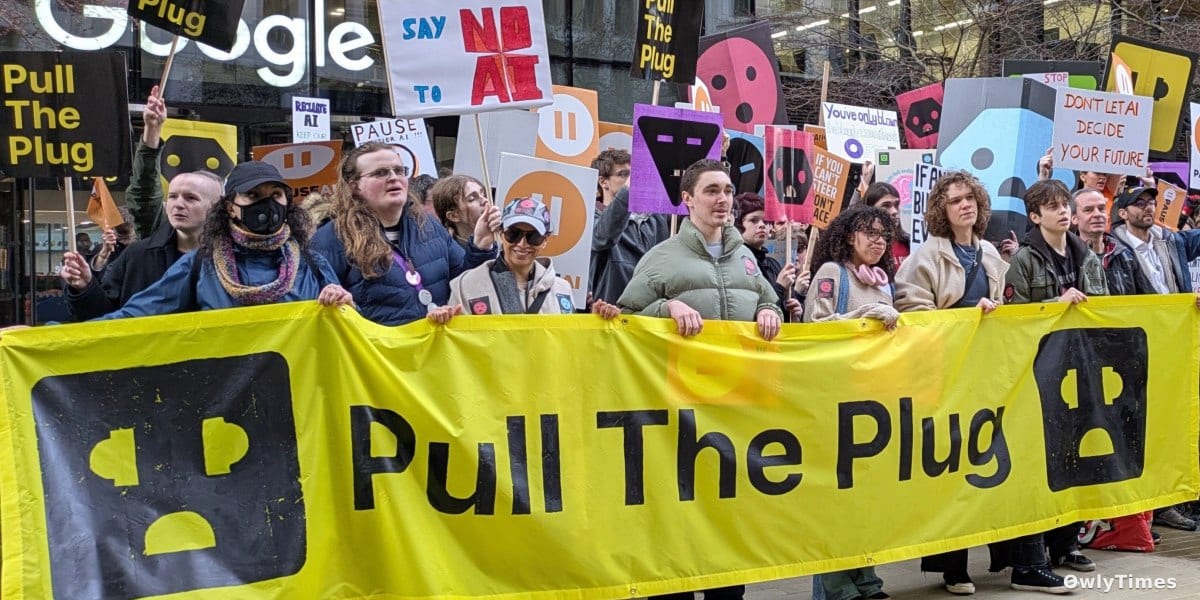

Are we really protesting the algorithms, or are we protesting a future where we have less control? This weekend, roughly 200 demonstrators marched through London’s King’s Cross, the UK hub for tech giants like OpenAI, Meta, and Google DeepMind, chanting slogans like “Pull the plug!” and “Stop the slop!” – a visceral reaction to the accelerating pace of artificial intelligence. The real story here isn't the fear of sentient robots taking over, it’s the growing anxiety that powerful, opaque systems are being deployed with little public oversight, and increasingly, even without the consent of the people whose data fuels them.
The protest, organized by groups Pause AI and Pull the Plug, isn’t some fringe reaction. It’s a symptom of a deeper unease that’s been brewing for years within the research community. As Will Douglas Heaven reports, researchers have been flagging the potential harms of generative AI – models like OpenAI’s ChatGPT and Google DeepMind’s Gemini – for quite some time. But the shift from academic papers to street protests signals a critical turning point: the concerns are now resonating with a broader public, demanding a seat at the table. This isn’t about Luddites smashing looms; it’s about citizens questioning who benefits from these technologies and at what cost.
The recent scramble for government contracts illustrates this power imbalance perfectly. The US government’s initial intention to leverage Anthropic’s AI to analyze bulk data collected from Americans, a move that ultimately fell apart, reveals a disturbing willingness to hand over vast troves of personal information to private companies. The fact that OpenAI quickly stepped in to secure the deal, as reported by The Atlantic, Financial Times, and The New York Times, isn’t just a business win. It’s a demonstration of how easily public data can become a commodity, traded between tech firms and government agencies with minimal transparency. Anthropic’s subsequent vow to legally challenge its “security risk” label only underscores the murky ethical landscape.
Meanwhile, we’re simultaneously building a second, less visible layer of infrastructure above our heads. The number of active satellites orbiting Earth has exploded in the last five years, jumping from around 3,000 to a staggering 14,000 – and that number is still climbing, as Jonathan O’Callaghan details. This isn’t just about better GPS or faster internet. It’s about creating an “anthroposphere,” a dense shell of human-made technology enveloping the planet. We’re so focused on the digital world being built for us, we’re barely acknowledging the physical infrastructure being built around us, and the potential consequences of space debris and orbital congestion. Think of it as a digital gold rush happening simultaneously with a space junk accumulation problem.
Source material: technologyreview.com.
This dual trajectory – the increasing power of AI and the expanding reach of space technology – highlights a fundamental tension. We’re relentlessly pursuing technological advancement, often without fully considering the societal and environmental implications. The recent MIT Technology Review investigation into AI’s energy footprint, a 2026 ASME finalist for reporting, is a prime example. James O’Donnell and Casey Crownhart painstakingly revealed the hidden energy burden of these systems, a story that’s been largely overlooked in the hype cycle. It’s easy to get caught up in the promise of AI-powered solutions, but we need to ask ourselves: at what energy cost, and who bears that burden?
Even seemingly unrelated developments, like the surge in popularity of the discontinued iPod among Gen Z, point to a broader cultural yearning for simpler, more tangible technologies. As Julie Kim notes, the iPad was initially hailed as a revolutionary accessibility tool, but the development of truly useful communication apps for non-speakers has been painfully slow. This isn’t just a tech failure; it’s a failure of imagination, a reminder that technology should serve human needs, not the other way around. The fact that people are actively seeking out older, less “smart” devices suggests a growing disillusionment with the relentless push for constant connectivity and algorithmic control.
Looking ahead, the next six months will be critical. The UK’s trial of a social media ban for under-16s, with overnight digital curfews and screen time limits, is a bold experiment that could reshape our understanding of the impact of social media on young minds. But the real test won’t be whether the ban works, but whether it sparks a broader conversation about digital wellbeing and the responsibility of tech companies to protect their users. Expect to see increased regulatory scrutiny of AI development, particularly around data privacy and algorithmic bias. The question isn’t if governments will intervene, but how effectively they will do so, and whether they’ll prioritize public interest over corporate profits.
My prediction? By the end of 2026, we’ll see a significant rise in “algorithmic audits” – independent assessments of AI systems to identify and mitigate potential harms. The demand for transparency and accountability will be so strong that companies will be forced to open their black boxes, not because they want to, but because they have to. And the first major lawsuit stemming from an AI-driven decision will be filed, not by a tech ethicist, but by an ordinary citizen whose life was demonstrably harmed by an opaque algorithm.