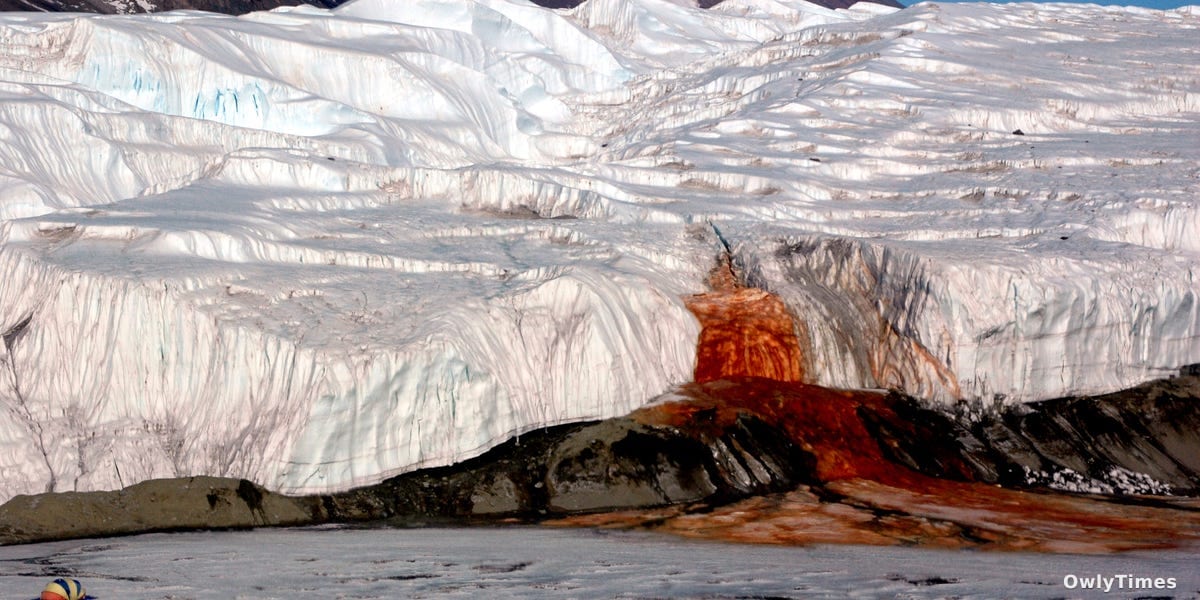

Beyond the Crimson Stain: Unraveling the Mechanics of Antarctica’s Blood Falls
For over a century, the stark, red cascade of Blood Falls in Antarctica’s McMurdo Dry Valleys has captivated and confounded scientists. The initial mystery – what causes the blood-like color – has largely been solved, attributed to iron-rich brine oxidizing in contact with air. However, the more fundamental question of how this brine emerges, and what forces drive its periodic flow, remained elusive. A recent study, published in Antarctic Science, doesn’t just confirm the iron’s role, but reveals Blood Falls as a critical pressure release valve within a complex subglacial system, offering new insights into glacial dynamics and even informing our understanding of planetary geology. This isn’t simply about a visually striking phenomenon; it’s about understanding the hidden hydraulics shaping one of Earth’s most extreme environments.
This piece references the popularmechanics.com report.
The McMurdo Dry Valleys themselves are a crucial point of comparison. Designated an Antarctic Specially Managed Area, these valleys haven’t seen rainfall in approximately two million years, making them one of the most arid places on Earth. This extreme aridity, coupled with frigid temperatures, has led NASA to utilize the region as a terrestrial analog for Mars – a place to test instruments and strategies for future planetary exploration. The presence of Blood Falls, mirroring the “Red Planet’s” coloration, only strengthens this connection. First observed in 1911 by Thomas Griffith Taylor, the falls immediately sparked speculation, but a comprehensive understanding required a convergence of data that only recently became possible.
The breakthrough came in September 2018, thanks to a “serendipitous alignment” of sensor readings collected by Peter Doran of Louisiana State University Baton Rouge and his team. They weren’t specifically looking for the mechanism behind Blood Falls; rather, they were monitoring glacial movement, water temperature in Lake Bonney’s West Lobe (WLB), and visually documenting the falls with a time-lapse camera. As Doran and his co-authors detail, these datasets revealed a crucial correlation: a 15-millimeter drop in the Taylor Glacier, coinciding with an outflow event from Blood Falls and a localized cold-temperature anomaly within the WLB. This synchronous record, as the authors emphasize, highlights the power of multi-sensor monitoring in capturing fleeting but impactful subglacial processes.
What this data reveals is that the immense weight of the Taylor Glacier creates significant pressure on the brine trapped beneath it and within the underlying bedrock. This brine, saturated with iron-containing nanospheres (along with silicon, calcium, aluminum, and sodium), acts as a “hydraulic brake,” slowing the glacier’s movement. Periodically, this pressure overcomes the resistance, and the brine is forced to the surface through a fissure in the glacier, creating Blood Falls. The outflow isn’t a continuous stream, but rather episodic releases responding to shifts in glacial stress and subglacial water dynamics. The iron within the brine then oxidizes upon exposure to air, resulting in the characteristic red hue – a process remarkably similar to the rusting that gives Mars its color.
It’s important to acknowledge the limitations of this study. The data relied on a single GPS station, one time-lapse camera, and a single thermistor string. While the correlation is compelling, it doesn’t provide a spatially comprehensive picture of the subglacial processes at play. Furthermore, the study focuses on a single outflow event; continued monitoring is needed to determine the frequency and variability of these releases. However, the authors rightly point out that even this limited dataset underscores the interconnectedness of glacial dynamics, subglacial hydrology, and the delicate ecosystem within the McMurdo Dry Valleys. Perturbations in lake temperature and nutrient transport, triggered by these brine outflows, could have significant consequences for the microbial life thriving in this extreme environment.
Looking ahead, the next crucial step is expanding the sensor network to provide a more detailed, real-time understanding of the subglacial system. Researchers are planning to deploy additional GPS stations, thermistor strings, and potentially even subglacial radar to map the extent of the brine reservoirs and track their movement. More importantly, understanding how climate change is impacting glacial stability and brine pressure is paramount. Will increased glacial meltwater alter the hydraulic balance, leading to more frequent or larger outflow events? Could this, in turn, disrupt the fragile ecosystem of Lake Bonney? These are the questions that will define the next chapter in the story of Blood Falls – a story that, remarkably, continues to offer insights into both our own planet and the potential for life beyond it.





