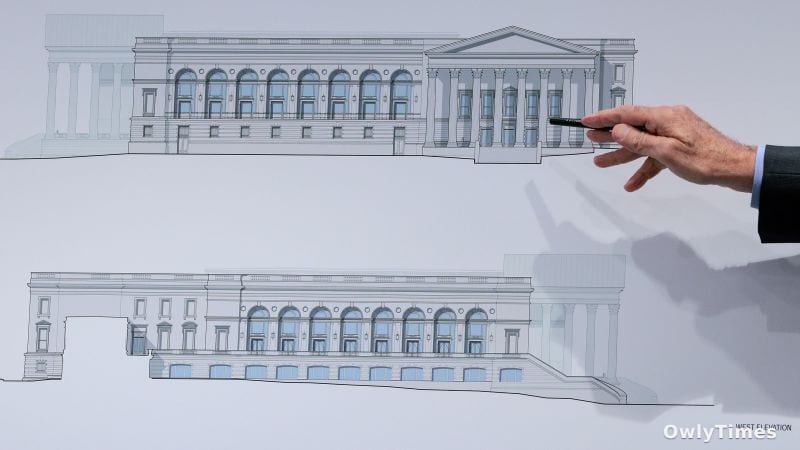

The strategic imperative behind President Trump’s reshaping of the Commission of Fine Arts (CFA) isn’t about aesthetics; it’s about control. As the CFA prepares to evaluate the President’s ambitious East Wing renovation, the deliberate stacking of the commission with political loyalists reveals a calculated effort to bypass independent oversight and ensure swift approval of projects central to his legacy. This isn’t simply a personnel shift; it’s a dismantling of a system designed to provide expert, non-partisan review of federal design, replacing it with a body primed to validate the President’s vision.
The Erosion of Independent Oversight
The CFA, traditionally populated by architects, artists, and landscape designers, serves as a crucial check on presidential ambitions for the nation’s capital. Its role is to advise on the aesthetic impact of federal projects, ensuring they harmonize with the existing architectural fabric of Washington D.C. However, the recent appointments – culminating in this week’s planned swearing-in of Chamberlain Harris, a 26-year-old White House executive assistant with limited arts experience, and Pamela Hughes Patenaude, former deputy secretary of Housing and Urban Development – signal a clear departure from this precedent. The fact that the commission will convene without a single practicing architect reviewing the White House project is not an oversight, but a direct consequence of the President’s deliberate strategy. A source familiar with the commission’s workings predicted, “The commission is stacked with loyalists who will rubber stamp all of the president’s projects,” a sentiment that underscores the perceived futility of expecting critical assessment.
Based on the original CNN report.
Who Benefits and Who Loses?
The immediate beneficiaries are, of course, President Trump and his administration. Securing approval for projects like the East Wing renovation and the proposed National Garden of American Heroes without substantive challenge allows for the rapid realization of a presidential vision, solidifying a tangible legacy. Mary Anne Carter, chair of the National Endowment for the Arts and a close friend of White House chief of staff Susie Wiles, and Roger Kimball, a conservative art critic, represent the ideological alignment driving these appointments. Conversely, those who lose are the principles of independent oversight, the public interest in thoughtful urban planning, and potentially, the aesthetic integrity of the nation’s capital. The sidelining of professional expertise raises concerns about the long-term impact of these projects on the historical and visual landscape of Washington D.C.
A Historical Echo of Executive Power
This maneuver isn’t unprecedented. Throughout American history, presidents have sought to influence the design of the capital to reflect their ideologies and project power. President Lincoln’s interventions in the design of the National Mall, and Franklin D. Roosevelt’s extensive public works projects, demonstrate a presidential desire to leave a lasting mark on the cityscape. However, the current situation differs in its explicit dismantling of the independent review process. Previous presidents generally worked within the system, leveraging their influence to advocate for their visions while still respecting the expertise of advisory bodies. President Trump’s approach is more direct: replace the referees with players who will always call the game in his favor.
The Virtual Review and Limited Public Access
The decision to hold Thursday’s meeting virtually, despite Chairman Rodney Cook’s initial preference for an in-person session with architectural models, further exacerbates concerns about transparency and public engagement. The limited opportunity for public comment – relegated to submitted statements at the chairman’s discretion – and restricted media access are highly unusual for a project of this magnitude. As one source noted, “No project as significant as the ballroom has ever been reviewed by the commission meeting virtually. It’s outrageous.” This constriction of access mirrors a broader pattern of limiting scrutiny surrounding the President’s projects, effectively shielding them from potential criticism. The brief posting and subsequent removal of detailed renderings from the National Capital Planning Commission’s website only reinforces this perception of opacity.
The Next Chess Move: NCPC Approval
The CFA vote is only one hurdle. The project also requires approval from the National Capital Planning Commission (NCPC), where, crucially, President Trump has also been installing loyalists. The NCPC is scheduled to meet on March 5th to discuss the proposal, and this is the next critical point to watch. Will the NCPC follow the CFA’s lead and expedite approval, or will it offer a degree of independent resistance? The President’s stated desire to begin above-ground construction on the East Wing by April creates a tight timeline, intensifying the pressure on the NCPC to align with his agenda. The question isn’t simply whether the East Wing will be renovated, but whether the principles of independent oversight and public engagement will survive the process.





