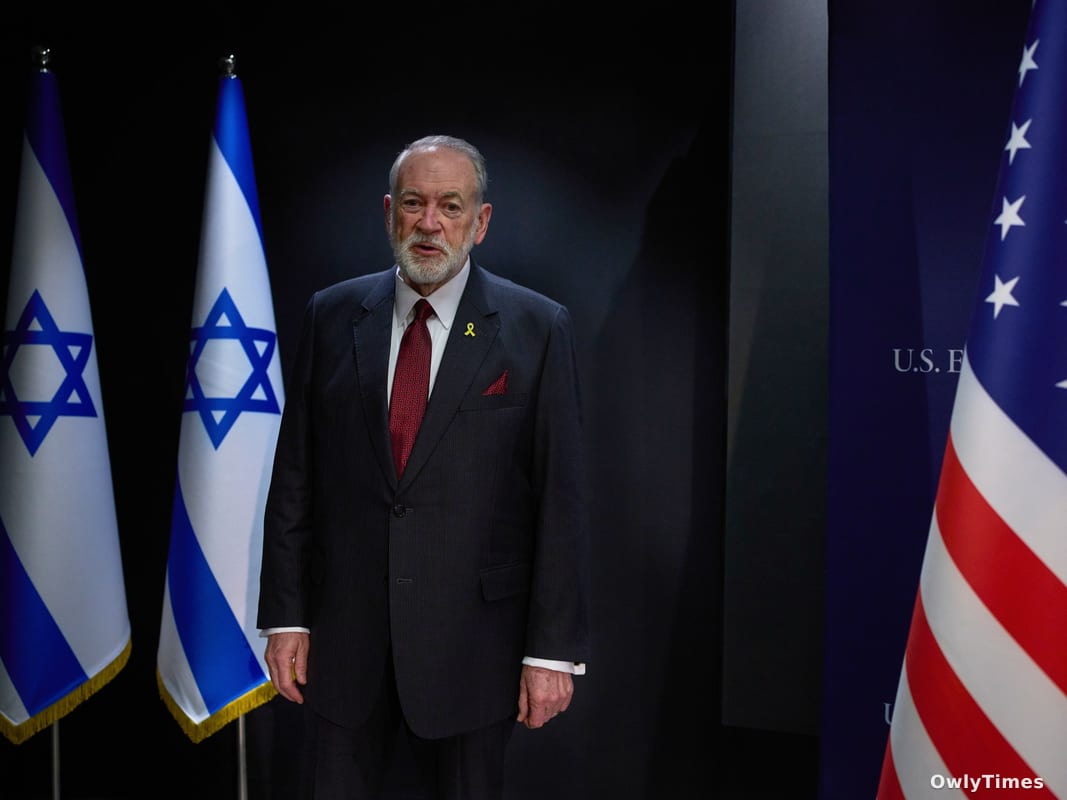

The strategic calculation behind Tucker Carlson’s interview with US Ambassador to Israel Mike Huckabee wasn’t about policy details; it was a calculated probe of a long-suspected power dynamic: the degree to which American officials prioritize a foreign nation’s interests over those of the United States. The resulting uproar, spanning the political spectrum, isn’t merely about controversial statements – it’s about a potential fracturing of the decades-long consensus of unconditional US support for Israel, and the emerging political risks associated with openly prioritizing that relationship. The interview, released Friday, has rapidly become a litmus test for American politicians navigating a shifting electorate and a growing awareness of the costs of this alliance.
The Ambassador’s Loyalty and the Shifting Narrative
Mike Huckabee’s performance in the interview wasn’t a deviation from his established record; as a Baptist minister, former governor of Arkansas, and confirmed ambassador in April 2025, he’s consistently been identified as a “true friend of Israel.” However, the context – a pointed interrogation by a prominent conservative voice – amplified the implications of his statements. Huckabee repeatedly echoed Israeli talking points, referencing Israel’s “biblical right” to the land and referring to the occupied West Bank as “Judea and Samaria.” More critically, he appeared to endorse further Israeli territorial expansion and framed Israeli concerns – such as the situation on the Lebanon border – as inherently American interests. This isn’t simply diplomatic alignment; it’s a blurring of national identity, suggesting a prioritization of Israeli security concerns as if they were US security concerns. The defense of Jonathan Pollard, the American convicted of spying for Israel, and the subsequent advocacy for his release, further underscores this pattern.
This article draws on reporting from Al Jazeera.
Who benefits and who loses from this open display of allegiance? Israel clearly benefits from having a US ambassador actively advocating for its positions, even at the expense of appearing to contradict US policy. Conversely, the United States loses a degree of diplomatic independence and risks appearing beholden to a foreign power. The Palestinian population, already facing dire circumstances in Gaza, loses any semblance of a fair-minded advocate within the US government. The most immediate loss, however, may be to Huckabee himself, as the backlash demonstrates the growing political cost of such overt alignment.
Historical Echoes of Foreign Influence
The situation isn’t unprecedented in American history. Throughout the 20th century, concerns about foreign influence shaped US foreign policy debates. The debate over neutrality during World War I, for example, centered on anxieties about American entanglement in European conflicts and the potential for undue influence from both sides. Similarly, the Red Scare of the McCarthy era was fueled by fears of Soviet infiltration and subversion. However, the current situation differs in its nature. Unlike past anxieties about ideological subversion, the concern now centers on a powerful lobby – both financial and political – actively shaping US policy in favor of a foreign government.
This dynamic has been documented for decades by academics like John Mearsheimer and Stephen Walt, whose work on the Israel lobby was initially dismissed as fringe but is now gaining wider traction. What’s new is the breach into mainstream conservative discourse, traditionally a staunch defender of Israel. Donald Trump’s repeated claims of being “the best friend to Israel” and Joe Biden’s self-professed Zionism, while consistent with decades of US policy, now appear as part of a pattern that is being openly questioned. Even figures like South Carolina Senator Lindsey Graham and former New York City Mayor Eric Adams have publicly emphasized their personal commitment to Israel, blurring the lines between American and Israeli interests.
The Carlson Factor and the Rightward Shift
The significance of the Carlson-Huckabee interview lies not just in the content, but in the messenger and the venue. Carlson, a highly influential conservative media figure, chose to conduct the interview in Israel, signaling a deliberate challenge to the established narrative. His line of questioning – probing the theological basis of Zionism, criticizing Israel’s treatment of Palestinian Christians, and questioning the allocation of US tax dollars – was designed to provoke a response and expose the underlying tensions.
The interview’s impact on the American right is particularly noteworthy. For years, questioning Israel’s policies was considered taboo within conservative circles, often equated with anti-Semitism. Carlson’s willingness to challenge this orthodoxy has opened a space for a more critical discussion, forcing even staunch supporters of Israel to reassess their positions. Huckabee’s defensive reaction and the subsequent social media fallout demonstrate that openly prioritizing Israel over America is no longer a politically safe position, even within the conservative movement. Polling data reflecting a dramatic shift in American public opinion towards Israel further reinforces this changing calculus.
The Next Political Chess Move
The interview didn’t create this shift, but it brought it into the open, particularly on the right. The political incentive for unconditional support for Israel is demonstrably weakening. The question now isn’t whether this trend will continue, but how American politicians will respond. The political chess move to watch is whether, and when, a prominent US politician will openly advocate for conditioning aid to Israel on its adherence to international law and respect for Palestinian rights. The current administration has already signaled a willingness to use leverage, however limited, in its dealings with Benjamin Netanyahu’s government. But a more fundamental shift – a willingness to publicly challenge the long-held assumption that Israel’s interests automatically align with US interests – will require a politician willing to risk the wrath of the pro-Israel lobby and embrace a more independent foreign policy. The next election cycle will reveal whether such a politician exists.





