
China's AI Ambitions Clash with US Security Concerns as New Models Emerge
Is the global AI race shifting tectonic plates faster than we can track? It appears so. Just as Silicon Valley grapples with its own internal dramas, a significant power play is unfolding from the East, challenging long-held assumptions about technological parity. The real story here isn't just about a new AI model; it's about a potential reordering of the global AI landscape, fueled by China's rapid advancements and complicated by escalating cybersecurity accusations.
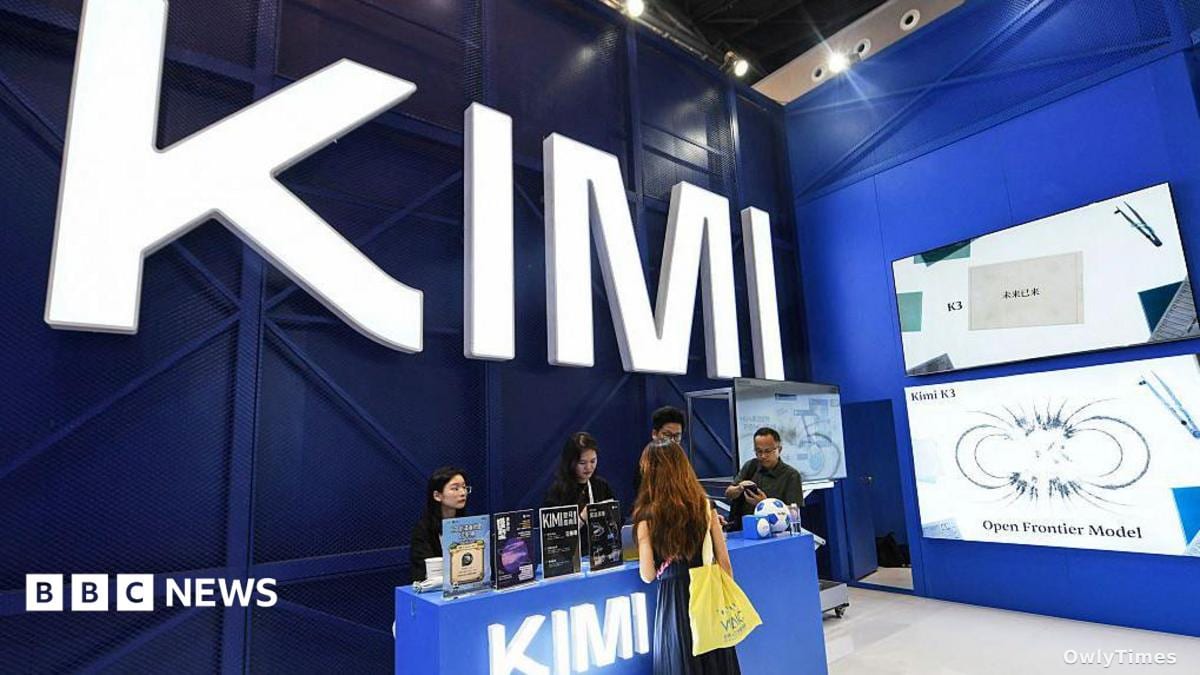
Chinese AI startup Moonshot has thrown down a gauntlet, unveiling its Kimi K3 model, which boasts an astonishing 2.8 trillion parameters. Both the BBC and CBS News confirm the model's immense scale, a key indicator of an AI's processing power. This massive leap suggests that China's tech prowess is rapidly closing the gap with leading American firms like OpenAI and Anthropic. The BBC notes that Kimi K3 is slated for an open-source release on July 27th, which would make it the world's first model in the three-trillion-parameter class available for free download and customization by developers globally. This move directly challenges the proprietary, closed systems that have dominated the US market.
The timing of Kimi K3's arrival is particularly noteworthy. It follows closely on the heels of the US government's abrupt demand that Anthropic temporarily withdraw its Fable and Mythos models due to "severe cybersecurity concerns," as reported by the BBC. While those restrictions have since been lifted, the incident underscored how the US government now views advanced AI as critical national infrastructure, subject to stringent export controls. The BBC highlights that China's rapid progress with Kimi K3, despite US restrictions on hardware sales, indicates Chinese firms are successfully navigating these barriers and advancing independently.
Adding another layer of complexity to this unfolding narrative, CBS News reported on July 8, 2026, that China's National Vulnerability Database (NVDB), affiliated with the Ministry of Industry and Information Technology, warned of a "security backdoor" in versions of Anthropic's Claude Code coding tool. The alleged backdoor could potentially transmit sensitive user information, including locations and identity identifiers, back to Anthropic's servers without consent. While Anthropic has not yet responded to requests for comment, CBS News notes that an engineer from the company, Thariq Shihipar, previously stated on X that the feature was an experiment launched in March to prevent account abuse and protect against "distillation," a process where one AI model mimics another. He indicated that stronger mitigations had been implemented and the feature was intended to be removed.
This accusation from the NVDB is significant. CBS News reports that Chinese tech giant Alibaba had already informed employees last week of a ban on Claude Code starting July 10th due to security concerns. This development is particularly interesting given Anthropic's past accusations against Alibaba for allegedly reverse-engineering its AI models.
Meanwhile, the fundamental infrastructure powering these advanced AI models is also undergoing a shake-up. TechCrunch reported on Monday that Infinity, an AI infrastructure startup, has secured $15 million in funding at a $100 million valuation. Investors include Touring Capital, Principal VC, and crucially, researchers from both OpenAI and Anthropic. Infinity is developing software designed to make it easier for AI chips to run AI models, aiming to create a "CUDA-alternative kernel software" that works across various chip architectures. This move directly challenges Nvidia's long-standing dominance, which has been built on its high-performance chips and its proprietary CUDA software.
Jeremy Nixon, the founder of Infinity and a former researcher at Google Brain, told TechCrunch that his company's AI research agent, Ignition, is intended to write low-level code for AI inference on chips that are not Nvidia-based. This self-optimizing system can test, debug, and automatically rewrite code to improve hardware performance, adapting to different chip architectures. Infinity's business model involves taking a cut of performance gains and cost savings rather than upfront licensing fees, a strategy designed to incentivize adoption. TechCrunch also mentions that Infinity has 26 employees and is in talks with other major chip and cloud companies, with D-Matrix already listed as a customer.
The emergence of Kimi K3, coupled with the cybersecurity allegations surrounding Anthropic's Claude Code and the infrastructure innovation by Infinity, paints a picture of a rapidly evolving global AI ecosystem. The US government's focus on national security in AI and China's rapid independent development are creating a dynamic tension. The real story here isn't just about faster processors or more parameters; it's about who controls the foundational technology and how those controls will impact global innovation and security.
Looking ahead, the July 27th open-source release of Kimi K3 will be a critical juncture. Its actual performance and the extent to which it can be freely modified by developers worldwide will reveal the true impact of this breakthrough, potentially forcing a significant recalibration of strategies for Western AI companies and investors alike.