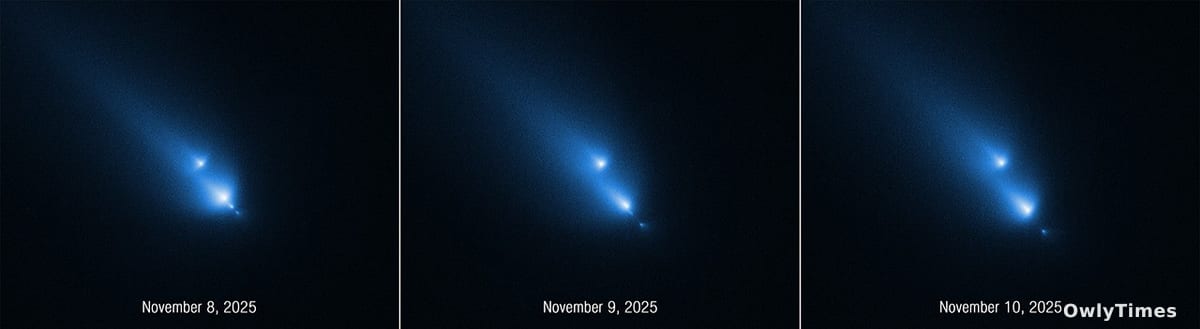

The question of how comets die – not if, but how – has long captivated planetary scientists. These icy relics from the solar system’s formation offer a glimpse into its earliest days, but their fragility makes observing their disintegration a rare and fleeting opportunity. Recent observations from NASA’s Hubble Space Telescope have unexpectedly provided just such an opportunity, capturing a comet, designated C/2025 K1 (ATLAS), in the very act of breaking apart. While headlines proclaim a “comet explosion,” the reality, as revealed by the data and the researchers involved, is a far more nuanced and valuable scientific event.
The serendipitous nature of this discovery is key. K1, distinct from the interstellar comet 3I/ATLAS, wasn’t the primary focus of the Hubble observation when the study, published in Icarus, began. A scheduling conflict forced John Noonan, a research professor in the Department of Physics at Auburn University in Alabama, and his team to switch targets. “Sometimes the best science happens by accident,” Noonan remarked, highlighting the unpredictable path of astronomical discovery. It was only upon reviewing the images the day after they were taken that he realized the initial single target had become four distinct cometary bodies, each surrounded by its own fuzzy coma – the cloud of gas and dust enveloping the nucleus.
Drawn from science.nasa.gov.
This isn’t simply a case of witnessing a comet’s demise; it’s the timing of the observation that’s revolutionary. Previous observations of fragmented comets have typically captured them weeks or even months after the initial breakup. Dennis Bodewits, principal investigator and also a professor at Auburn University’s Department of Physics, noted the “irony” of studying a ‘regular’ comet only to have it crumble before their eyes. Crucially, Hubble documented K1’s fragmentation just a month after its closest approach to the Sun – perihelion – when the comet experienced peak heating and stress. This proximity to perihelion, inside Mercury’s orbit, is where long-period comets like K1 are most vulnerable to disintegration. Before the breakup, K1 was estimated to be roughly five miles across, a size considered average for cometary nuclei.
The images reveal a fascinating puzzle: a delay between the comet’s physical fragmentation and a corresponding increase in brightness as observed from Earth-based telescopes. One might expect that exposing fresh ice would immediately result in a brighter reflection of sunlight. However, the team’s initial analysis suggests a more complex process. They hypothesize that a layer of dust must first form over the exposed ice, then be ejected by escaping gases, creating the visible brightening. Alternatively, heat may need to penetrate the surface, build pressure, and then release a shell of dust. This delay challenges existing models of cometary activity and suggests a more intricate interplay between ice, dust, and solar radiation than previously understood.
It’s important to acknowledge the limitations to consider. While Hubble’s resolution allowed the team to trace the fragments back to their origin, reconstructing the timeline relies on assumptions about the comet’s initial velocity and trajectory. Furthermore, the analysis of the comet’s composition is ongoing. Preliminary ground-based observations indicate K1 is unusually depleted in carbon compared to other comets, a finding that raises questions about its formation environment. Detailed spectroscopic analysis using Hubble’s Space Telescope Imaging Spectrograph (STIS) and Cosmic Origins Spectrograph (COS) instruments is expected to provide a more complete picture of K1’s chemical makeup and its place in the early solar system.
The fragments of K1, now approximately 250 million miles from Earth and receding into the outer solar system, represent a unique opportunity to study primordial materials. Comets are often described as “dirty snowballs,” remnants from the solar system’s formation. But as Bodewits points out, they aren’t pristine; they’ve been altered by solar radiation and cosmic rays over billions of years. By observing a comet actively breaking apart, scientists can access material that has remained largely untouched since the solar system’s birth, offering clues to its composition and evolution. The next steps involve a thorough analysis of the gases released during the fragmentation process, coupled with the detailed compositional data from Hubble’s spectrographs. The key question now is whether the observed carbon depletion is a unique characteristic of K1, or a more widespread phenomenon among long-period comets, potentially reshaping our understanding of the building blocks of planets.





