
The search for life beyond Earth often focuses on identifying habitable environments – places with liquid water, a source of energy, and the right chemical ingredients. But a new study, published this week in The Journal of Geophysical Research: Planets, suggests that some of those ingredients might not have arisen within those environments, but were delivered to them, fully formed, during the chaotic birth of our solar system. This isn’t simply about finding the right address for life; it’s about reconsidering how fully equipped those addresses were from the start. While headlines proclaim “life’s building blocks delivered to Jupiter’s moons,” the nuance of the research lies in understanding how those building blocks survived a process typically thought to be destructive to complex organic chemistry.
A Solar System Nursery and the Preservation of Complexity
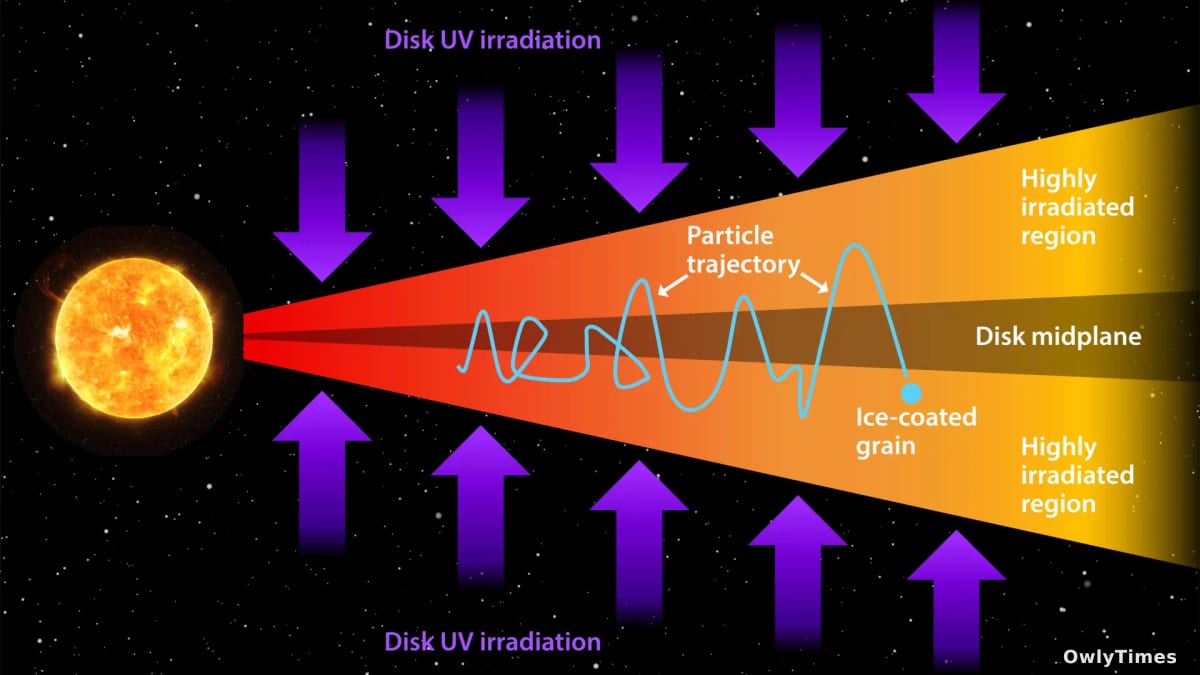
For decades, the prevailing theory held that complex organic molecules – the carbon-based compounds crucial for life as we know it – formed later in the solar system’s history, within the protective environments of asteroids, comets, or even on planetary surfaces. The early solar system was a violent place, filled with intense radiation and high temperatures. These conditions would normally break down complex molecules into simpler ones. However, a team led by Dr. Alice Chau, a research scientist at NASA’s Ames Research Center, used computer modeling to simulate the conditions in the protoplanetary disk surrounding the young Sun, roughly 4.5 billion years ago. Their simulations focused on the region where Jupiter formed, and crucially, the disk around Jupiter itself as its moons coalesced. The team discovered that the swirling gas and dust within these disks could actually shield organic molecules, preventing their destruction by radiation.
The modeling specifically examined the formation of formaldehyde (H₂CO) and methanol (CH₃OH), relatively simple but vital organic compounds. These aren’t life itself, but they serve as precursors to more complex molecules like amino acids and sugars. Dr. Chau explained in a press briefing that “we found that up to half of the icy material that eventually formed the moons Europa, Ganymede, and Callisto could have contained these pre-made organic compounds.” This is a significant figure; previous estimates suggested any organic material would have been largely destroyed before incorporation into the moons. The team’s calculations indicate that the shielding effect of the disk allowed these molecules to persist, effectively “baked in” to the moons’ composition during their formation. This contrasts sharply with scenarios where organic molecules are delivered later via impacts, which often involve significant heating and potential destruction.
Drawn from sciencedaily.com.
Beyond the Sun: Implications for Exoplanet Research
This research isn’t solely about our own solar system. The processes modeled by Dr. Chau’s team are likely universal. Protoplanetary disks are a natural byproduct of star formation, and the shielding effect they identified would apply to any young planetary system. This has profound implications for the search for life on exoplanets – planets orbiting other stars. If complex organic molecules can be preserved during planet formation, it dramatically increases the probability that habitable worlds elsewhere in the galaxy are already equipped with the necessary chemical building blocks. “It suggests that the initial conditions for life might be more common than we previously thought,” stated Dr. Oliver Baum, a co-author on the study from the University of Cologne. He cautioned, however, that “having the ingredients isn’t enough. You still need the right environment for those ingredients to assemble into something living.”
The study’s methodology involved sophisticated hydrodynamic simulations, tracking the movement and chemical evolution of gas and dust within the disks. These simulations were then coupled with chemical kinetics models, which calculated the rates of formation and destruction of the organic molecules. The team validated their models by comparing the predicted abundances of formaldehyde and methanol with observations of similar molecules in star-forming regions. This rigorous approach strengthens the credibility of their findings, moving beyond speculation to a data-driven understanding of early solar system chemistry.
Limitations to Consider: Modeling the Unknown
Despite the robust methodology, several limitations must be acknowledged. The simulations relied on assumptions about the composition and density of the protoplanetary disk, which are not fully known. While the team used observational data to constrain these parameters, there remains inherent uncertainty. Furthermore, the models focused on only two specific organic molecules – formaldehyde and methanol. While these are important precursors, they represent only a small fraction of the vast array of organic compounds that could be relevant to life. The study also doesn’t address the subsequent evolution of these molecules within the icy moons themselves. While they were delivered intact, their long-term stability and potential for further reactions remain open questions.
It’s also important to note that the “up to half” figure refers to the mass of icy material containing the organic compounds, not the percentage of the total organic inventory. A smaller percentage of highly concentrated organic material could have the same overall impact. Finally, the simulations didn’t account for the potential influence of magnetic fields, which could also play a role in shielding organic molecules.
The Next Steps: From Models to Missions
The next crucial step is to test these predictions with direct observations. The Europa Clipper mission, scheduled to launch in 2024, will conduct detailed reconnaissance of Europa, searching for evidence of organic molecules in its subsurface ocean. While Clipper won’t be able to directly sample the ocean, its instruments will analyze plumes of water vapor erupting from the moon’s surface, potentially revealing the composition of the hidden ocean below. Similarly, the JUICE (Jupiter Icy Moons Explorer) mission, launched by the European Space Agency in April 2023, will study Ganymede and Callisto, providing further insights into the chemical makeup of these icy worlds.
Looking further ahead, future missions might involve robotic landers capable of drilling into the icy surfaces and directly analyzing the composition of the subsurface material. But even before those missions return data, scientists will continue to refine the models, incorporating more complex chemistry and accounting for the influence of magnetic fields. The central question now isn’t just if life could exist on these moons, but how readily the necessary ingredients were available from the very beginning. And that, ultimately, will shape our understanding of life’s potential throughout the universe.