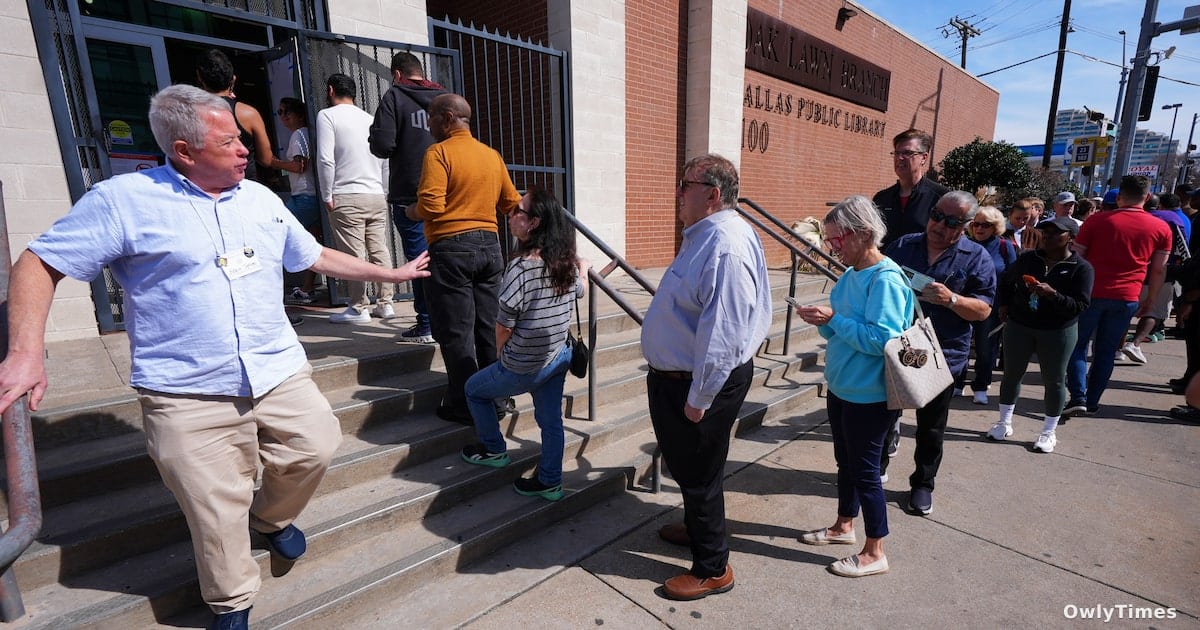

The decision by the Dallas County Commissioners Court to reinstate separate primary elections, effectively partitioning voters by party affiliation, isn’t a regression to a bygone era of overt discrimination – it’s a calculated move to solidify partisan control and reshape the local political landscape. While framed as a response to concerns about election worker impartiality and voter privacy, the shift reveals a deeper strategic calculus: to increase turnout within each party’s base and empower a vocal minority of Republican precinct chairs who drove the decision. This isn’t simply about logistical efficiency, as proponents claim; it’s about leveraging the mechanics of elections to achieve a desired political outcome.
The echoes of “separate but equal” are unavoidable, as Rev. Amy W. Moore rightly points out, referencing the historical stain of the 1896 Plessy v. Ferguson ruling and the Jim Crow era. Though the Dallas County decision isn’t explicitly based on race, the psychological effect of directing voters through partisan “doors” – creating an “aura of judgment,” as Moore describes – reinforces a pattern of division. This division isn’t organic; it’s manufactured through the structure of the election itself. The Dallas County Elections Department previously updated its software to ask voters for their party affiliation on a tablet, circumventing the need for election workers to inquire, demonstrating a viable alternative to the current system. The reversal suggests the issue wasn’t practicality, but preference.
Who benefits and who loses from this change? The immediate beneficiaries are the roughly 200 Republican precinct chairs – a majority of whom were present at the county executive committee meeting and voted for the separation – who now have a clearer path to mobilizing their base. Dallas County, with over 790 precincts and a majority Democratic electorate, sees a potential increase in administrative costs and logistical complexity. More significantly, the broader electorate loses. The shared experience of voting, regardless of party, fosters a sense of civic unity. Separating voters subtly reinforces the narrative of irreconcilable differences, potentially exacerbating political polarization. Bonnie L. Mathias’s observation that elections have consequences is particularly apt here – the consequences are not merely about who wins, but about the kind of civic culture the process cultivates.
Original reporting: dallasnews.com.
The timing of this decision is also revealing. It coincides with a broader national trend of increasingly restrictive voting measures, often justified under the guise of election security. However, as numerous studies have shown, voter fraud is not a widespread problem. The focus on perceived threats to election integrity often serves as a pretext for policies that disproportionately impact certain demographics and suppress voter turnout. This echoes historical precedents, where restrictions on voting rights were often implemented to disenfranchise specific groups and maintain the power of the dominant class. The Texas Legislature’s frequent revisions to the election code, even when unnecessary, as Mathias notes, demonstrate a willingness to manipulate the rules of the game for political advantage.
Beyond the local implications, the broader letters to the editor reveal a simmering discontent with the current political climate. Devin Johnson’s frustration with the deluge of negative political mailers highlights a growing fatigue with partisan attacks and a desire for substantive policy discussions. Ronald Briggs points to the unintended consequences of protectionist policies, arguing that the “war” against foreign interests ultimately harms American citizens. Even commentary on the presidential race, from Judy Giese, frames Donald Trump’s approach to Ukraine as indicative of a lack of genuine commitment to peace. These seemingly disparate concerns converge on a common theme: a distrust of political maneuvering and a yearning for authentic leadership.
The political chess move to watch next isn’t whether the separate primaries will increase turnout – that’s almost guaranteed. It’s whether the Democratic Party will respond in kind, further escalating the partisan divide, or whether they will attempt to leverage the situation to highlight the Republican Party’s embrace of division and appeal to moderate voters. The answer to that question will determine whether Dallas County’s experiment in partisan partitioning becomes a model for other jurisdictions, or a cautionary tale about the dangers of prioritizing political advantage over civic unity.





