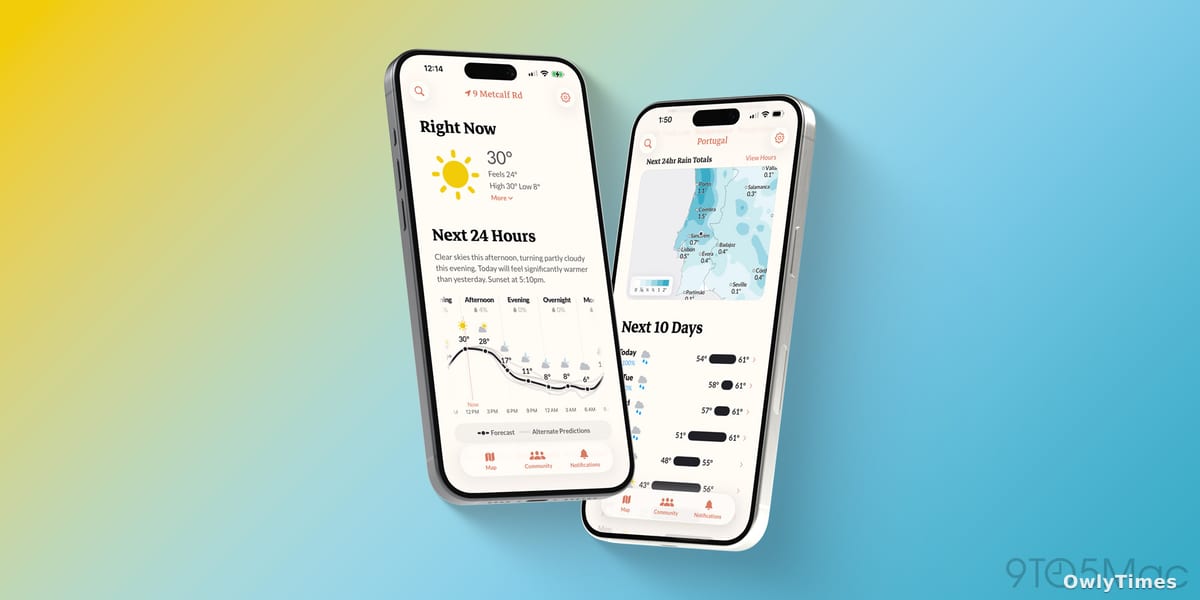

Is the future of weather forecasting admitting you’re probably wrong? That’s the surprisingly radical proposition behind Acme Weather, the new iPhone app from the team that brought you Dark Sky – and, briefly, into the belly of the Apple beast. The real story here isn't just another weather app hitting the App Store; it’s a quiet rebellion against the Silicon Valley obsession with presenting algorithms as infallible, and a surprisingly human approach to a data-driven problem.
For those who don’t remember the pre-Apple Weather days, Dark Sky was the weather app. Launched in 2014, it distinguished itself with hyperlocal, minute-by-minute forecasts, a sleek interface, and a devoted following. Apple acquired the company in March 2020, promising to integrate Dark Sky’s technology into its own native Weather app. They did, to a degree, but ultimately shuttered Dark Sky in January 2023, leaving a void for users who valued its granular detail and, frankly, its accuracy. The team, led by co-creator Adam Grossman, spent time within Apple, contributing to WeatherKit, Apple’s weather API for developers. But something wasn’t right.
Original reporting: 9to5mac.com.
“We enjoyed our time at Apple,” Grossman wrote in a blog post explaining their departure. “But…we found ourselves feeling unsatisfied.” That dissatisfaction, it turns out, stemmed from a fundamental disagreement about how weather forecasts should be presented. Most apps, including Apple’s, offer a single “best guess” – a confident prediction that often feels…well, confidently wrong. Acme Weather flips that script with its core feature: Alternative Forecasts.
The idea is elegantly simple. Weather is chaotic. No model, no matter how sophisticated, can perfectly predict the future. Instead of pretending otherwise, Acme Weather presents a range of plausible outcomes. Imagine a forecast for rain. Instead of a single line indicating a 3 PM shower, you’ll see a cluster of lines showing the storm could arrive anywhere between 2 PM and 4 PM. The wider the spread, the less certain the forecast. As Grossman explains, it’s a visual cue to “check other conditions or maps, or come back to the app more frequently.” This isn’t about dumbing down the science; it’s about acknowledging its inherent limitations.
This approach feels particularly relevant in an era where we’re increasingly reliant on algorithmic predictions – from stock market forecasts to political polls. The temptation to treat these outputs as gospel is strong, even when they’re demonstrably flawed. Acme Weather is a small but significant pushback against that tendency. It’s a reminder that data is a tool for understanding, not a substitute for critical thinking. The app pulls data from multiple sources – “numerical weather prediction models, satellite data, ground station observations, and radar data” – but doesn’t present that synthesis as absolute truth.
Beyond the Alternative Forecasts, Acme Weather offers a familiar suite of features: detailed maps for radar, lightning, temperature, and more; robust notification options (including, delightfully, a “rainbow might be visible” alert); and a community reporting system. It’s a polished, thoughtfully designed app, but the real innovation lies in its philosophical underpinnings. At $25 per year, it’s pricier than many competitors, but that cost reflects a commitment to providing not just data, but context and transparency. 9to5Mac’s Chance Miller noted the app’s ability to distill complex information into a readable interface, a crucial element for a feature that could easily become overwhelming.
The Dark Sky team’s return isn’t just a story about a better weather app. It’s a case study in the challenges of integrating independent innovation into a large tech company. Apple acquired Dark Sky for its technology, but perhaps underestimated the value of its approach – its willingness to embrace uncertainty and prioritize user understanding. The question now is whether this more honest, nuanced approach to forecasting will resonate with a public accustomed to the illusion of algorithmic certainty. My prediction? Expect to see other weather apps, and even other data-driven services, begin to incorporate elements of this “probabilistic forecasting” model. The future isn’t about predicting what will happen – it’s about preparing for what might happen. And that requires acknowledging that even the smartest algorithms can be wrong.