
How much trust are you willing to place in an automated janitor that occasionally decides your front door is a security threat? For enterprise IT departments, that question stopped being theoretical on April 30, 2026, when a routine update to Microsoft Defender turned into a digital demolition crew.
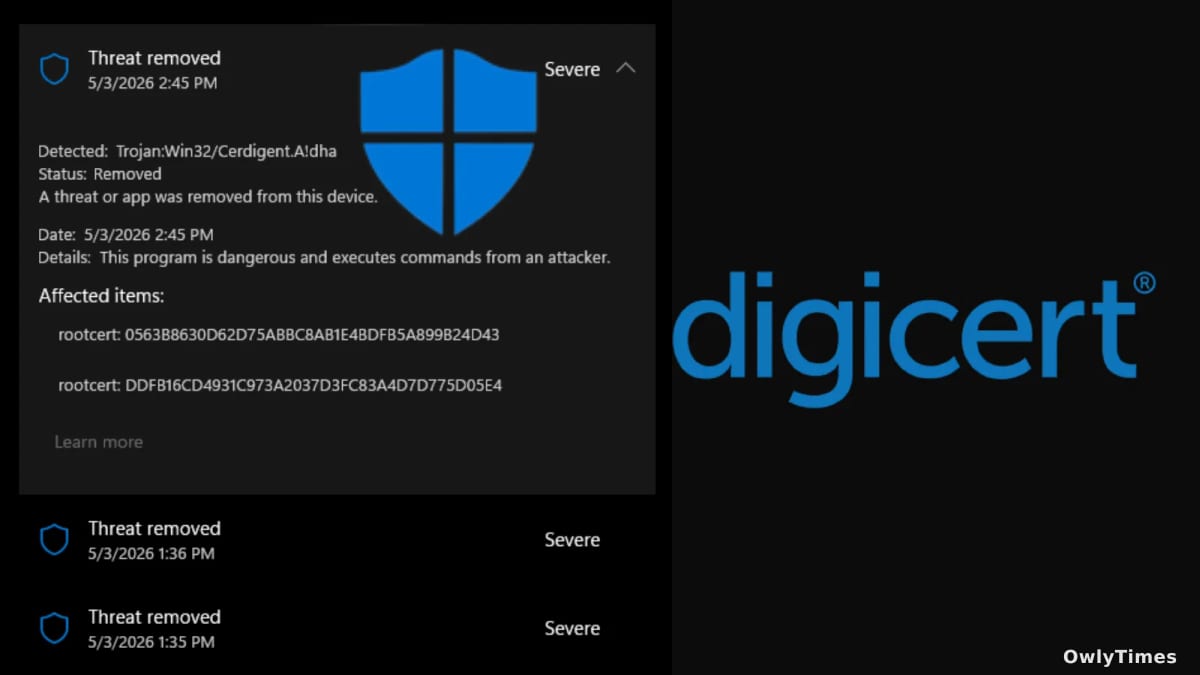
The real story here isn't just a software bug—it’s the terrifying fragility of our automated security infrastructure. When Microsoft deployed a signature update labeled Trojan:Win32/Cerdigent.A!dha, it didn’t just target malware; it targeted the very foundation of the internet's identity system. The update incorrectly flagged two essential root certificates—DigiCert Assured ID Root CA (thumbprint: 0563B8630D62D75ABBC8AB1E4BDFB5A899B24D43) and DigiCert Trusted Root G4 (thumbprint: DDFB16CD4931C973A2037D3FC83A4D7D775D05E4)—as high-severity threats.
When the Guard Becomes the Saboteur
In the world of cybersecurity, root certificates are the digital equivalent of a government-issued passport. They allow your computer to verify that the website you’re visiting or the software you’re installing is legitimate. By quarantining these specific entries, Defender essentially revoked the "passports" for a vast swath of the web.
This isn't just an annoyance for a single user; it is an enterprise-level crisis. When these certificates vanish from the Windows trust store, systems stop trusting the outside world. This triggers a cascade of failures: SSL/TLS connections to websites break, and legitimate software fails to run because its digital signature can no longer be verified. For an average employee, this manifests as a sudden, inexplicable inability to access company portals or run internal applications, turning a simple workday into a troubleshooting nightmare.
The Role of the Independent Watchdog
As the chaos unfolded, the tech giant’s internal quality control appeared to be trailing behind the security community. Cybersecurity researcher Florian Roth (@cyb3rops) emerged as a critical node in the response, using his platform on X to alert administrators to the scope of the issue.
Roth didn’t just highlight the problem; he provided the tools for the fix. He shared an Advanced Hunting query for Microsoft Defender for Endpoint and a command-line check—certutil -store AuthRoot | findstr -i "digicert"—that allowed IT teams to see if their machines were effectively "blinded" by the update. His intervention served as a vital bridge while Microsoft worked to push out a correction.
The Cost of Over-Automated Security
Microsoft eventually responded with version .430, a definition update designed to restore the quarantined certificates. While the company moved to deploy this fix automatically, the incident highlights a glaring contradiction in modern tech: the tools we use to stay safe are now complex enough to become the primary vectors of system instability.
We have reached a point where the speed of automated threat remediation often outpaces the rigor of human oversight. The Cerdigent incident proves that even the most trusted security platforms can become a single point of failure when they target foundational components like the root certificate store.
The next reading of Advanced Hunting logs in environments with restricted update policies will indicate whether the restoration of these certificates was truly complete or if hidden, residual service disruptions remain. For the ordinary user, the lesson is clear: in the race to automate defense, the most dangerous malware might just be the "remediation" you downloaded this morning.