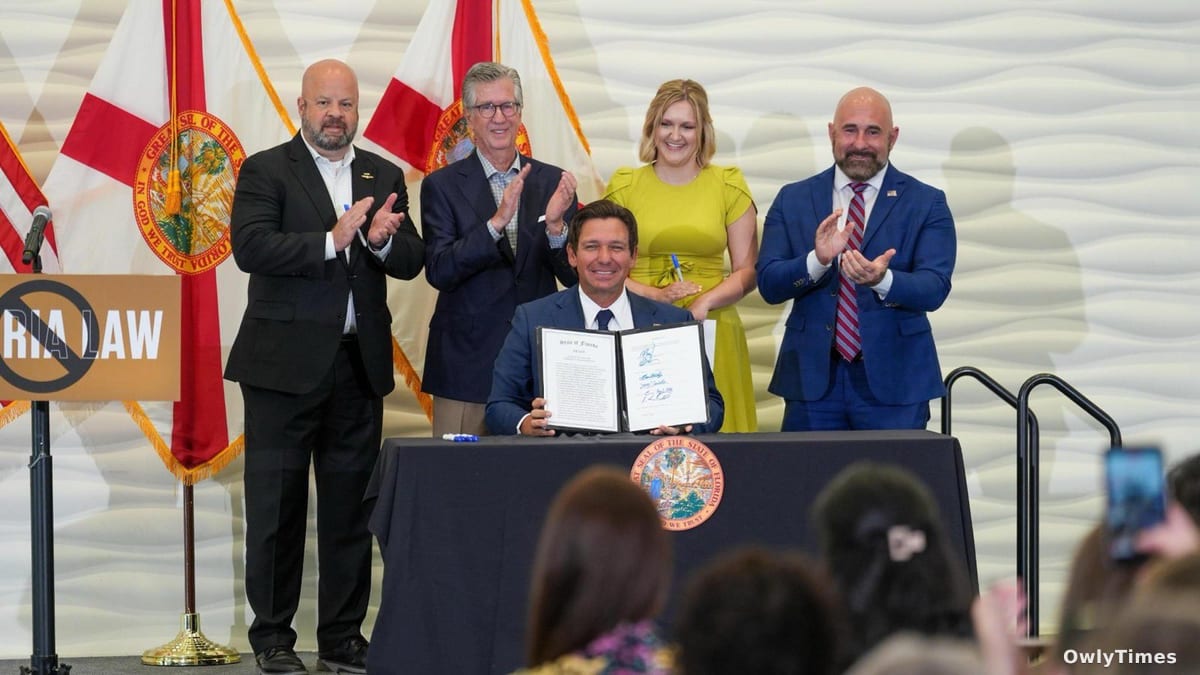

The Calculus of Control: Florida’s New Domestic Terrorism Law
The signing of HB 1471 by Ron DeSantis isn’t simply about responding to perceived threats; it’s a strategic consolidation of power, mirroring historical expansions of executive authority during times of perceived national crisis. The law, granting the state unprecedented ability to designate “domestic terrorist organizations” and penalize associated individuals – particularly college students – isn’t a reactive measure, but a proactive attempt to shape the political and ideological landscape of Florida ahead of the 2024 election cycle and beyond. The stated justification – protecting Floridians and their tax dollars – serves as a rhetorical shield for a move that fundamentally alters the balance between state power and individual liberties. This isn’t an isolated incident; it’s a continuation of a pattern observed throughout American history, from the Alien and Sedition Acts of 1798 to the post-9/11 Patriot Act, where security concerns are leveraged to expand governmental reach.
The core mechanism of HB 1471 rests with the Florida Department of Law Enforcement (FDLE), specifically its Chief of Domestic Security, who can now flag organizations for potential designation. This list requires final approval from DeSantis and his Cabinet, effectively centralizing the decision-making process. The law’s impact extends beyond mere labeling. Public schools are prohibited from funding designated groups, and state funds can be withheld from colleges and universities that “promote” them. For students, the consequences are particularly severe: immediate expulsion and subsequent out-of-state tuition fees. The inclusion of visa status reporting requirements adds another layer of complexity, potentially impacting international students involved in activities deemed suspect. Jay Collins, the Lieutenant Governor, frames the law as having “real teeth,” and that assessment is accurate – the penalties are designed to be demonstrably impactful.
Who benefits and who loses from this legislation? DeSantis clearly stands to gain. By positioning himself as a staunch defender against extremism, he reinforces his base and potentially broadens his appeal to voters concerned about security. The law also allows him to preemptively discredit potential political opponents by associating them with designated groups. Conversely, the immediate losers are likely to be students and organizations engaged in political activism, particularly those on the left. The vagueness of the term “promoting” creates a chilling effect on free speech and assembly, as colleges and universities will likely err on the side of caution to avoid losing state funding. The long-term losers could be the principles of due process and academic freedom, as the law establishes a system where guilt by association can have devastating consequences. The concerns voiced by Democrats – that the law could be weaponized against dissenting voices or religious institutions – are not unfounded, given the broad scope of the legislation.
Drawn from Florida Politics.
The predictable legal challenges foreshadowed by DeSantis (“They’ll sue us like they do on everything”) are not a bug, but a feature. The ensuing court battles will serve as a platform to further galvanize his supporters and frame the opposition as obstructionist. This tactic mirrors the strategy employed during his previous legislative battles, where lawsuits were used to rally his base and solidify his image as a fighter against the “woke” agenda. The timing is also significant. Coming on the heels of lawsuits challenging new voting ID requirements, this law reinforces a narrative of a governor under constant attack from liberal forces. The $2.2 million allocated for legal defense in the state budget suggests DeSantis anticipates – and welcomes – these challenges. This isn’t simply about winning in court; it’s about controlling the narrative and shaping public perception.
The political chess move to watch next isn’t whether the law survives legal scrutiny, but how DeSantis utilizes the designation power. Will he immediately target specific groups, or will he adopt a more cautious approach, waiting for a perceived provocation? The first designation will set the tone for the entire law and reveal its true intent. More crucially, the lack of an explicit endorsement of Jay Collins’ gubernatorial campaign, despite the Lieutenant Governor’s prominent role in promoting HB 1471, raises a critical question: is DeSantis positioning himself to potentially influence the next gubernatorial race by maintaining control over the levers of power, even after leaving office? The answer to that question will determine whether this law is merely a tool for political maneuvering or a long-term strategy for shaping Florida’s future.





