
Are we really chasing the wrong future of computing? For years, Silicon Valley has obsessed over virtual reality, augmented reality, and the metaverse – immersive experiences meant to replace our reality. But what if the most significant shift isn’t about escaping where we are, but about radically simplifying how we get work done, wherever we are? The real story here isn't the quest for digital worlds — it's the quiet revolution happening in our bags, a trend I’m calling “Purse Computer.”
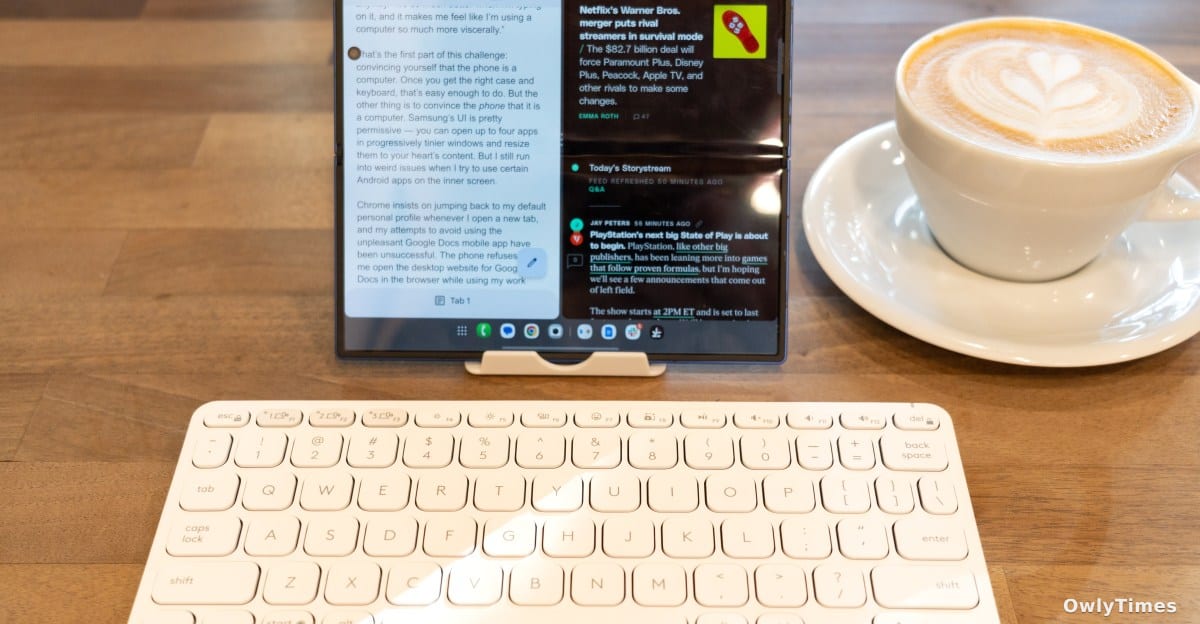
A few days ago, I took a 15-minute walk to a nearby coffee shop, confidently anticipating a productive hour fueled by caffeine and my new folding keyboard. The keyboard, naturally, was the missing piece. I’d left it behind, congratulating myself on how light my bag felt – a feeling quickly replaced by shame as I pecked out emails with my thumbs. This, I realized, perfectly encapsulates the promise and the peril of Purse Computer: the combination of a lightweight travel keyboard and a foldable phone, aiming to replace the laptop for everyday tasks. You don’t need to be a purse-carrier to participate; it’s simply the most accurate descriptor of the setup’s portability.
After wading through every major phone release of 2025, revisiting favorites in early 2026 has been a clarifying experience. While I’m anticipating the arrival of the Galaxy Z TriFold, I’ve found myself consistently reaching for the Galaxy Z Fold 7. It’s so remarkably slim and light that it delivers the benefits of a folding phone without the usual bulk. Initially, I treated it as a keyboard-less Chromebook, prompting a search for the right companion. The goal wasn’t to replicate a full desktop experience, but to create something lighter, more spontaneous than my usual “Backpack Computer” – my company-issued MacBook Air.
This piece references the The Verge report.
Let’s be honest, even a “light” laptop is still…a lot. My MacBook Air technically fits in my tote bag, but it’s heavy enough that longer trips require the full backpack commitment. That’s the core problem Purse Computer solves. The laptop encumbers you. Need to run to Target for toothpaste? Suddenly, your work life is tethered to a potentially vulnerable (and expensive) piece of equipment. The Logitech Keys 2 Go keyboard, with its three-year battery life and surprisingly satisfying key feel, proved to be the final piece. It’s not about replacing power – it’s about removing friction.
This isn’t a novel concept. Folding phone enthusiasts have been building these mobile workstations for years, mirroring the early days of netbooks and iPad keyboard cases. Michael Fisher of Mr. Mobile has been evangelizing this idea since the Galaxy Z Fold 3 in 2021, even coining the term “four-pocket laptop.” His advice was simple: invest in a kickstand case. My current workaround – borrowing the stand from a cheap Amazon keyboard – is, as he pointed out, “another pocket to forget.” A dedicated kickstand streamlines the experience, minimizing the fiddling required to transform a phone into a functional workstation.
But the hardware is only half the battle. The real challenge is convincing yourself that your phone can be a computer. The keyboard helps, bridging the gap between touchscreen typing and a more traditional workflow. Samsung’s UI is surprisingly permissive, allowing for multiple resizable windows. However, Android apps often fall short. Chrome stubbornly reverts to my personal profile, and the mobile version of Google Docs is a non-starter. A workaround, courtesy of The Verge’s Richard Lawler, involves accessing Slack through a Chrome tab – a slightly convoluted process that highlights the inherent limitations of adapting desktop applications to a foldable form factor. The promise of ChromeOS and Android unification offers a potential solution, but that’s likely years away.
It requires a certain level of patience, and a willingness to embrace workarounds. I’ve definitely received curious glances at coffee shops while navigating this setup. Battery life is also a concern – nowhere near the longevity of my MacBook Air. Purse Computer isn’t about all-day productivity; it’s about focused bursts of work, easily accessible on the go. And honestly, that’s enough. The slight friction of packing a backpack often prevents me from leaving the house to work. But carrying a phone and a small keyboard? That’s a barrier low enough to encourage spontaneous productivity. Fisher puts it best: “You have to use it to understand its utility.” And once you do, going back to a traditional phone feels…primitive.
I’ll inevitably move on to testing the Galaxy Z TriFold, as a reviewer can’t afford to get too comfortable. But I suspect it will offer even more opportunities to leave my laptop behind. My prediction? By late 2027, we’ll see a surge in accessories specifically designed for “Purse Computer” setups – not just keyboards and kickstands, but portable monitors, optimized apps, and even dedicated foldable-optimized cloud services. The question isn’t if this trend will take off, but when manufacturers will finally recognize that the future of work might just fit in your bag.