
Do we really need another tech revolution promising to upend everything? Because frankly, the last few have mostly delivered slightly shinier ways to waste time and money. The current obsession with quantum computing feels a lot like that – breathless pronouncements about “quantum supremacy” masking the fact that building a genuinely useful quantum computer remains a monumental, and perhaps insurmountable, challenge. The real story here isn't the promise of qubits and entanglement – it's the surprisingly unglamorous, decades-old technology of superconducting circuits, and how a small firm in upstate New York is quietly trying to fix quantum computing’s biggest bottleneck.
It’s a story that begins, somewhat ironically, in the 1980s. While the world obsessed over synthesizers and shoulder pads, IBM was making a serious bet on superconducting circuits. These materials, unlike the copper and silicon in our everyday electronics, transmit electricity with perfect efficiency – no energy lost as heat. As Michael Frank, a computer scientist, pointed out in 2017, a conventional computer is essentially “an expensive electric heater that happens to perform a small amount of computation as a side effect.” Superconductors promised to change that, and in May 1980, Scientific American even featured a superconducting circuit on its cover. But the revolution stalled. Maintaining the incredibly low temperatures required for superconductivity proved too costly and impractical, and IBM shuttered its research program in 1983.
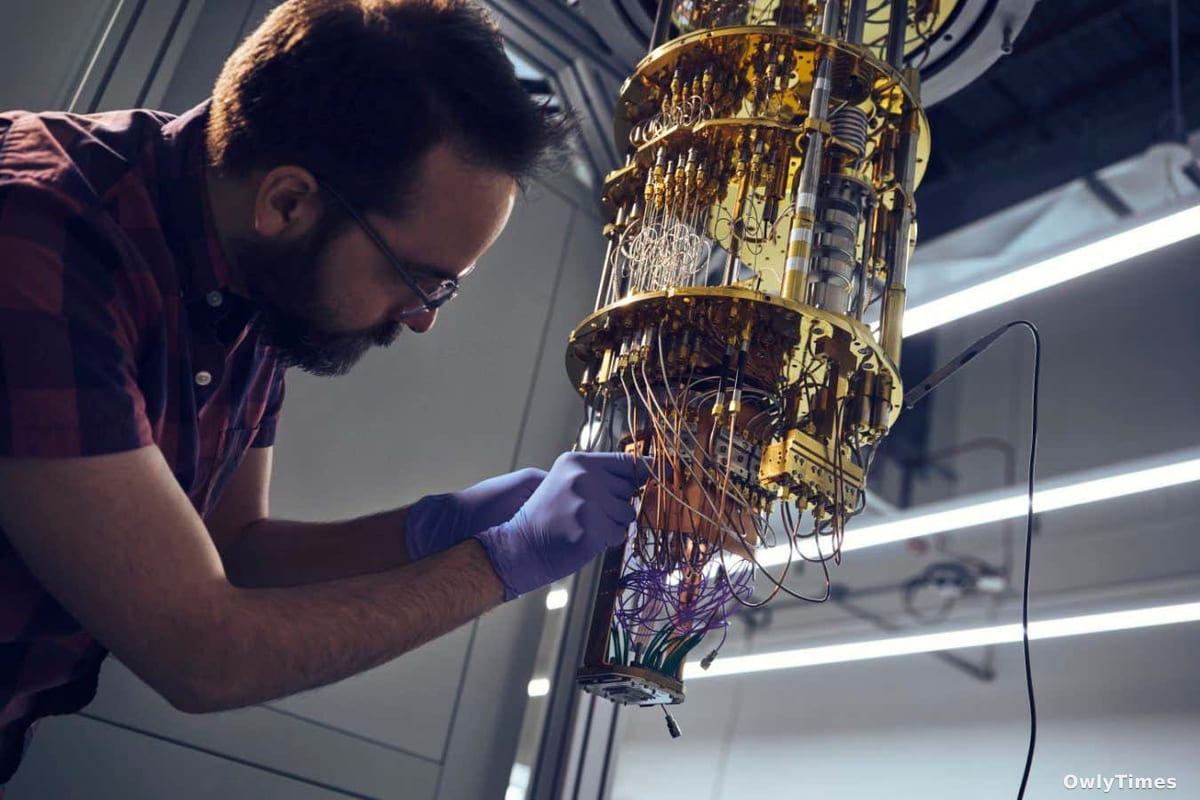
Fast forward to today, and superconductivity is back, driven by the resurgence of quantum computing. Google and IBM are both using superconducting qubits – the basic building blocks of quantum computers – but they’ve hit a wall. Building bigger, more powerful, and more reliable quantum computers isn’t just about adding more qubits; it’s about controlling and connecting them, and doing so without introducing so much heat and complexity that the whole system collapses. This is where SEEQC, a quantum chip foundry born partly from the ashes of IBM’s earlier efforts, comes in. I recently visited their headquarters and fabrication facility, and the scale of the problem – and their potential solution – became strikingly clear.
This article draws on reporting from newscientist.com.
The facility itself is a scene straight out of a sci-fi film: technicians in full-body protective suits, clean rooms buzzing with machinery, and everything bathed in yellow light designed to minimize interference with the delicate chip-making process. Inside, they’re meticulously layering ultrathin films of niobium, a superconducting metal, onto dielectric materials, creating structures that are, as John Levy, SEEQC’s CEO, put it, “delicate sandwich-like.” But the real innovation isn’t in the qubits themselves, it’s in what controls them. Shu-Jen Han, SEEQC’s CTO, explains the core issue: “Physically, you can’t just keep adding cables forever.” Each cable adds heat, disrupting the fragile quantum state of the qubits.
SEEQC’s approach is to integrate the control circuitry onto the same chip as the qubits, using superconducting materials. This eliminates the need for a vast network of room-temperature cables and energy-wasting conventional devices that currently surround every quantum computer. The chip Levy handed me – small, square, and deceptively simple-looking – represents a potential billion-fold improvement in energy efficiency. Considering that some designs for future quantum computers could consume more energy than existing supercomputers, according to the Quantum Energy Initiative, this isn’t a trivial improvement. It’s a fundamental shift in how we think about building these machines.
This isn’t just about power consumption, though. By placing the control circuitry closer to the qubits, SEEQC aims to reduce signal delays and “crosstalk” – unintended interactions between qubits that introduce errors. Error correction is arguably the biggest hurdle facing quantum computing today, and anything that minimizes errors at the source is a game-changer. Oleg Mukhanov, SEEQC’s chief science officer, detailed the firm’s innovative method for dealing with quantum vortices – a pesky phenomenon that can disrupt qubit performance – demonstrating that even the most futuristic technologies are still bound by the laws of fundamental physics.
The vision, as articulated by David DiVincenzo, who laid out the foundational principles of quantum computing nearly two decades ago, is a million-qubit device. Currently, SEEQC is testing its chips with fewer than ten qubits, a tiny fraction of that goal. But the early results are promising, and the company is collaborating with other quantum computer manufacturers to test its chips with different qubit technologies. The team is aiming for a “Mac, not ENIAC” future – a quantum computer that fits within a reasonable footprint, rather than filling an entire room.
But here’s where the skepticism returns. We’ve seen promising quantum computing breakthroughs before, only to have them run into unforeseen engineering challenges. The path to a fault-tolerant, scalable quantum computer is littered with obstacles. However, SEEQC’s focus on the underlying infrastructure – the often-overlooked plumbing of quantum computing – feels different. They aren’t trying to invent a new type of qubit; they’re trying to make the existing ones work better. And that, in the long run, may be the more realistic, and ultimately more impactful, approach.
Watch for this: in the next 18 months, keep an eye on whether SEEQC can successfully scale its chip production and demonstrate consistent performance with a significantly larger number of qubits. If they can, we might just see the 1980s – and a forgotten revolution in superconducting circuits – finally deliver on its promise. If not, the hype cycle will continue, and the dream of a truly transformative quantum computer will remain just that: a dream.