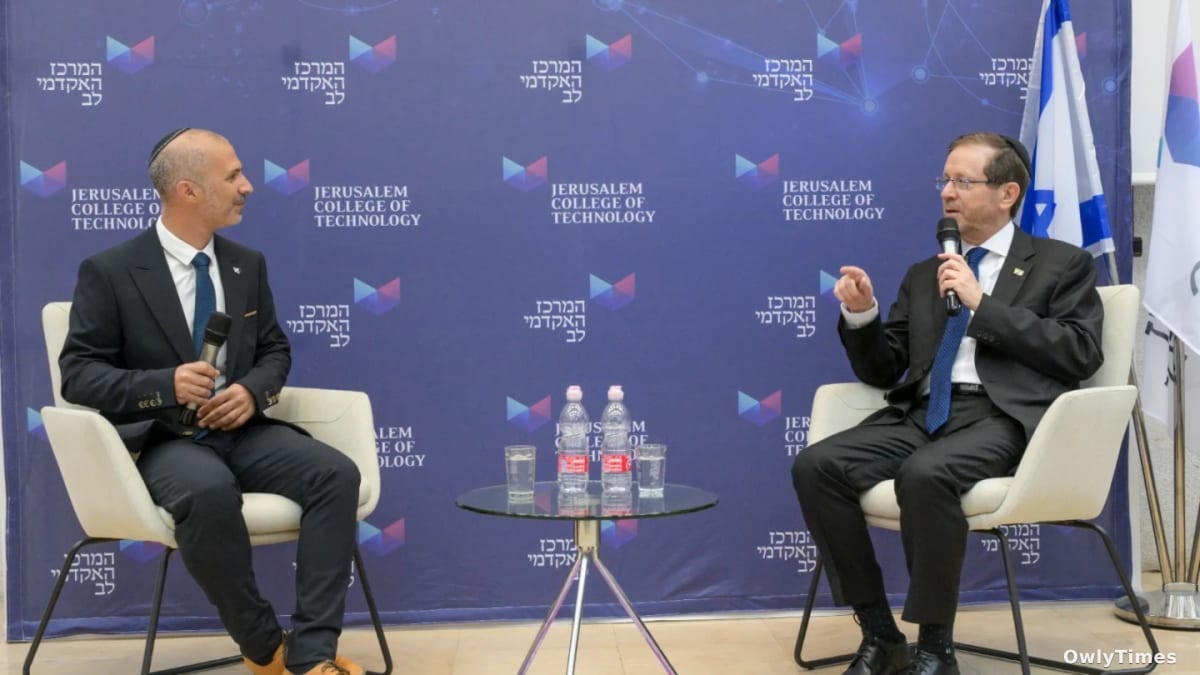

Can a rigorous academic environment function as a bridge for societal fractures? This is the central question currently facing the Jerusalem College of Technology (JCT), an institution that serves approximately 4,500 religious and Haredi students. During a visit to the campus on April 29, 2026, Israeli President Isaac Herzog examined how the integration of traditional religious study and secular scientific advancement might offer a scalable model for national cohesion.
The Intersection of Torah and Technology
At the heart of the JCT model is a deliberate effort to blend undergraduate and graduate degree programs in engineering, management, life sciences, and health professions with traditional Torah learning. CEO Roi Ohev Zion frames this as a "uniquely Israeli model" designed to allow students to enter high-tech and defense sectors without sacrificing their religious identity or lifestyle. The institution’s stated goal is to cultivate values-driven leadership that maintains a strong connection to Jewish tradition while meeting the technical demands of modern industry.
While some might view the intersection of theological studies and advanced technical research as contradictory, the JCT approach suggests that these two disciplines can exist in a complementary framework. The institution serves as a pipeline for graduates who currently hold influential roles within the Israel Defense Forces, the Defense Ministry, and various civilian sectors. The visit highlighted that this model is not merely theoretical; it is a functioning pathway for Haredi young men and women to pursue meaningful professional careers in an environment that respects their cultural and religious boundaries.
Bridging Discourse Through Scientific Methodology
The visit also served as a platform for practical discussions regarding the state of public communication. Dr. Haya Libeskind, a computer science lecturer and mother of eight, presented research centered on the algorithmic detection of harmful discourse on social media platforms in both Hebrew and Arabic. Her inquiry into how technological solutions could be paired with public responsibility and educational standards directly addresses the rising tensions in Israeli civil society.
It is important to clarify that while the visit highlights the potential for technology to mitigate societal friction, such tools remain in the developmental phase. The study of social media discourse via technical analysis is distinct from the complex sociological reality of political polarization. Headlines describing the visit often emphasize the symbolic unity between the President and the institution, yet the practical focus of the meeting remained on the technical viability of moderating online spaces. The success of Dr. Libeskind’s research, or similar initiatives, will depend on whether such algorithms can be adopted as a standard for public discourse without infringing on individual expression.
Limitations to Consider
The JCT model is specifically designed for a niche demographic—religious and Haredi students—and it remains to be seen how such a framework scales to the broader, more secularized segments of the Israeli workforce. The institution’s success is deeply rooted in its specific Beit Midrash-based environment, which provides a high degree of cultural continuity for its students. Expanding these methodologies into the wider public sphere would require reconciling diverse values that do not always align with the college’s core mission of integrating Torah learning into professional life.
The next indication of whether this research will move beyond the laboratory setting will come next month, when the President’s office hosts a conference dedicated to easing social tensions. The active participation of researchers like Dr. Libeskind in this forum will reveal whether the technological frameworks being developed at JCT can effectively influence national policy and social standards for discourse. Monitoring the implementation of these digital moderation tools will be the primary metric for determining if the bridge between traditional values and modern science can withstand the pressures of a divided society.





