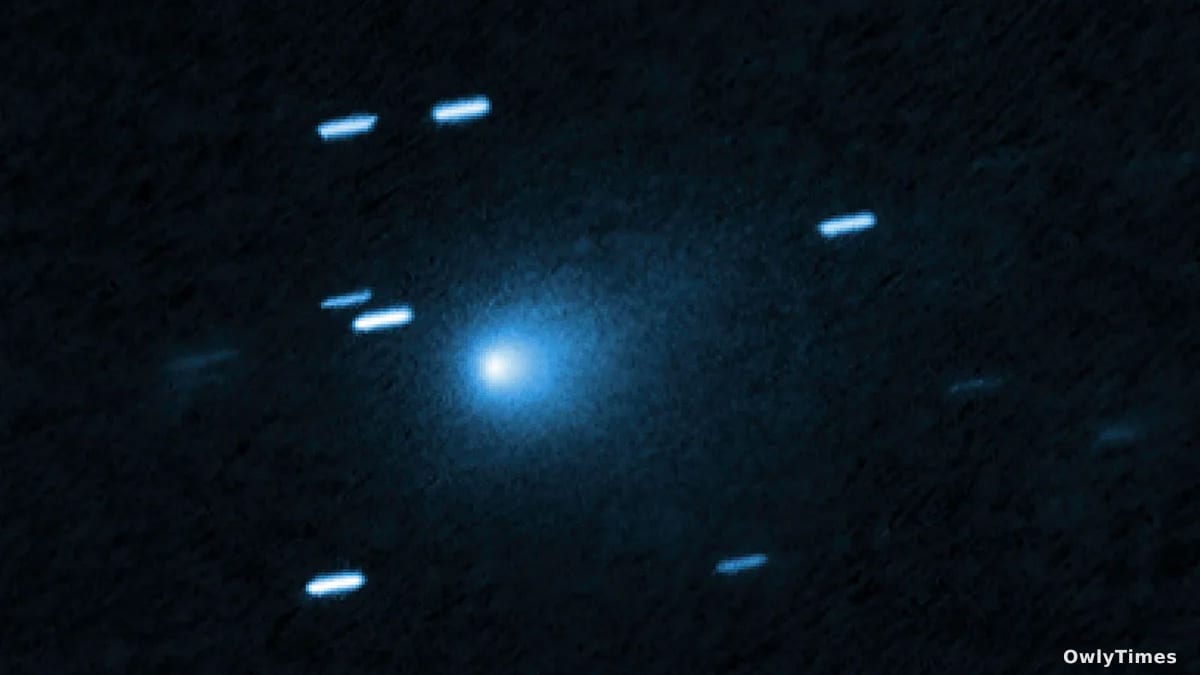

The fleeting passage of interstellar objects through our solar system presents a unique, and rapidly closing, window into the building blocks of planetary systems beyond our own. While headlines have focused on the difficulty of intercepting these cosmic visitors – particularly the recently discovered comet 3I/ATLAS – the narrative often simplifies a complex engineering challenge. It’s not simply a matter of “too slow” or “too late,” as some reports suggest. The core issue is timing, and a new analysis from the Initiative for Interstellar Studies (i4is) proposes a surprisingly viable solution: waiting. Rather than scrambling to launch a mission now, researchers led by Hibberd demonstrate that a mission launched in 2035, leveraging a carefully timed maneuver around the sun, could successfully intercept 3I/ATLAS. This isn’t a concession of defeat, but a pragmatic shift in strategy acknowledging the constraints of current propulsion technology and the celestial mechanics at play.
The excitement surrounding 3I/ATLAS, the third confirmed interstellar object (ISO) to enter our solar system, is justified. Unlike asteroids and comets formed within our own system, ISOs originate from other stars, carrying with them pristine material from distant planetary nurseries. Studying them offers a shortcut to understanding the composition and formation processes of exoplanetary systems – a feat that would otherwise require centuries-long missions to nearby stars. Initial proposals, like NASA’s Janus mission and the ESA’s Comet Interceptor, envisioned direct intercept missions using conventional chemical rockets. However, as Hibberd explained in an email to Universe Today, 3I/ATLAS was detected too late in its journey – already inside Jupiter’s orbit and traveling at over 60 kilometers per second – rendering a quick intercept impractical. Even a spacecraft already positioned at the Sun-Earth L2 point, like the planned Comet Interceptor, would have struggled to adjust course in time. The problem isn’t just speed, but the optimal launch window having already passed.
The i4is team’s approach, detailed in a recent paper and utilizing Hibberd’s own Optimum Interplanetary Trajectory Software (OITS), centers on a “Solar Oberth maneuver.” This technique exploits the gravitational pull of the sun to dramatically increase a spacecraft’s velocity. The spacecraft essentially waits until it reaches the closest point in its orbit to the sun (perihelion), then fires its engines to maximize the “slingshot effect,” gaining enough speed to rendezvous with the rapidly receding 3I/ATLAS. This isn’t a new concept – OITS has a proven track record with similar maneuvers, including a previous study for intercepting the first ISO, ‘Oumuamua (Project Lyra). The key difference here is the timing. The simulations show that a 2035 launch provides the most favorable alignment of Earth, Jupiter, the sun, and 3I/ATLAS, minimizing the required propulsion and flight time.
Source material: Live Science.
The proposed mission isn’t a sprint, however. A 2035 launch would still result in a 50-year journey to intercept 3I/ATLAS, though Hibberd notes this duration could be marginally reduced. This lengthy timeframe highlights a fundamental tension in interstellar object research: the desire for rapid data acquisition versus the realities of interplanetary travel. While advanced propulsion concepts like directed-energy propulsion (DEP) are being explored – as seen in i4is’s Swarming Proxima Centauri project – their technological readiness level remains decades away. The Solar Oberth maneuver, utilizing currently available technology, offers a more realistic pathway to studying an ISO within a reasonable timeframe. The simulations, visualized in an image released by i4is, demonstrate the trajectory’s feasibility, but rely on precise calculations and a well-timed launch window.
It’s crucial to acknowledge the limitations of this proposed mission. A 50-year flight duration introduces significant risks related to spacecraft component degradation and potential system failures. Furthermore, the trajectory relies on accurate predictions of 3I/ATLAS’s path, which could be affected by non-gravitational forces like outgassing. The simulations also assume a certain level of propulsion capability; any underperformance could jeopardize the intercept. Finally, the mission’s success hinges on continued funding and political will over a half-century timescale – a considerable challenge in itself. However, the potential scientific payoff – a detailed analysis of material from another star system – justifies the investment.
The next crucial step is refining the trajectory calculations and assessing the feasibility of a dedicated mission architecture. Will international space agencies prioritize a long-duration ISO interceptor, or will resources continue to focus on shorter-term objectives? More importantly, what will happen when the next interstellar object is discovered? Will we be prepared to act decisively, armed with the lessons learned from 3I/ATLAS and the insights provided by the i4is study? The arrival of each new ISO is a cosmic opportunity, and the question isn’t just if we can catch one, but how we will prepare for the inevitable next encounter.