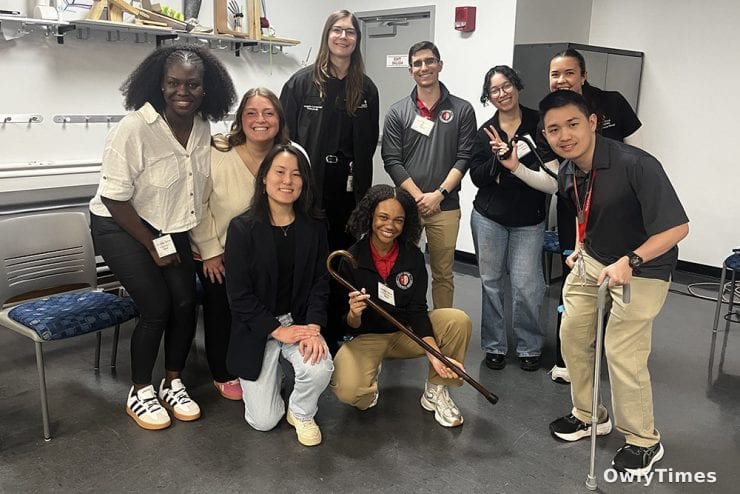

Can simulated competition bridge the gap between clinical theory and actual patient outcomes? While modern medical curricula emphasize interprofessional education—the practice of training students from different healthcare disciplines to work in tandem—the challenge remains in moving beyond the classroom to foster genuine operational synergy. On April 10, Stony Brook University’s School of Health Professions tackled this hurdle by hosting an immersive, interprofessional event across the Health Sciences Center, moving beyond lectures to test how future practitioners communicate under the pressure of a deadline.
Gamifying the Clinical Workflow
The event, which adopted a Winter Olympics theme, served as a stress-test for collaborative behavior. A total of 274 students from the School of Health Professions organized into interdisciplinary teams, tackling tasks ranging from cane relay races to precision test-tube sorting. While the activities were playful in nature, the pedagogical goal was rigid: to simulate the high-stakes coordination required in a real-world hospital setting.
What the event actually demonstrated, according to faculty observations, was not just physical coordination but the navigation of professional hierarchies. Kathleen McGoldrick, vice chair, clinical associate professor and director of IPE in the Department of Health Science, noted that the competition was designed to force students to "understand one another’s roles within the healthcare team." The students were not merely competing for medals; they were practicing cultural humility and role-clarity in a low-risk environment, which is a vital precursor to their eventual transition into clinical practice.
Leadership and Behavioral Integration
The day began at the Medical and Research Translation (MART) building, where Kristie Golden, assistant vice president of operations for neurosciences at Stony Brook University Hospital, provided the foundational framing for the day’s activities. Her presentation focused on healthcare leadership and the integration of behavioral health, grounding the students’ competitive spirit in the reality of institutional operations. Golden emphasized that each student represents the future of the workforce, bringing distinct cultural backgrounds and skill sets that must be synthesized to improve patient care.
Aligning Values with Practice
The event was rooted in the formal Interprofessional Education Collaborative (IPEC) competencies, which prioritize ethics, equity, and communication. Stacy Jaffee Gropack, dean of the School of Health Professions, framed the day as an embodiment of the school’s commitment to "excellence in care." The core philosophy presented here is that healthcare is never delivered in isolation. By forcing students to solve problems side-by-side, the institution aims to replace the traditional "siloed" training model with one built on collective purpose and mutual trust.
Limitations to Consider
While the enthusiasm at the MART building was palpable, it is important to distinguish between a one-day simulation and long-term clinical competency. The primary limitation of such events is the "transfer of learning" gap; skills practiced in a relay race do not automatically translate into the complex, often chaotic environment of an emergency department or a surgical suite. The success of this methodology depends on whether these students can recall the feeling of collaborative reliance when they are later faced with real-world clinical decision-making.
The next measurement of this program’s effectiveness will be found in the ongoing assessment of student performance during their clinical rotations. By tracking how these participants navigate their roles and communication standards when they are no longer in a competition setting, the School of Health Professions will be able to determine if these high-energy interventions yield measurable improvements in the quality of care provided to their future patients.





