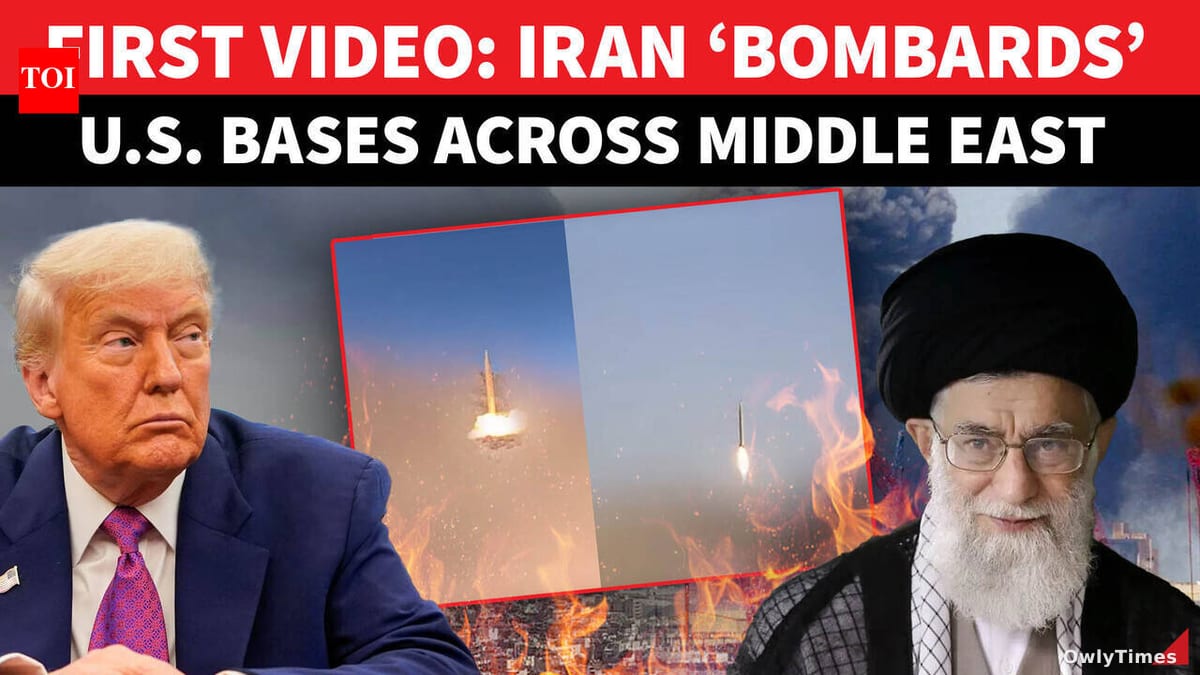

The coordinated missile strikes launched by Iran against Israel and U.S. military installations across the Middle East aren’t simply retaliation for recent joint U.S.-Israeli strikes within Iranian territory; they are a calculated attempt to redraw the regional security architecture, leveraging escalation to force a renegotiation of America’s role and, crucially, to test the resolve of a second Trump administration. The timing, targeting, and even the conditional offer of talks all point to a strategy designed not for outright victory, but for establishing new parameters of engagement. This isn’t a spontaneous outburst, but a pressure test on a system deliberately destabilized over decades.
The Calculus of Retaliation and Restraint
The immediate trigger for these strikes was, of course, the joint U.S.-Israeli operation inside Iran. While details remain tightly controlled, reports suggest the strikes targeted facilities linked to Iran’s nuclear program and advanced missile development. This action, undertaken despite repeated warnings from the Biden administration and international allies, represented a significant departure from the previously maintained, albeit fragile, red lines. However, to view Iran’s response solely as reactive is to miss the larger strategic game. The selection of targets – Al-Udeid in Qatar, Al-Salem in Kuwait, and Al-Dhafra in the UAE – isn’t random. These bases represent the logistical backbone of U.S. military presence in the region, critical for power projection and rapid response capabilities. Attacking them simultaneously demonstrates Iran’s reach and its willingness to directly challenge U.S. assets, but also signals a desire to raise the cost of maintaining that presence. The explosions reported across Gulf states, even if limited in damage, amplify this message.
Original reporting: timesofindia.indiatimes.com.
Who Benefits and Who Loses in the New Equation?
The immediate losers are clear: regional stability and the perception of U.S. dominance. The strikes expose vulnerabilities in U.S. defenses and demonstrate the limitations of its ability to unilaterally control events in the Middle East. The Gulf states, caught in the crossfire, face heightened security risks and economic disruption. However, several actors stand to benefit, at least in the short term. Vladimir Putin’s Russia gains leverage as a potential mediator, positioning itself as a stabilizing force while the U.S. is preoccupied. China, heavily reliant on Middle Eastern oil, also benefits from a weakened U.S. presence, allowing it to expand its economic and political influence. Within Iran, the strikes bolster the hardliners’ narrative of resistance against Western interference, consolidating their power and potentially silencing internal dissent. The conditional offer of talks, while seemingly conciliatory, is likely intended to divide the international community and create a perception of Iranian reasonableness.
Echoes of 1979 and the Iranian Hostage Crisis
The current escalation bears unsettling parallels to the period surrounding the 1979 Iranian Revolution and the subsequent hostage crisis. Then, as now, a perceived affront to Iranian sovereignty – the Shah’s exile and subsequent U.S. support – triggered a radical response aimed at dismantling the existing regional order. The hostage crisis wasn’t simply about the hostages; it was a strategic maneuver to cripple the Carter administration and force a reassessment of U.S. policy. Similarly, the current strikes aren’t solely about retaliation; they are about forcing a reckoning with the consequences of decades of intervention and a recalibration of U.S. commitments. The key difference is the presence of a more assertive and technologically advanced Iran, capable of inflicting significant damage and disrupting regional stability on a scale unseen in 1979. The 1979 crisis ultimately led to a period of strained relations and a more cautious U.S. approach to Iran; the question now is whether this escalation will lead to a similar outcome, or a more direct confrontation.
Trump’s Call for Regime Change and the Path Forward
President Trump’s call for regime change, while unsurprising given his long-standing animosity towards the Iranian government, adds a dangerous layer of complexity. It signals a willingness to escalate the conflict beyond the current parameters and potentially pursue military intervention. This stance, however, is not without risk. A direct military confrontation with Iran could trigger a wider regional war, drawing in other actors and destabilizing the global economy. The conditional offer of talks from Iran, framed as a willingness to engage “under certain conditions,” is a calculated attempt to exploit the divisions within the U.S. political landscape and create a diplomatic off-ramp. However, the conditions are likely to be unacceptable to the Trump administration, which has consistently advocated for a maximalist approach.
The political chess move to watch next isn’t whether Iran will launch further attacks – that is almost certain. It’s whether the Trump administration will respond with military force, or attempt to leverage the offer of talks, however insincere it may be. The answer to that question will determine whether the Middle East spirals into a full-blown conflict, or enters a new era of uneasy coexistence defined by a significantly diminished U.S. role.





