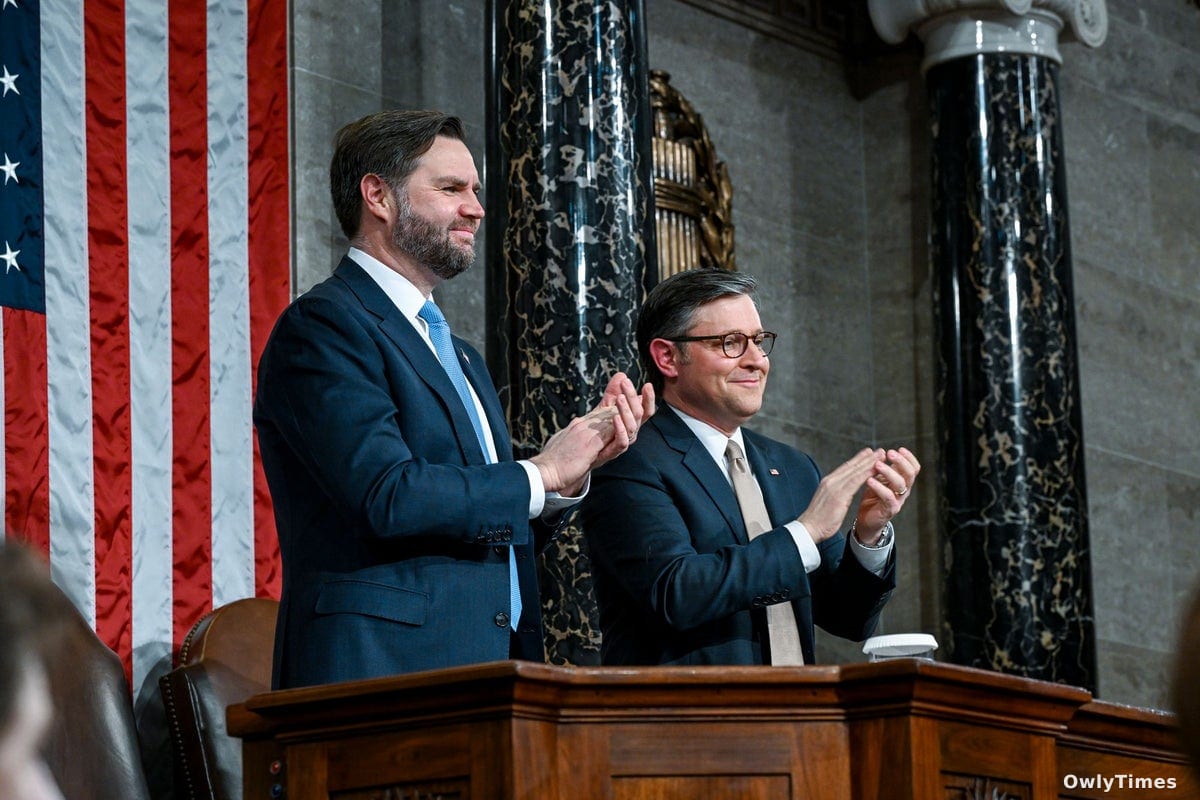

The strategic calculus driving the current administration’s defense of the Iran conflict rests on a sophisticated, if controversial, effort to reframe military aggression as a moral imperative. By invoking "just war" theory, Vice President JD Vance and House Speaker Mike Johnson are attempting to insulate the White House from rising domestic and international criticism by anchoring their policy in a centuries-old theological tradition. This move serves a dual purpose: it provides a veneer of moral legitimacy to the ongoing operation while simultaneously positioning the administration against the Vatican’s vocal opposition, led by Pope Leo.
In this power dynamic, the beneficiaries are the architects of the current foreign policy who seek to bypass the need for traditional congressional authorization by appealing to a higher, "settled" moral authority. The losers are not only the civilian populations in the region but also the integrity of the doctrine itself, which experts argue is being weaponized to justify actions that bear little resemblance to the principles originally established by figures like Saint Augustine.
The tension between the White House and the Vatican reached a breaking point following an April 10 post by Pope Leo, the first U.S.-born pontiff, who declared that God does not bless conflict and that Christ’s disciples are never on the side of those who wield the sword. Vance, who converted to Catholicism in 2019, countered this by questioning the Pope’s theological stance, drawing a direct parallel to the Allied liberation of Nazi concentration camps during World War II. For Vance and Johnson, the argument is simple: if the war against Hitler was just, then the war against Iran—framed as a protective measure—must also hold moral weight.
However, the application of this doctrine faces severe scrutiny from those who study the mechanics of military ethics. David Whetham, a professor of ethics and the military profession at King’s College London, argues that the current U.S. operation fails to satisfy a single criterion of the theory. The disconnect is stark: while the administration claims the war is a necessary shield against Iranian nuclear ambition, intelligence provided by the International Atomic Energy Agency on March 3 indicated no evidence that Iran was building a nuclear bomb. Furthermore, the head of the Office of the Director of National Intelligence, Tulsi Gabbard, testified last month that Iran’s nuclear enrichment program had already been dismantled by previous strikes.
The contradiction deepens when examining the human cost. According to HRANA, a U.S.-based human rights organization, the conflict has claimed 3,636 lives since late February, 1,701 of whom were civilians. These figures stand in direct opposition to the principle of proportionality central to just war theory. Walter Dorn, a professor of Defense Studies at the Royal Military College of Canada, pointed to an April 8 social media post by President Donald Trump—who warned that "a whole civilization will die tonight"—as a flagrant violation of the doctrine’s requirement for restrained conduct.
As the administration continues to cite "Operation Epic Fury" as a success—noting the destruction of ballistic missiles and naval assets—the gap between political rhetoric and ethical theory remains wide. The political chess move to watch next will be the upcoming reading of the casualty and infrastructure impact reports from the region; as these numbers continue to climb, the administration’s reliance on just war theory will face an increasingly difficult test of public and international credibility.





