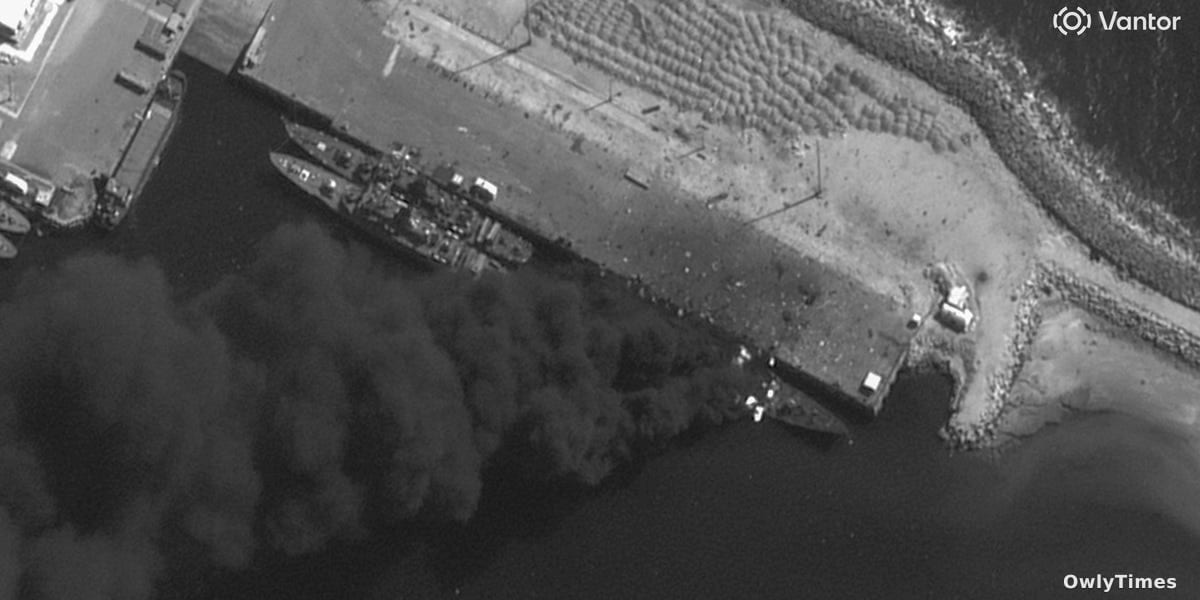

The calculated escalation now unfolding between the United States, Israel, and Iran wasn’t a spontaneous reaction to failed nuclear negotiations; it was a strategically timed demonstration of force predicated on a weakening position for all parties involved. The satellite imagery released by Vantor – depicting a burning Iranian frigate at the Konarak naval base – isn’t simply evidence of damage, but a signal intended to reshape the risk calculus in the region. President Trump’s declaration of intent to “annihilate” the Iranian navy, while rhetorically extreme, underscores the core objective: to eliminate Iran’s capacity to develop nuclear weapons through a demonstrably crippling blow to its military infrastructure. This isn’t about preventing a bomb; it’s about re-establishing a deterrent that diplomacy failed to achieve.
The immediate impact of the joint US-Israeli strikes, as reported by the Institute for the Study of War (ISW), centers on Iranian naval assets, with initial reports focusing on the IRGC Navy frigate Jamaran and the Imam Ali Navy Base in Chabahar. However, the broader implications extend beyond naval capabilities. The deployment of Tomahawk cruise missiles, HIMARS, and drones – alongside “undisclosed standoff weapons” – signals a willingness to bypass traditional defensive layers and target strategically vital infrastructure directly. This approach mirrors the 1986 Operation El Dorado Canyon, where the US targeted Libyan facilities in response to terrorist attacks, demonstrating a commitment to direct military action when diplomatic channels are exhausted. Who benefits and who loses in this initial phase is clear: the US and Israel gain a temporary advantage in regional power dynamics, while Iran suffers a significant, though not necessarily crippling, blow to its military prestige and capabilities.
Based on the original Business Insider report.
The retaliatory strikes launched by Iran against US military bases across the region – Bahrain, Qatar, the UAE, Kuwait, Jordan, and Saudi Arabia – were predictable, and arguably, anticipated by Trump’s administration. This tit-for-tat exchange, coupled with Iran’s drone and missile barrage against Israel, isn’t a sign of strength, but a demonstration of limited options. Iran’s response is constrained by its understanding of the overwhelming US military superiority. The activation of MIM-104 Patriot and THAAD batteries highlights the defensive posture adopted by US allies, effectively turning the region into a testing ground for advanced air defense systems. The parallel to the 1973 Yom Kippur War is striking; while Iran, like Egypt and Syria then, initiates conflict, it lacks the capacity to achieve a decisive victory, relying instead on attrition and regional destabilization.
The timing of this escalation is crucial. The collapse of nuclear talks created a vacuum, and the perceived urgency stems from Iran’s accelerating nuclear program. The June 2025 US strike on Iranian nuclear facilities, while a precursor, proved insufficient to halt progress. The current operation, “Epic Fury,” represents a significant escalation in both scope and intensity, reflecting a growing frustration with Iran’s intransigence. The build-up of US forces in the Middle East in the weeks leading up to the attack wasn’t a secret; it was a deliberate signal intended to deter Iranian aggression and prepare for a large-scale operation. This mirrors the US military build-up prior to the 2003 invasion of Iraq, though the current objective appears more focused on containment than regime change. The key difference is that the current situation lacks the broad international coalition that supported the Iraq War, raising questions about the long-term sustainability of the US-led campaign.
The political chess move to watch next isn’t whether Iran will escalate further – that’s almost guaranteed. It’s whether President Trump will capitalize on the military operation to push for a broader regional realignment, potentially seeking to broker new security agreements with Saudi Arabia and other Gulf states. The success of “Operation Epic Fury” will be measured not just by the damage inflicted on Iranian military assets, but by whether it creates an opportunity to reshape the geopolitical landscape in the Middle East, solidifying US influence and containing Iranian ambitions for decades to come. The question is whether this demonstration of force will ultimately lead to a more stable, or a more volatile, regional order.