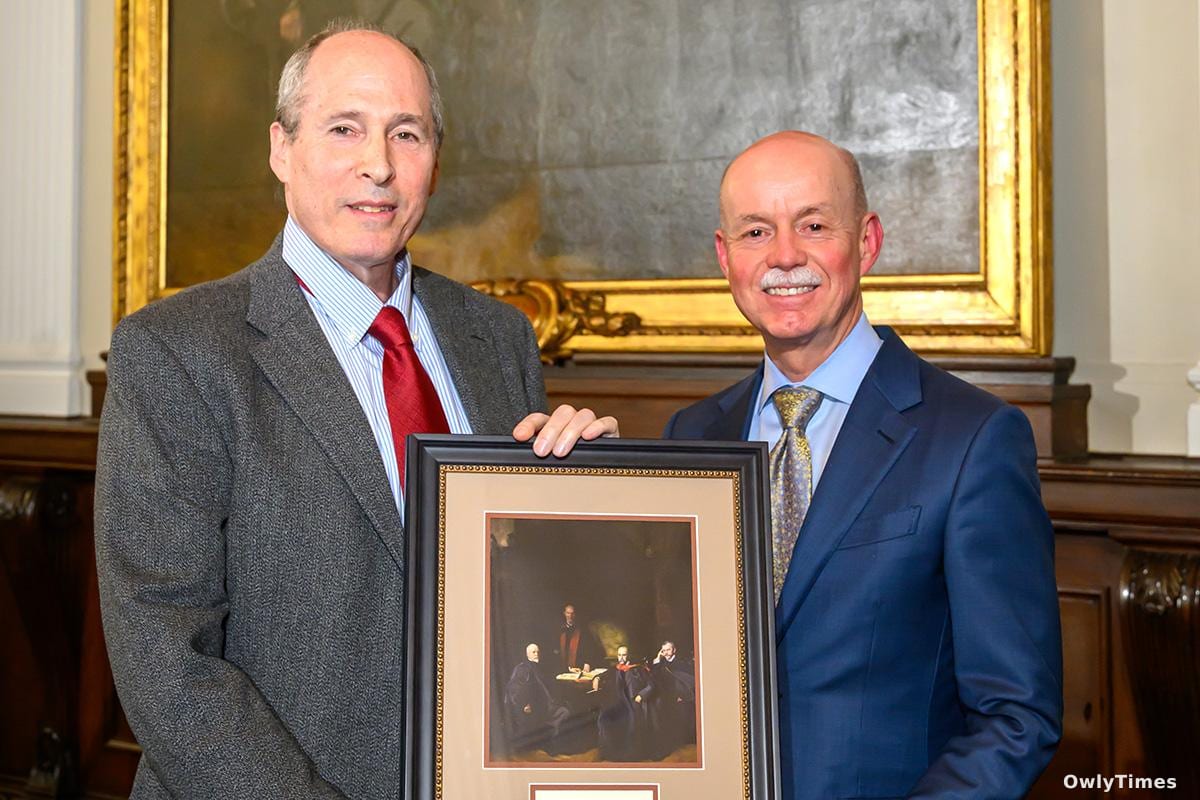

How do we measure the impact of a scientific career that spans nearly four decades? While modern metrics often prioritize publication counts or citation indices, the Johns Hopkins University School of Medicine recently turned toward a different yardstick: the preservation of a foundational institutional vision. By honoring Jeremy Nathans with the inaugural Welch Award for Excellence in Basic Science Research on May 12, the institution is emphasizing that the most significant scientific contributions are often those that build a culture of mentorship as much as they produce laboratory breakthroughs.
According to the Johns Hopkins report, the ceremony took place in the West Reading Room of the Welch Medical Library. This venue serves as the home of the iconic John Singer Sargent painting, The Four Doctors, which depicts the institution's founders: William Henry Welch, William Stewart Halsted, William Osler, and Howard Atwood Kelly. The event itself serves as a reminder that institutional excellence is rarely the product of a single genius, but rather a lineage of researchers who prioritize long-term scientific infrastructure over short-term accolades.
What the ceremony highlighted, beyond the prestige of the award, is the specific methodology of the Nathans Lab. Over the past 38 years, the lab has operated at the complex intersection of human genetics, ophthalmology, and retinal cell biology. While public headlines frequently reduce such research to "curing color blindness," the reality is a deeper investigation into the genetic architecture of vision and the mechanisms of the blood-retina barrier. By identifying the genes responsible for color-vision receptors, Nathans provided the blueprint for understanding how genetic variations manifest as sensory differences in the human population.
However, a critical limitation to consider in evaluating such awards is the "hero narrative" trap. While the scientific community celebrates individual laureates, the reality of the breakthroughs mentioned—such as the 1978 Nobel Prize shared by Daniel Nathans, Hamilton Smith, and Werner Arber for the discovery of restriction enzymes—is that they are the result of collaborative, iterative processes. The award criteria for the Welch prize specifically attempt to sidestep this by mandating "leadership in education and mentorship" as a prerequisite, rather than rewarding discovery in a vacuum.
The financial structure of these awards also reveals a conscious effort to sustain scientific progress. Nathans, who auctioned his father’s Nobel Prize medal to bolster the Hamilton Smith Award for Innovative Research, has further committed the $50,000 prize money from this new Welch Award to the Lee Hood Prize in Biomedical Science. This movement of capital back into early-career faculty endowments acts as a hedge against the chronic funding uncertainty that often stalls basic research in the academic sector.
The next steps for this research trajectory will be measured by the output of the early-career faculty supported by these specific endowments. By tracking the progression of those recipients at Johns Hopkins, the scientific community can determine if this model of intergenerational funding effectively accelerates the pace of discovery in vascular and retinal biology. As Nathans noted during the ceremony, the goal is to provide the "intellectual, financial, and psychological support" necessary for the next generation to move beyond existing barriers in biomedical science.





