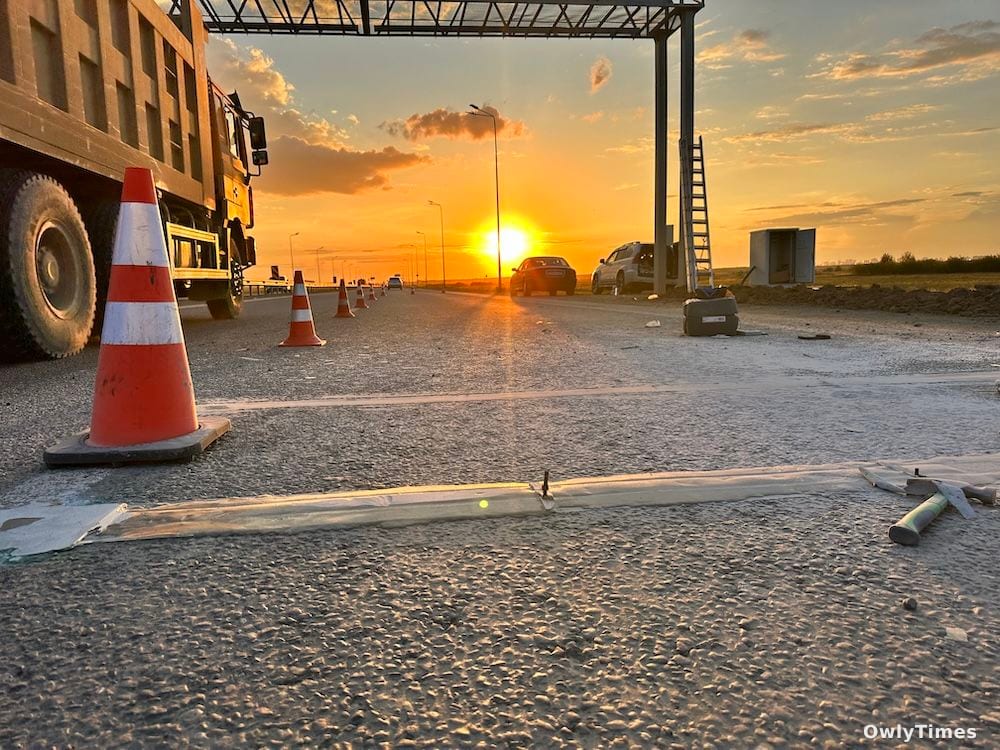

Is the secret to saving our crumbling infrastructure hidden inside a strip of metal buried in the asphalt? We often talk about "smart cities" as if they are defined by flashy digital billboards or autonomous shuttles, but the real story here isn't the flashy UI—it’s the invisible, high-stakes plumbing of industrial regulation. Kazakhstan’s recent overhaul of its heavy-vehicle enforcement proves that the most impactful tech isn't the kind that alerts your phone; it’s the kind that makes it impossible to break the law in the first place.
The Engineering Behind the Enforcement
For years, the struggle to keep heavy trucks from pulverizing road networks has been a game of cat and mouse. Traditional enforcement is slow, manual, and prone to human error or bribery. Kazakhstan changed the math by turning its highways into a giant, high-speed scale. The core of this transition relies on the 1.75m strain gauge strip sensor manufactured by Intercomp.
Unlike piezoelectric sensors, which can drift or require constant babying, these strain gauges provide the kind of raw, consistent stability that engineers dream of. They have been validated by the Kazakhstan Institute of Standardization and Metrology, ensuring that the data holding up in court is as precise as the physics behind it. When you consider that these sensors are tasked with monitoring vehicles in the brutal temperature swings of the Kazakh winter, the "set it and forget it" reliability of the hardware is the only reason the system works at scale.
Closing the Loop on Automation
The real genius of this system isn't just the hardware; it’s the software integration that effectively removes the human middleman. In partnership with APM Pro and Automatic Systems, the country launched the SmartWIM solution. The journey to a fully autonomous system was a slow burn, starting with pilot installations in Astana that underwent rigorous testing between 2023 and 2024.
During that initial rollout, the enforcement was strictly semi-automatic, requiring a human operator to look at the data and sign off on a fine. That changed in December 2024, when legislative amendments finally flipped the switch to fully automated enforcement. Now, when a sensor detects an overweight vehicle, the system doesn't wait for a person to wake up or decide to act. It generates an electronic violation protocol, syncs it with the Kazakhstan Ministry of Transport’s database, and fires off an SMS to the offender in real-time. It is a closed-loop system where the penalty for non-compliance is as instantaneous as the measurement itself.
The Reality Check on the Asphalt
The data coming out of the pilot programs paints a sobering picture of how easily regulations were ignored before this tech hit the pavement. When the system began recording violations in September 2024 at six control points surrounding Astana, the results were startling: nearly one-third of all dump trucks entering the city were breaking the law. Some of these vehicles were hauling loads 1.5 to 2 times the legal weight limit, effectively acting as wrecking balls for the local road network.
By 2025, the country had scaled this technology to cover more than 100 lanes nationwide. This is a massive shift in operational reality; we are moving from "random spot checks" to "constant surveillance." For the average driver, this means fewer potholes and longer-lasting roads, but it also signals a future where infrastructure maintenance is no longer reactive.
The next reading of the violation rates across those 100+ lanes will show whether this automated deterrence actually forces a change in shipping behavior or if we’ve simply built a very expensive machine for collecting fines.