
Is the "perfect" monitor finally boring enough to buy? For years, the display industry has treated high-end visual fidelity like a luxury handbag—something to be admired behind glass, priced for the elite, and far too fragile for the average user’s desk. We’ve spent a decade chasing the thin-film promises of OLED, only to be haunted by the specter of burn-in and astronomical price tags.
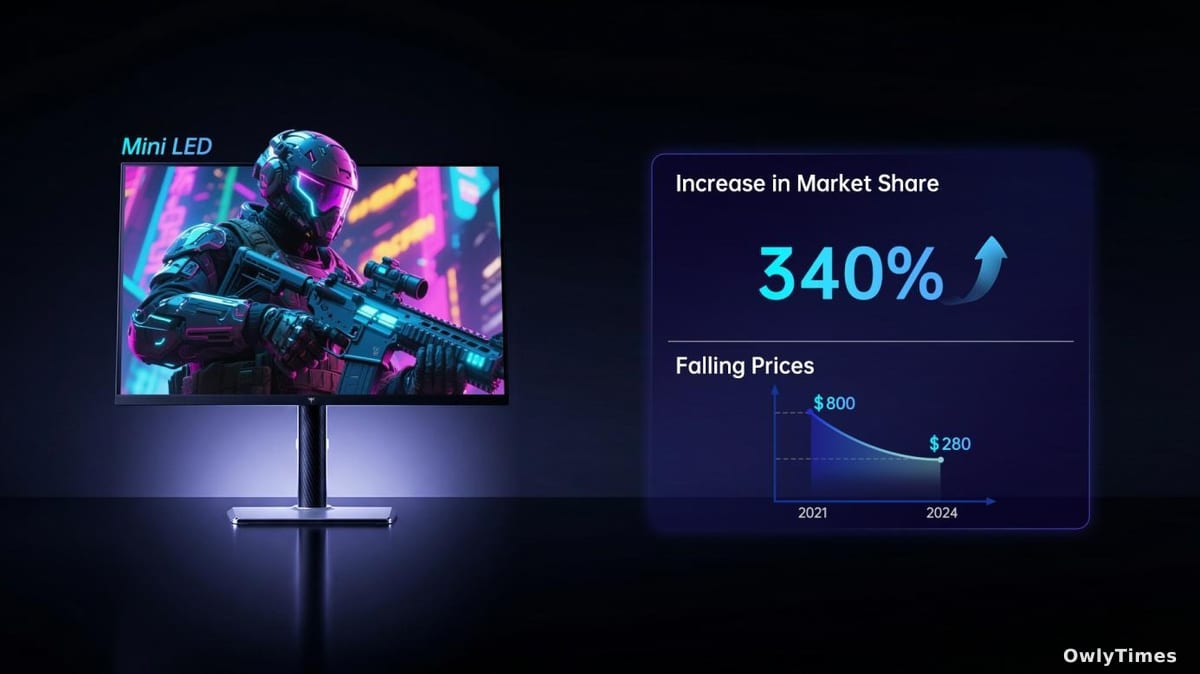
The real story here isn’t just that another company is launching a monitor; it’s that the display market has finally reached a tipping point where bleeding-edge tech is being forced to play by the rules of mass-market economics. According to public reports from TrendForce, global Mini-LED monitor shipments have surged by 340%, signaling that this tech has officially graduated from a high-end niche to a standard consumer expectation.
The Death of the Luxury Display Premium
For the average user, the math behind monitor shopping used to be a miserable exercise in compromise. You could either pay a premium for OLED and pray your static taskbar didn't ghost itself into your screen permanently, or settle for a traditional IPS panel that looked like a flashlight in a dark room.
The price collapse for Mini-LED has been nothing short of surgical. In 2021, the average selling price of a Mini-LED monitor hovered above $800. By 2024, that figure cratered to a range of $280–$430, with entry-level units now dipping below the $300 mark. When the entry price for "premium" drops by more than half in just three years, it suggests the industry has stopped trying to sell status and started trying to sell utility.
Why Burn-In Is the New "Check Engine" Light
The shift toward Mini-LED isn't just about the spec sheet; it's about the psychological relief of not having to babysit your hardware. Third-party consumer research highlights this shift clearly: 59% of users now cite burn-in-free performance as an essential factor for long-hour office work and gaming.
It turns out, people don't want to worry about their screen's mortality. While OLED panels still struggle with ghosting risks and peak brightness caps of 600–1000 nits, Mini-LEDs are hitting 1000–4000 nits without breaking a sweat. For the 68% of consumers who prioritize high brightness for HDR gaming or sun-drenched offices, the "better" tech isn't the one that wins the color contrast award in a lab—it's the one that still works five years from now.
Engineering the Mid-Range Revolution
KTC is currently betting that the path to market dominance isn't just lower prices, but proprietary manufacturing shortcuts. By leaning into Chip-on-Board (COB) technology—specifically their one-light-one-zone ultra-thin backlight board—they are squeezing 2,304 dimming zones into units that aim to undercut the mid-range competition.
This is the classic Silicon Valley playbook applied to hardware: take a complex, expensive process and refine it until the assembly line becomes the competitive advantage. By pairing this with a peak brightness of over 1,400 nits, they are effectively offering a "good enough" experience that bridges the gap between mid-range pricing and near-OLED visual depth.
The next reading of global shipment data from TrendForce will show whether this downward price trajectory continues to squeeze out traditional IPS panels or if the market begins to plateau. If the current growth holds, we are likely looking at the end of the "premium display" era, replaced by a world where high-performance HDR is simply the standard for the home office.