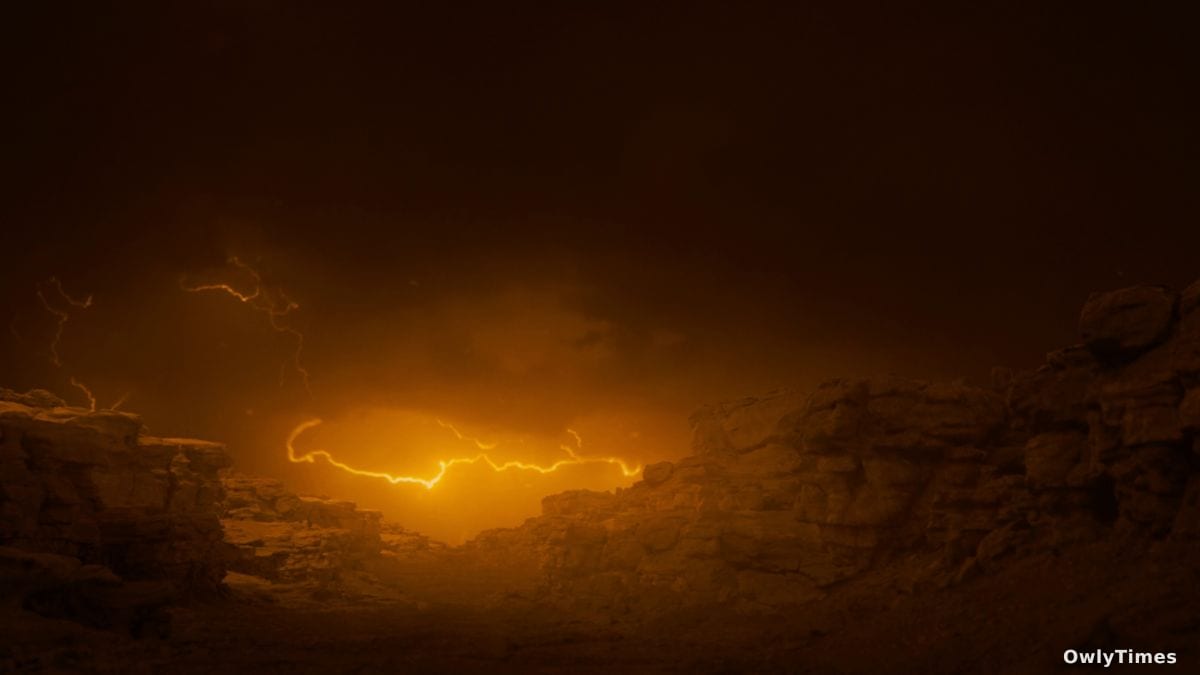

The persistent question of whether Mars, our planetary neighbor, shares fundamental atmospheric processes with Earth has taken a striking step toward resolution. For decades, scientists have theorized about the possibility of electrical discharges – akin to lightning – on the red planet, but definitive proof remained elusive. Now, data retrieved from NASA’s MAVEN spacecraft, initially recorded in June 2015, has revealed the first confirmed detection of a ‘whistler’ – a distinct radio wave signature generated by lightning-like events. This isn’t simply about confirming the existence of Martian lightning; it’s about understanding how planetary atmospheres, even those drastically different from our own, behave under the influence of powerful electrical forces, and what that might imply for the potential for past or present life.
The initial signal, a peculiar electromagnetic anomaly, was flagged during a routine data review by a team led by atmospheric physicist František Němec of Charles University in Czechia. Rather than immediately interpreting it as lightning, the team embarked on a meticulous analysis of over 108,000 plasma wave recordings collected by MAVEN since its arrival at Mars in 2014. What they discovered wasn’t a fleeting anomaly, but a clear match to a ‘whistler’ – a descending tone in radio frequencies created when electromagnetic emissions from lightning travel through a planet’s ionosphere. Crucially, this finding validates decades-old theoretical models predicting how such signals should appear on Mars, given its unique magnetic environment. It’s a powerful example of how revisiting archived data with new analytical tools can yield groundbreaking results.
Source material: ScienceAlert.
The challenge in detecting Martian lightning stems from the planet’s stark differences from Earth. While Earth’s lightning is intimately linked to water vapor in clouds, Mars’ atmosphere is exceedingly dry. However, as researchers have observed on Earth, water isn’t a prerequisite. Lightning can also occur within volcanic ash plumes, and recent evidence suggests electrical discharges can be generated by dust particles in Martian dust storms. The detected whistler, recorded at an altitude of 349 kilometers (217 miles) on the night side of Mars, provides further support for this latter mechanism. The nightside location is critical; the sunlit side’s ionosphere is compressed, hindering the propagation of the necessary plasma waves. The signal itself lasted 0.4 seconds, sweeping downward in frequency, and was ten times stronger than background noise, indicating a substantial energy release at its source – comparable to a strong lightning discharge on Earth, even accounting for signal loss during its journey.
What makes this detection particularly remarkable is the context of Mars’ magnetic field. Unlike Earth, Mars lacks a global magnetic field. However, remnants of an ancient magnetic field are preserved in localized patches within the Martian crust. These ‘fossilized’ magnetic fields were theorized to potentially channel whistler signals, but confirmation required precise observation. Němec’s team demonstrated that the detected whistler propagated along one of these crustal magnetic fields, confirming the long-held hypothesis. This also explains why such signals are so rare; fewer than 1% of MAVEN’s wave snapshots were taken in regions with the necessary magnetic geometry. Detecting a whistler requires a confluence of factors: a powerful discharge, a specific location, the right timing, and a spacecraft equipped to capture the fleeting signal.
This single detection doesn’t mean Martian lightning is commonplace, but it strongly suggests it occurs more frequently than previously thought. More importantly, it opens exciting avenues for astrobiological research. Laboratory experiments have demonstrated that electrical discharges can catalyze the formation of organic molecules – the building blocks of life. If similar processes occur on Mars, they could have played a role in prebiotic chemistry, potentially creating conditions suitable for life in the planet’s past. The next steps involve refining models of Martian atmospheric electricity, searching for additional whistler events in the MAVEN archive, and potentially designing future missions specifically equipped to monitor electrical activity on Mars. We should be watching for whether future data reveals seasonal or regional patterns in these discharges, and whether they correlate with specific weather events like dust storms. Understanding the frequency and intensity of Martian lightning could fundamentally alter our understanding of the planet’s habitability, both past and present.





