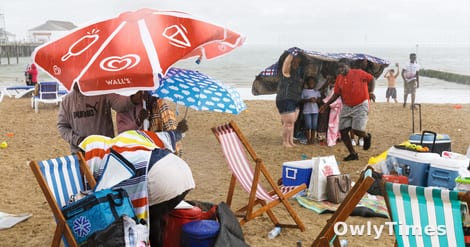

Are we really looking at beach photos and village fêtes, or a photographic autopsy of a culture consuming itself? The recent release of two new books revisiting the work of Martin Parr, who passed away last December at 73, feels less like a celebration of a beloved photographer and more like a stark warning we’re collectively ignoring. Parr’s signature style – that aggressively close, hyper-saturated color – wasn’t just about aesthetics; it was a deliberate tactic to force us to see the excess, the awkwardness, and ultimately, the unsustainable habits of modern life. The real story here isn’t Parr’s technical brilliance – it’s the uncomfortable truth he captured about our relationship with consumption and the environment, a truth that feels even more urgent now than it did when he first started pointing his lens.
From Frozen Streams to Global Excess
Martin Parr’s journey began humbly enough. Born in 1952 in Epsom, Surrey, his early photographic education came from his grandfather, George Parr, during weekends in West Yorkshire. That first photograph, an 11-year-old Martin’s atmospheric shot of his father on a frozen stream, foreshadowed a lifelong obsession with documenting the world around him. But the subject matter drastically shifted. While many photographers chase beauty, Parr seemed determined to find the messy, the garish, and the often-unflattering reality of everyday life. He famously declared, “By the age of 13 or 14, I wanted to be a photographer. Nothing else was going to happen.” This wasn’t a romantic pursuit of artistic expression; it was a compulsion to record, to observe, and to present back to us a reflection we often didn’t want to see. Consider his 1998 photograph of Tokyo, Japan – a vibrant, chaotic scene that hints at the relentless energy of a consumer society, but also the potential for overwhelming waste.
The “Serious Photographs Disguised as Entertainment”
Parr’s self-described mantra – “Remember I make serious photographs disguised as entertainment” – is key to understanding his impact. He wasn’t preaching; he was presenting. Images of crowded beaches in Clacton (2017), the Surrey Bird Club (1972), and fêtes on the Isle of Wight (2007) aren’t simply quaint snapshots of British life. They’re studies in leisure, consumption, and the sheer volume of stuff that defines our existence. The saturated colors aren’t accidental; they amplify the artificiality, the manufactured joy, and the underlying sense of unease. This isn’t about judging his subjects – it’s about holding a mirror up to our collective behavior. His 2022 book, A Year in the Life of Chew Stoke Village, and 2017’s Remote Scottish Postboxes demonstrate this focus on the mundane, elevating the ordinary to a level of critical observation.
Original reporting: airmail.news.
Beyond the Surface: An Environmental Subtext
While Parr rarely explicitly framed his work as environmental commentary, the implications are undeniable. The sheer volume of disposable goods, the overflowing plates at picnics, the relentless pursuit of leisure – all point to a system built on unsustainable consumption. His photographs, taken over decades, document a gradual escalation of this trend. Compare images from the 1980s, like those of New Brighton, to his later work, and the increase in visible waste and consumerism is striking. This isn’t about blaming individuals; it’s about exposing the systemic forces driving us towards ecological limits. The fact that these images are often funny doesn’t diminish their power – it makes them more insidious, because we’re more likely to engage with something that doesn’t immediately feel like a lecture.
What Comes After the Last Snapshot?
Martin Parr’s legacy isn’t just a collection of striking photographs; it’s a challenge. He forced us to confront the uncomfortable truths about our own lives and the world we’re creating. Now, with his passing, the question becomes: who will pick up the lens and continue this critical work? More importantly, will anyone listen? I predict that in the next five years, we’ll see a surge in AI-generated “nostalgia” content – idyllic, sanitized versions of the scenes Parr documented, designed to evoke positive emotions and obscure the underlying problems. The challenge for the next generation of photographers will be to resist that temptation and continue to show us the world as it is, not as we wish it to be. Will they have the courage to make “serious photographs disguised as entertainment” in an age increasingly addicted to manufactured happiness?