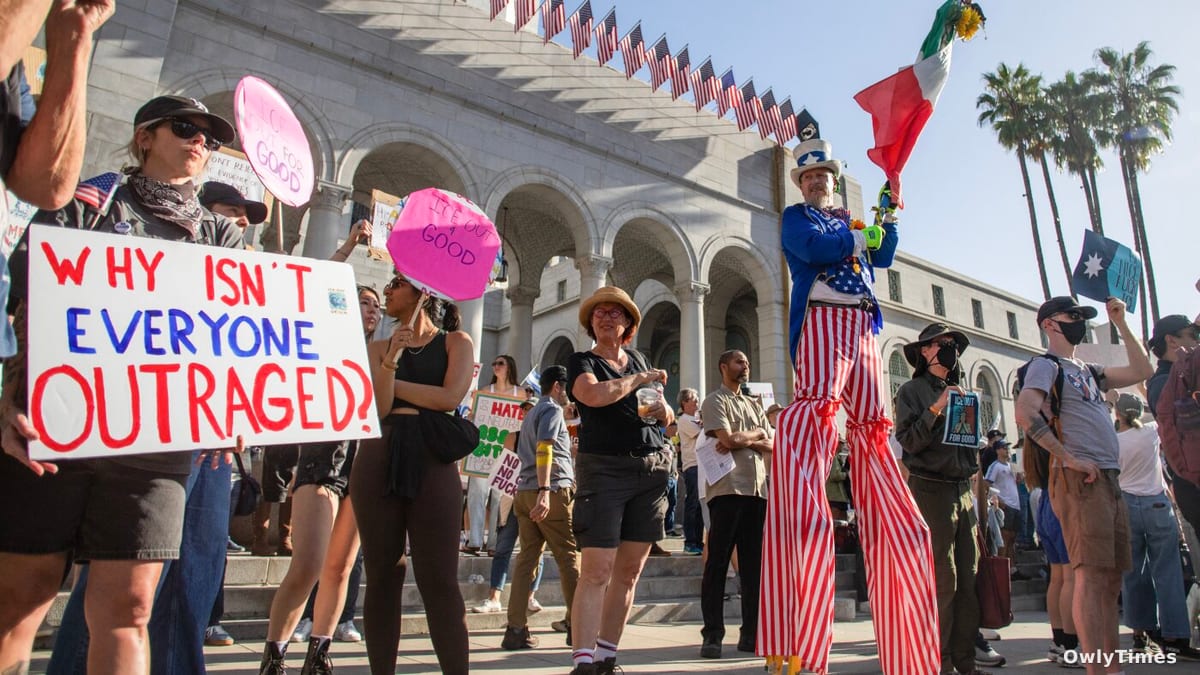

The escalating rhetoric and increasingly assertive actions of the Trump administration aren’t simply policy disagreements; they represent a calculated, if not yet fully realized, strategy to redefine the boundaries of American democracy. The current push – from threats to media organizations to proposals for deploying federal agents domestically – isn’t about isolated incidents, but a systematic effort to erode institutional checks and consolidate power, mirroring tactics observed in nations sliding toward competitive authoritarianism. This isn’t a prediction of imminent dictatorship, but a recognition that the rules of the game are being actively rewritten, and the consequences will be felt long after the midterm elections.
The Erosion of Norms: A Pattern Emerges
The alarm bells are sounding within the political science community. Staffan I. Lindberg, director of Sweden’s V-Dem Institute, now categorizes the U.S. as an “electoral autocracy,” a designation that reflects a demonstrable decline in democratic standards. Steven Levitsky, co-author of How Democracies Die, goes further, suggesting a slide into “mild competitive authoritarianism” by 2025-26. This isn’t merely about holding elections; it’s about manipulating the conditions around those elections. The September incidents – the threat to Disney following Jimmy Kimmel’s criticism and the proposal to use U.S. cities as military training grounds – weren’t aberrations. They were deliberate tests of boundaries, probing for resistance and establishing a new normal of presidential overreach. The language employed – “invasion from within,” framing domestic dissent as an enemy threat – echoes the rhetoric used by authoritarian leaders like Augusto Pinochet in Chile, a historical parallel Levitsky explicitly draws. Who benefits from this normalization of aggressive tactics? Primarily, the executive branch, expanding its power at the expense of traditional constraints. Who loses? The press, political opponents, and ultimately, the citizenry, whose ability to participate freely and critically in the democratic process is diminished.
The Limits of Executive Power: Pushback and Constraints
Despite the concerning trends, a narrative of inevitable authoritarian descent is premature. Scholars like Kurt Weyland at the University of Texas at Austin argue that the U.S. system, while battered, retains significant resilience. Weyland points to instances where Trump’s attempts to reshape the political landscape have been thwarted. Kimmel’s swift return to air after being temporarily sidelined, and the limited success of efforts to gerrymander districts for partisan advantage, demonstrate that institutional and public pushback can effectively constrain executive overreach. The disastrous fallout from the shooting of two U.S. citizens by federal agents in Minneapolis, leading to the scaling back of immigration enforcement in Minnesota, further illustrates the limits of aggressive tactics. This isn’t to dismiss the threat, but to acknowledge the countervailing forces at play. The key here is understanding that power isn’t simply seized; it’s negotiated, contested, and often limited by unforeseen consequences. Tom Homan, border czar, acknowledging the end of the surge in Minnesota, is a clear signal that even within the administration, there’s a calculation of political cost.
Based on the original NPR report.
Weaponizing the Electoral Process: Data and Disenfranchisement
The current focus on voter data and potential interference at polling places represents the most immediate and dangerous escalation. The Trump administration’s lawsuits seeking voter data, coupled with proposals from figures like Steve Bannon to deploy ICE to polling locations, aren’t about preventing voter fraud – a statistically rare occurrence. They are about intimidation and disenfranchisement. Kim Scheppele, a Princeton sociologist studying authoritarian tactics, draws a direct parallel to Viktor Orbán’s government in Hungary, which actively manipulated voting access for opposition voters in the UK. The chilling effect of even contemplating such a move, as Brendan Nyhan of Dartmouth College points out, is substantial. The potential to suppress participation among communities of color and naturalized citizens, fueled by fear of harassment, strikes at the heart of democratic principles. The fact that federal law prohibits such deployment doesn’t negate the threat; it underscores the administration’s willingness to push the boundaries of legality and propriety. This is a strategic gamble: if successful in suppressing turnout, the administration solidifies its power. If it sparks a backlash, it risks further alienating the electorate.
Beyond the Midterms: The Next Chess Move
The immediate outcome of the midterm elections will be crucial, but the longer-term game extends beyond November. The next political chess move to watch isn’t about election results, but about the response to potential challenges to those results. Will the administration accept a legitimate defeat, or will it employ the tactics already on display – questioning the integrity of the process, alleging widespread fraud, and potentially mobilizing legal challenges – to delegitimize the outcome? The willingness to abide by democratic norms, even in defeat, will be the ultimate test of whether the U.S. is truly sliding toward authoritarianism, or whether its democratic institutions remain robust enough to withstand the strain. The question isn’t simply if the administration will challenge the results, but how – and whether the institutions designed to protect the democratic process will hold firm.