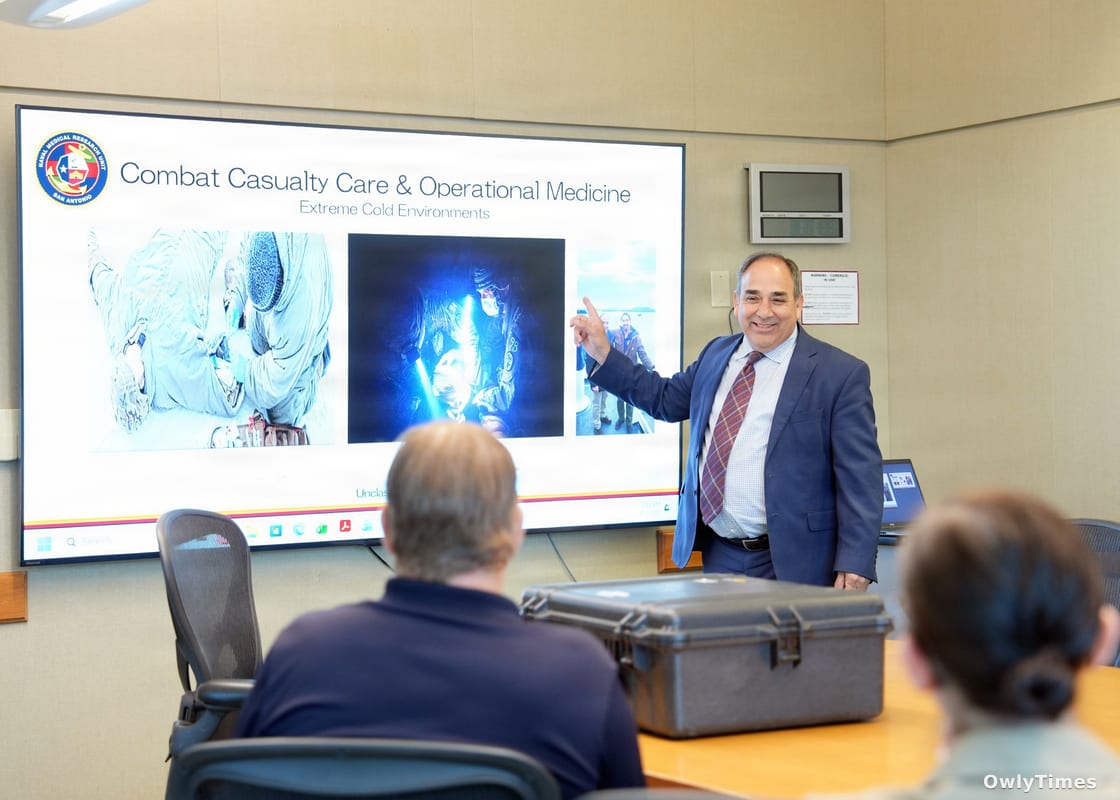

The increasing demand for rapid medical intervention in austere environments – a hallmark of modern special operations – isn’t simply about faster helicopters or more advanced field hospitals. It’s about fundamentally altering the window between injury and effective treatment, and a recent visit to the Naval Medical Research Unit (NAMRU) San Antonio by F. Bowling of U.S. Special Operations Command (USSOCOM) Acquisitions, Technology & Logistics underscores a critical, often overlooked, component of that effort: the deliberate, methodical research that precedes any deployable technology. While headlines often focus on the application of medical advancements, this meeting highlights the crucial, upstream work of identifying precisely what advancements are needed, and then rigorously testing their potential. The narrative isn’t just about getting better care to the warfighter; it’s about understanding the specific physiological challenges they face and building solutions from the ground up.
Bridging the Gap: Research Driven by Operational Needs
On April 7, 2026, Dr. Darrin Frye, chief science director of NAMRU San Antonio, briefed Bowling on the unit’s research portfolio at the Battlefield Health and Trauma Research Institute. This wasn’t a demonstration of finished products, but a deep dive into ongoing projects designed to address “capability gaps” – areas where current medical support falls short of operational requirements. NAMRU San Antonio, operating under Navy Medicine Research & Development, focuses on three core areas: combat casualty care, craniofacial research, and the emerging field of directed energy research. The emphasis on directed energy, while less publicly discussed, signals a proactive approach to anticipating future threats and developing countermeasures, a departure from the historically reactive nature of military medical research. This proactive stance is particularly noteworthy given the increasing prevalence of non-kinetic warfare and the potential for novel weapon systems.
This piece references the dvidshub.net report.
Beyond Bandages: The Scope of NAMRU San Antonio’s Work
The term “combat casualty care” often conjures images of tourniquets and immediate wound stabilization, and those remain vital. However, NAMRU San Antonio’s work extends far beyond these initial interventions. Their research delves into the complex physiological responses to traumatic injury, focusing on areas like hemorrhage control, shock resuscitation, and the prevention of infection in resource-limited settings. Critically, they aren’t simply adapting civilian medical techniques for military use; they are investigating how the unique stresses of combat – prolonged exertion, sleep deprivation, extreme environments – alter the body’s response to injury. This is a crucial distinction. A civilian trauma protocol optimized for a well-equipped hospital may be ineffective, or even harmful, when applied to a wounded service member in a remote, austere location. The unit’s craniofacial research, often overshadowed by trauma care, addresses the high incidence of facial injuries from blast events and shrapnel, developing innovative reconstructive techniques and protective materials.
What the Visit Signifies – and What It Doesn’t
Reports of this briefing have, predictably, been framed as USSOCOM seeking “cutting-edge” medical technology. While that’s partially true, it’s a simplification that obscures the more important dynamic at play. Bowling’s visit wasn’t a shopping trip; it was a strategic alignment. USSOCOM isn’t simply looking for solutions; they are actively shaping the research agenda, ensuring that NAMRU San Antonio’s efforts are directly relevant to the evolving needs of special operations forces. This collaborative approach is a significant improvement over past models where research was often conducted in isolation, resulting in technologies that failed to translate to the battlefield. However, it’s important to note that a briefing is not a contract, nor does it guarantee the rapid deployment of any specific technology. The research process is inherently iterative, and many promising projects fail to meet the rigorous standards required for military use.
Limitations to Consider
The success of NAMRU San Antonio’s research, and its subsequent impact on warfighter health, is contingent on several factors. Funding stability is paramount; disruptions in funding can derail long-term projects and hinder the development of critical capabilities. Equally important is the ability to recruit and retain highly qualified researchers, a challenge given the competition from the private sector and academic institutions. Furthermore, the translation of research findings into deployable technologies requires close collaboration with industry partners, a process that can be complex and time-consuming. Finally, the unique physiological characteristics of special operations forces – their exceptional physical conditioning and rigorous training – may limit the generalizability of research findings to the broader military population.
Looking ahead, the next crucial step is not simply more research, but more focused research. Specifically, NAMRU San Antonio needs to prioritize studies that investigate the long-term health consequences of exposure to directed energy weapons, a threat that is rapidly evolving. Will the physiological effects differ significantly from conventional blast injuries? What preventative measures can be developed to mitigate these risks? The answers to these questions will be critical in ensuring the continued health and lethality of U.S. warfighters in the years to come, and the ongoing collaboration between NAMRU San Antonio and USSOCOM will be instrumental in finding them.





