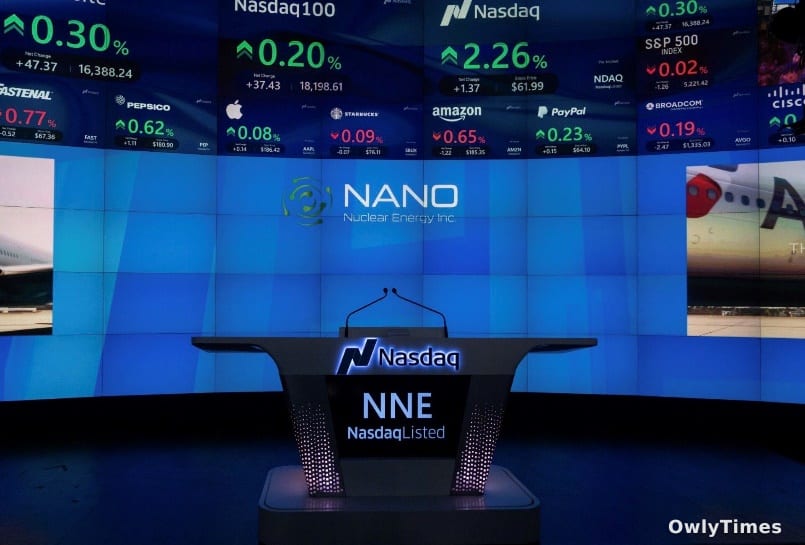

$578 Million Cash Position Fuels NANO Nuclear’s Vertical Integration Play
A $379 million influx of capital, following an oversubscribed $400 million private placement in October 2025, has positioned NANO Nuclear Energy Inc. (NASDAQ: NNE) for aggressive expansion – not just in reactor development, but critically, in controlling its own fuel supply. The company’s Q1 FY26 results, released today, reveal a strategic pivot beyond simply building micro modular reactors (MMRs) to owning key pieces of the nuclear fuel cycle, a move that significantly alters the competitive landscape and raises the stakes for rivals. This isn’t merely about building a better reactor; it’s about insulating NANO Nuclear from the vulnerabilities exposed by geopolitical instability and supply chain bottlenecks plaguing the broader nuclear industry.
See the original nanonuclearenergy.com story for the full account.
The jump in cash and cash equivalents to $577.5 million, up from $203.3 million at the end of September 2025, isn’t simply a balance sheet improvement. Follow the money: $4 million was used in operating activities, a slight increase year-over-year, reflecting increased R&D spending on the KRONOS MMR™ system. Another $3.1 million went to investing, including a new engineering facility in Oak Brook, Illinois. But the most telling investment is the strategic acquisition of Global First Power, rebranded as True North Nuclear, and the $1.38 billion commitment to build a commercial laser enrichment facility through affiliate LIS Technologies. This represents a calculated bet that controlling uranium enrichment – a historically concentrated and often politically sensitive process – is the key to scalable, affordable MMR deployment.
Why Vertical Integration Matters in a Tightening Fuel Market
The conventional nuclear industry faces a looming fuel crisis. Russia currently controls a significant portion of the global uranium enrichment capacity. Sanctions and geopolitical tensions have already driven spot prices upwards, and the demand for enriched uranium is projected to increase dramatically as nations pursue nuclear energy to meet climate goals and energy security needs. NANO Nuclear’s strategy, spearheaded by Founder and Chairman Jay Yu, directly addresses this vulnerability. The company’s acquisition of LIS Technologies, with its patented laser enrichment technology, isn’t just about future profits; it’s about establishing an independent, domestic supply chain. This is particularly crucial given the company’s focus on TRISO fuel, a more advanced and inherently safer fuel form that requires specialized enrichment processes.
The $6.8 million REV Illinois incentive further underscores the strategic importance of this move. The state’s investment isn’t simply a tax break; it’s a signal that policymakers recognize the economic and national security benefits of a resilient nuclear fuel supply chain. This contrasts sharply with competitors who rely on established, but potentially vulnerable, enrichment services. James Walker, NANO Nuclear’s CEO, highlighted this advantage, stating the KRONOS MMR system’s “compelling value proposition…includes a superior safety profile we expect to enable a favorable footprint, co-location and the ability to provide reliable off-grid or behind the meter power.” This value proposition is significantly enhanced by the prospect of a secure, domestically controlled fuel supply.
Commercial Momentum Builds Alongside Technical Progress
While the fuel supply chain grab dominates the narrative, NANO Nuclear is simultaneously advancing its KRONOS MMR™ system towards commercialization. Progress on the licensing front in both the U.S. and Canada is encouraging, with a construction permit application planned for submission to the U.S. Nuclear Regulatory Commission (NRC) in the coming months. The Memorandum of Understanding (MOU) with the University of Illinois to host a prototype reactor is a critical step, providing a real-world testing ground and a valuable partnership with a leading research institution.
However, the most compelling developments are in the commercial pipeline. The Feasibility Study agreement with BaRupOn to power a 1 GW AI Data Center and Manufacturing Campus is a significant vote of confidence. The growing interest from AI data center operators, industrial clients, and even the military highlights the unique advantages of MMRs – their scalability, portability, and ability to provide reliable, off-grid power. This demand is particularly acute given the projected surge in electricity consumption from AI, which is already straining grid capacity in many regions. The MOU with DS Dansuk to explore deployment in South Korea and the partnership with Ameresco to target federal and commercial sites further demonstrate the global appeal of NANO Nuclear’s technology.
What This Means for Your Wallet
NANO Nuclear’s strategy isn’t directly impacting consumer energy bills today. However, the long-term implications are substantial. If successful, the company’s vertical integration strategy will help stabilize fuel costs and accelerate the deployment of clean, reliable energy. This could translate to lower electricity prices for businesses and consumers, particularly in regions reliant on expensive or unreliable energy sources. More immediately, investors should watch for the NRC’s response to the construction permit application. A swift approval would be a major catalyst, validating the company’s technology and paving the way for commercial deployment. The key question now is: can NANO Nuclear successfully execute its ambitious fuel supply chain plan and maintain its lead in the rapidly evolving MMR market? The next 12-18 months will be critical in determining whether this bold strategy pays off.