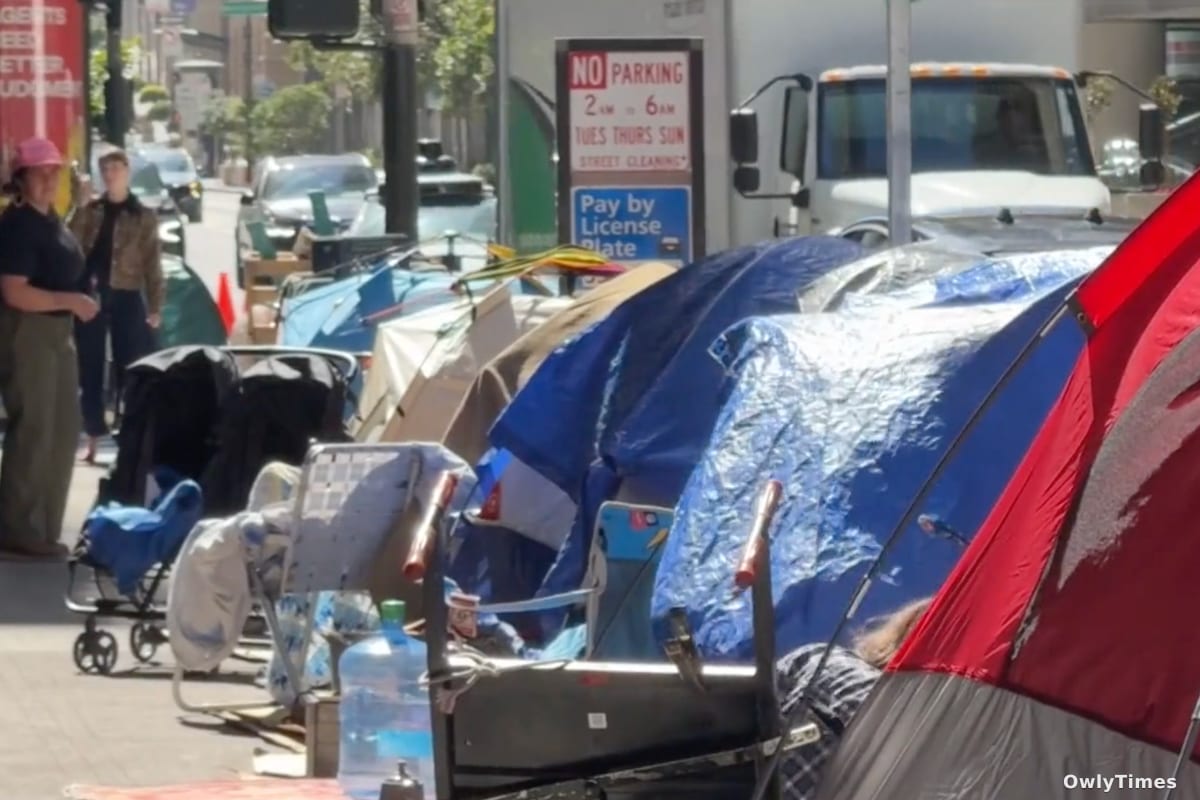

The scene in San Francisco’s Financial District last Friday felt all too familiar to local residents: a sprawling, makeshift homeless encampment suddenly materialized, with tarpaulin-covered tents and rusted burn barrels lining the streets. But for those watching closely, the reality was not a reflection of the city’s persistent housing crisis, but a meticulously constructed fiction. As reported by The Independent, the site was a temporary set for a Netflix production under the working title "2034," directed by Joseph Gordon-Levitt. While the juxtaposition of a film set mimicking the city’s most visible struggle drew confusion, it serves as a stark reminder of San Francisco’s shifting identity—a city currently caught between the artifice of Hollywood and a high-stakes, real-world transformation driven by the tech elite.
The High Cost of the AI Boom
Beyond the film sets, the city’s economic landscape is undergoing a radical, and perhaps more permanent, restructuring. According to the BBC, San Francisco reclaimed its title as the most expensive city for homebuyers in the U.S. this March, with median home prices hitting a record $1.76 million by May 2026. Experts like Daryl Fairweather, chief economist at Redfin, point to an influx of cash from AI giants OpenAI and Anthropic as the primary catalyst. This "AI money" has not only fueled bidding wars that push sale prices millions above asking but has also created unusual market behaviors, such as sellers considering shares in AI companies as a form of payment for luxury property.
While this wealth has halted the post-pandemic market softening, it has exacerbated the city's deep-seated inequality. The BBC notes that while high-level AI staff are seeing extraordinary compensation—including massive share sales, such as the $6.6 billion in shares sold by over 600 OpenAI employees last October—many families remain priced out of the market. Economics professor Enrico Moretti cautions that while the city is seeing a resurgence, the benefits of the coming AI stock market flotations may largely favor global investors rather than local residents, leaving the city’s long-term affordability in a precarious state.
Surveillance from Above
This economic pressure is unfolding in a city where the boundary between public and private life is increasingly blurred by technology. A WIRED investigation recently uncovered a significant security breach involving the San Francisco Police Department’s (SFPD) drone fleet. In mid-June, security researchers Sam Curry and Maik Robert discovered that real-time footage from five police drones was being accidentally livestreamed on an open, public web address hosted by the manufacturer, Skydio. The exposed data included thermal and color video, GPS telemetry, and the personal information of six SFPD pilots.
The leaked archives, which covered roughly 48 hours of operations, captured everything from high-stakes pursuits to routine surveillance of individuals, including an apparent search of an area populated by homeless people. WIRED reports that the drones tracked hundreds of people and vehicles, documenting over 5,000 GPS points. For researchers like Curry, the leak raised urgent questions about the lack of transparency in urban surveillance, noting that the ability to peer into apartments and track individuals from the sky creates a "big issue from a privacy perspective" that persists long after the specific footage is taken offline.
A City in Flux
For local officials, the challenge is balancing these competing realities. Manijeh Fata, executive director of the San Francisco Film Commission, emphasized to The Independent that major productions bring significant revenue, potentially generating up to $625,000 per day for the local economy. This is bolstered by a $1 million cash rebate program designed to keep film crews in the city. Yet, as the city navigates the dual pressures of a hyper-inflated property market and the expansion of high-tech police surveillance, the "2034" film set remains a poignant metaphor. It stands as a reminder that in San Francisco, the line between the city’s manufactured image and its lived reality is thinner than ever, with every new production and every new policy decision shaping a future that feels increasingly like a race against the clock.