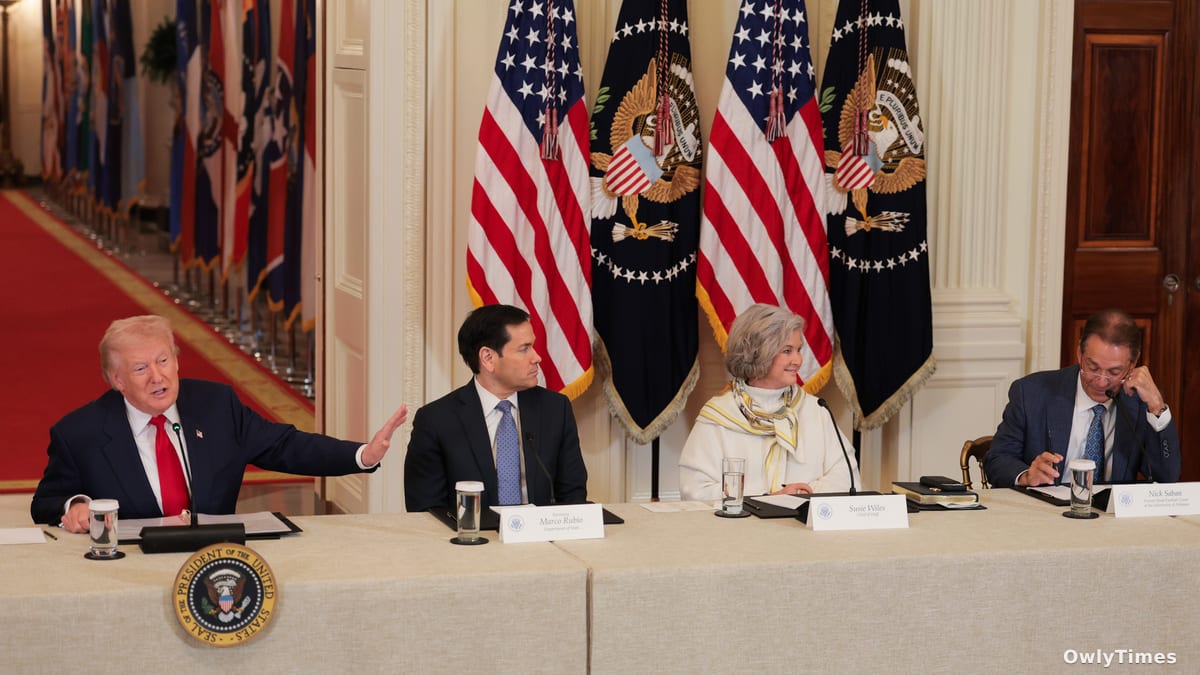

The room felt…off. That’s the only way to describe it as I watched last week’s White House roundtable on college sports, organized by President Donald Trump. Polished wood, serious faces, the weight of billions in revenue hanging in the air – and not a single current college athlete present. It wasn’t just the absence that stung, but the echo of a long-discarded mantra: “stick to sports.” Whatever happened to that convenient directive, the one that told athletes to be seen and not heard, to entertain and not engage? The hypocrisy was palpable, a stark illustration of how thoroughly the lines between athletics and politics have blurred, and how selectively that blurring is permitted.
The gathering, featuring former Alabama football coach Nick Saban and a host of Power Four conference executives, quickly devolved into a lament for a bygone era – an era where athletes were, in effect, unpaid laborers. Trump himself promised an executive order “within one week” to essentially rewind the clock to pre-NIL conditions, a move he acknowledged would almost certainly face legal challenges. But beyond the bluster and the impending lawsuits, the roundtable revealed a deeper, more troubling dynamic: a desperate attempt to control a rapidly changing landscape while conveniently ignoring the forces actually reshaping it. It’s a narrative that places blame on the athletes themselves for disruptions that are, in reality, symptoms of much larger systemic issues.
This piece references the andscape.com report.
The core of the issue isn’t simply about Name, Image, and Likeness (NIL) payments, though those have become the focal point of outrage. It’s about a fundamental power imbalance. Student-athletes are overwhelmingly responsible for generating the revenue that fuels a multi-billion dollar industry, yet they’ve historically been denied basic rights and protections. To suggest that NIL deals are somehow dismantling the foundations of higher education feels less like a genuine concern and more like a convenient scapegoat. Consider this: overall undergraduate enrollment was 15 percent lower in fall 2021 than in fall 2010, with 42 percent of that decline occurring during the pandemic, according to the National Center for Education Statistics. The looming “enrollment cliff,” projecting a decline in high school graduates starting in 2025, poses a far more significant threat to colleges and universities than a few athletes earning endorsement deals.
This isn’t just a college sports problem; it’s a reflection of broader societal trends. The dismantling of the Department of Education, the revocation of student visas, and political threats to funding all contribute to an atmosphere that discourages students from pursuing higher education. The rising cost of tuition, coupled with these political headwinds, creates a perfect storm. Yet, the narrative pushed at the White House roundtable conveniently sidestepped these critical factors, focusing instead on the perceived disruption caused by athletes finally having some agency over their own earning potential. According to a report from Opendorse, a leading NIL technology company, two-thirds of college football players make less than $10,000 in NIL deals – hardly a sign of a system spiraling out of control.
The real solution, one conspicuously absent from the discussion, lies in empowering athletes. A truly equitable model would allow for unionization, enabling players to collectively bargain for better terms and conditions. It would involve direct compensation from schools and the NCAA, alongside the freedom for athletes to profit from their NIL. This would be a radical shift, a reversal of the 75-year-old “student-athlete” construct – a term deliberately crafted to avoid classifying athletes as employees and thus sidestep workers’ compensation obligations. The irony is breathtaking: a system built on the backs of unpaid labor decrying the very notion of athletes being compensated for their contributions.
The hypocrisy extends beyond economics. The insistence that athletes “stick to sports” conveniently ignores the inherent link between sports and politics. How else could a business model predicated on exploiting labor persist for so long? Is it too soon to ask whether America is comfortable with a system that systematically undervalues the contributions of its athletes? The roundtable, attended by Power Four conference commissioners like James Phillips of the ACC, underscored this disconnect – what’s “best for college sports” is demonstrably not what’s best for college athletes.
The political winds are shifting, too. While Jennifer Abruzzo, former general counsel of the National Labor Relations Board, issued a memo in 2021 supporting the right of college athletes to unionize, that position is now under threat. William Cowen, appointed by Trump as the current NLRB leader, has rescinded several of Abruzzo’s memos, including the one recognizing athletes as employees. This reversal highlights the precariousness of athlete rights and the extent to which their fate is tied to the political agenda of the administration in power. Even in South Carolina, Governor Henry McMaster recently vetoed a bill that would have kept NIL revenue-sharing payments secret, citing a desire to maintain a “competitive advantage” – but for whom, exactly?
The most telling moment, however, was the absence of the athletes themselves. Despite being the driving force behind the entire enterprise, they weren’t granted a seat at the table. This isn’t just a matter of symbolism; it’s a fundamental power dynamic. It begs the question: will this moment inspire a player boycott, echoing the 2015 protest by the Missouri football team? Or will it simply further expose the double standards at play, where coaches are free to move schools with impunity while athletes face restrictions on their mobility? The future of college athletics hangs in the balance, and the question isn’t whether change is coming, but whether that change will prioritize the interests of the athletes who make it all possible. Will we see a genuine reckoning with the exploitative foundations of the system, or simply a return to the status quo, cloaked in a new layer of political maneuvering?

