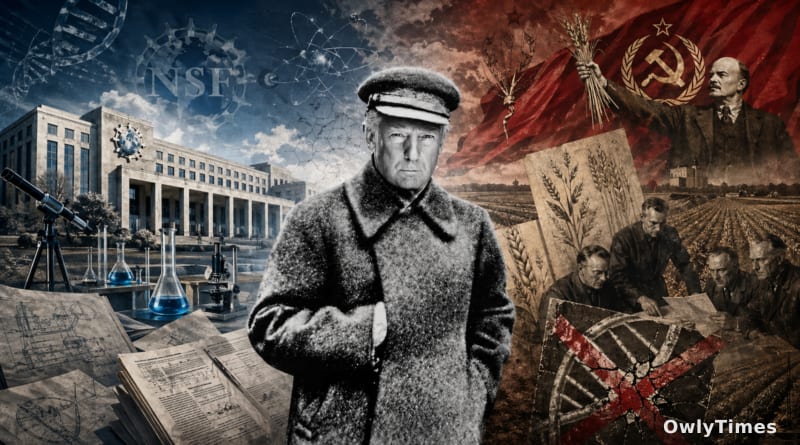

The stability of American scientific progress has long relied on a fundamental separation between political cycles and the governance of discovery. When we consider how the nation’s research engine functions, we often imagine the laboratory, but the real infrastructure lies in the oversight bodies that protect the integrity of the process. Recent events involving the National Science Board (NSB), the statutory governing body of the National Science Foundation (NSF), suggest that this institutional firewall is under significant strain. The core question is whether the American science system can maintain its rigor when its governance is treated as a political appointment list rather than a mechanism for objective quality control.
The recent dismissal of NSB members, reported by the Washington Post as arriving via brief email from the Presidential Personnel Office, presents a marked departure from established norms. As noted by Nature, members of a board established by Congress in 1950 were removed without explanation, hearings, or documented evidence of misconduct. While some might frame this as standard personnel turnover, it is critical to distinguish between the routine expiration of a six-year term and a purge. The NSB is not a decorative advisory committee; it is a structural component of the NSF, responsible for approving strategic budget directions and major research programs. Treating this body as a collection of political subordinates risks turning a quality-control mechanism into a vessel for loyalty-based administration.
The headlines surrounding this move often focus on the personality-driven nature of the change, but the actual scientific concern is deeper: the erosion of institutional memory. The NSB’s design, which features staggered terms, was specifically engineered to insulate basic science from the volatility of changing administrations. By removing these safeguards, the current path mirrors the historical pattern of Lysenkoism, a Soviet-era phenomenon where the state elevated political doctrine over biological evidence. In the Soviet case, Trofim Lysenko rejected Mendelian genetics, eventually leading to a collapse in agricultural output and the silencing of competent scientists. The danger in the American context is not that a single pseudo-science will be mandated, but that political capture will create a environment where researchers learn which questions are "safe" to ask and which conclusions are career-ending.
Limitations to consider include the resilience of the American research ecosystem, which remains significantly more pluralistic than the Soviet model of the 1940s. The United States maintains a complex network of universities, private industry, and international research collaborations that provide "shock absorbers" not available in the USSR. However, this diversity is not a guarantee of safety. The NSF serves as the "seed corn" of the modern economy, funding early-stage research in fields from cybersecurity to materials science—work that private industry often ignores until the commercial path is clear. If the upstream engine of basic research is hollowed out, the downstream consequences for private innovation, military readiness, and public health are not immediate, but they are inevitable.
The next steps for the research community involve tracking the impact of these changes through measurable signals. Specifically, the scientific community should watch for shifts in the approval of major NSF programs and the potential chilling effect on grant applications. When a governance board is politicized, the damage is often quiet; it appears as delayed approvals, rewritten solicitations, or self-censorship within academic institutions. Protecting the nation’s scientific capacity will require a focus on transparency and the rigorous documentation of every instance where political interference collides with empirical inquiry. Reality, as history has shown, is not optional, and the next reading of research output and talent retention metrics will indicate whether the country’s foundational institutions are still being governed by expertise or by ideology.